
Lung cancer kills roughly 125,000 Americans a year. It causes more cancer deaths than breast, prostate, and colon cancer combined. A low-dose CT scan can find it early, when it is still treatable. That scan is covered, endorsed by guidelines, and available at hundreds of facilities across the country.
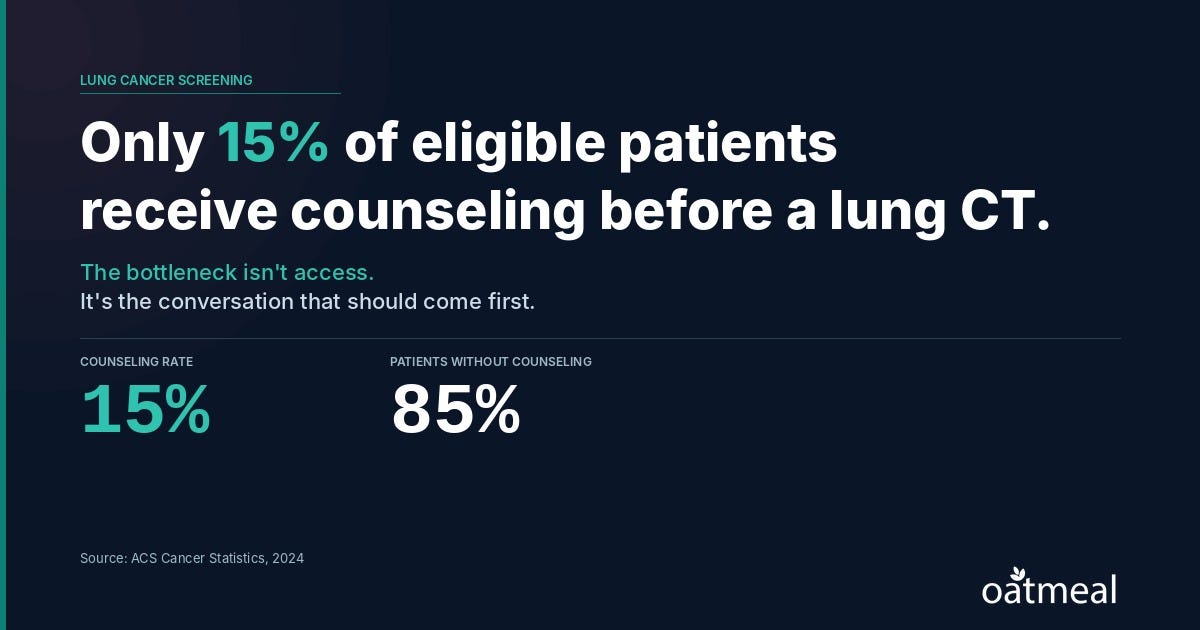
And yet a new analysis of the most recent Health Information National Trends Survey, published in the American Journal of Surgery, finds that only 15% of adults who qualify for lung cancer screening have discussed it with a clinician.
Not 15% who have been screened. 15% who have even had the conversation.
That number is the real bottleneck. Not the scan. Not the coverage. The talk.
What the Number Says
Researchers at the University of Cincinnati Cancer Center, led by senior author Robert Van Haren, MD, used HINTS, the National Cancer Institute's nationally representative survey of U.S. adults, to ask a direct question: had eligible adults spoken with a healthcare professional about lung cancer screening in the past year?
Out of roughly 1,500 adults who met USPSTF eligibility criteria, about 221 said yes.
That is 14.7%. The study rounds to 15%. Either way, it is approximately 1 in 7.
The USPSTF criteria for lung cancer screening are specific: adults aged 50 to 80, with at least a 20 pack-year smoking history, who currently smoke or quit within the past 15 years. This is not a broad population. These are people whose risk is documented, whose eligibility is defined, and whose insurer is generally required to cover the scan.
Among those eligible adults, the groups most likely to have had the conversation were current smokers and people already diagnosed with lung disease. That pattern makes sense. But it also means that the people who have already quit, who may assume their risk has faded, are the most likely to be skipped.

The American Cancer Society, in its most recent national dataset published in JAMA in November 2025, found that 18.7% of eligible adults were up to date with lung cancer screening as of 2024. BRFSS self-report data, which uses a slightly different eligibility window, puts the figure at 24.49%. Both numbers are improving. Twenty-one states showed significant increases since 2022.
But both numbers sit far below where they should be, and both are downstream of the counseling conversation. If only 15% of eligible adults have talked to a clinician about screening, the screening rate cannot meaningfully exceed that ceiling for long. At some point, the conversation precedes the scan.
The Comparison That Matters

Colonoscopy screening rates in the U.S. run between 70% and 80% for eligible adults. Mammography rates are similar. These numbers are not perfect, and access gaps remain for both. But the counseling conversation for colorectal and breast cancer screening has been normalized over decades of physician training, patient education, and public messaging.
Lung cancer screening was added to the USPSTF recommended list in 2013 and updated in 2021, when eligibility was expanded to include adults aged 50 to 80 and reduced the pack-year threshold from 30 to 20. Those changes nearly doubled the eligible population.
But awareness did not double. Training did not double. The counseling conversation did not follow.
The Centers for Medicare and Medicaid Services took an unusual step in 2015 when it required beneficiaries to complete a shared decision-making counseling visit before a covered lung cancer screening CT scan. This is the only such mandate for a preventive screening test in Medicare. The rationale: lung cancer screening carries real tradeoffs. False positives, unnecessary biopsies, incidental findings, and the psychological weight of a lung nodule finding all need to be discussed. The conversation is not a formality. It is part of the care.
The problem is that requiring a conversation before the scan assumes the conversation is happening. The Viana study shows it largely is not.
The Stage You're Catching

The reason screening matters comes down to what stage the cancer is at when you find it.
For non-small cell lung cancer, which accounts for roughly 80% to 85% of cases, the five-year relative survival rate when the disease is localized is 67%. That means 2 out of 3 people diagnosed at an early stage are still alive five years later.
When the disease has spread to distant organs, that number falls to 12%.
For small cell lung cancer, the gap is even wider: 34% five-year survival for localized disease, 4% for distant.
These numbers come from SEER data, compiled by the National Cancer Institute from 2015 to 2021. They represent averages across a large, heterogeneous patient population, and individual outcomes vary based on histology, mutation status, performance, and treatment access. But the direction is clear and consistent: early detection saves lives.
The American Cancer Society estimates that at 100% lung cancer screening uptake among eligible adults, approximately 62,110 deaths could be prevented over five years, with 872,270 life-years gained. At current uptake rates, the realized benefit is roughly a quarter of that: about 14,970 deaths prevented and 190,030 life-years gained.
That is the math of the counseling gap. Every eligible adult who never has the conversation is a person who may never get the scan, who may be diagnosed at stage IV instead of stage I, and whose odds drop from 67% to 12%.
Where the Conversation Breaks Down

Primary care physicians face real constraints. A standard outpatient visit runs 15 to 20 minutes. Chronic disease management, medication review, preventive care, and the patient's own list of concerns all compete for that time. Adding a counseling conversation about lung cancer screening that covers eligibility, benefits, risks, false positives, follow-up protocols, and smoking cessation requires time that is not always available and is often not separately reimbursed.
CMS does reimburse the shared decision-making visit for Medicare beneficiaries, using HCPCS code G0296. But billing and coding complexity, clinician unawareness of the code, and the administrative burden of documentation mean that the reimbursement often goes unclaimed.
The training gap is also real. Lung cancer screening expanded significantly in 2021 when USPSTF broadened eligibility. Clinicians who trained before that change may still be operating on older criteria, either referring too few patients or referring patients who no longer qualify under the previous, narrower guidelines. The 2021 expansion added an estimated 6 to 7 million newly eligible adults. Many of their primary care physicians have not been updated on the new criteria in any systematic way.
Among clinicians who do discuss lung cancer screening, a meaningful share report that they are uncertain how to counsel patients on the tradeoffs. False positive rates for low-dose CT are not trivial, particularly in high-prevalence areas with endemic fungal infections like histoplasmosis or coccidioidomycosis, where benign nodules can mimic early malignancy. Ordering a scan without discussing what a positive result might require, including follow-up imaging, PET scans, or biopsy, sets the patient up for anxiety and the health system up for downstream costs that may not have been intended.
The counseling conversation is not optional under Medicare. It is required. But the data show it is also rare.
Who Gets Left Out Entirely

Lung cancer screening uptake already reflects the broader inequities in U.S. preventive care. The counseling gap compounds them.
Among adults who are eligible for lung cancer screening, BRFSS data from 2024 show that uninsured adults are screened at a rate of 6.07%. Adults with military-related insurance are screened at 39.05%. The ratio between those two numbers is more than 6 to 1. The difference is not biology. It is access.
Screening uptake also varies by state to a degree that cannot be explained by population differences alone. Massachusetts reports 38.36% of eligible adults up to date on lung cancer screening. South Dakota reports 13.43%. That is a nearly threefold difference between two U.S. states.
The American Cancer Society analysis found that about 28.1 million adults who have ever smoked but do not currently meet USPSTF eligibility would still benefit from screening, particularly those who quit more than 15 years ago. The American Cancer Society's own 2023 guidelines expanded recommendations to anyone with at least a 20 pack-year history regardless of quit date. If the counseling rate among those who do qualify is 15%, the rate among those who are newly eligible or just outside eligibility criteria is likely even lower.
Rural adults face additional structural barriers. Lung cancer screening programs are concentrated in academic medical centers and urban hospital systems. A patient in a nonmetropolitan county who qualifies for screening may have no nearby facility with an accredited program, no clinician who regularly orders low-dose CT, and no system-level outreach to identify them as eligible.
The BRFSS data show that after adjustment, nonmetropolitan uptake (23.80%) is not significantly different from metropolitan (24.69%). But that national average masks local variation. In rural counties with high smoking prevalence and limited primary care access, the true gap is much wider.
What Closing the Gap Requires
Improving the counseling rate for lung cancer screening is not primarily a technology problem. It is an infrastructure and workflow problem.
Proactive outreach is one lever. Electronic health record systems that flag eligible patients and prompt clinicians at the point of care have shown measurable increases in referral rates. Order sets and decision support tools that automate the eligibility calculation, removing the clinician's need to remember the pack-year threshold and age criteria, reduce the friction that lets eligible patients leave without a referral.
Nonphysician-led counseling is another. The CMS requirement specifies a clinician visit, but trained nurses, respiratory therapists, social workers, and health coaches can conduct the shared decision-making conversation when it is structured around a validated decision aid and documented appropriately. Delegating the conversation to a trained support team member extends the reach without requiring a physician appointment for every eligible adult.
Telehealth-delivered counseling has shown promise in reaching patients who are unlikely to schedule an in-person visit. A 15-minute video visit to discuss eligibility, answer questions about the scan, and place the referral can reach patients who would not otherwise have the conversation.
Community health outreach, particularly through federally qualified health centers, rural health clinics, and community health workers embedded in high-risk communities, addresses the geographic and trust barriers that national averages obscure. These are the organizations with existing relationships in the communities where lung cancer rates are highest and screening rates are lowest.
The American Lung Association's "State of Lung Cancer" report and the ACS data make the same point from different angles: the infrastructure to find and screen people exists. The gap is in connecting eligible patients to the first conversation.
What This Means for Oatmeal Health
Oatmeal Health exists because lung cancer is most survivable when it is caught early, and most lung cancers are not caught early. The scan is one part of the solution. Getting eligible patients to the scan is another. But neither happens without the conversation that comes first.
The Viana study puts a specific number on the conversation gap: 15%. That number is not a rounding error. It represents roughly 10.8 million people who meet USPSTF criteria for lung cancer screening, qualify for covered scans, and have not had the talk with a clinician.
Our work is focused on closing that gap. That means identifying eligible patients, connecting them with the counseling conversation, and making it possible for health systems to deliver proactive lung cancer screening at scale, not as a reaction to a patient who asks, but as a systematic process that finds people before they find cancer.
The bottleneck is not the scan. The bottleneck is the conversation. Solving for that is what early detection in lung cancer actually looks like.
Jonathan Govette is Co-Founder and CEO of Oatmeal Health, a company focused on expanding access to lung cancer screening through proactive patient identification and health system partnership. Oatmeal Health works with health centers, health systems, and payers to close the gap between screening eligibility and actual screening completion.
Key References
Viana SW, et al. "National analysis of factors associated with patient-clinician discussions about lung cancer screening." *The American Journal of Surgery*. 2026. Senior author: Robert Van Haren, MD, University of Cincinnati Cancer Center. (HINTS data; n approx. 1,500 eligible adults; 15% discussion rate)
American Cancer Society. "Latest ACS Lung Cancer Data: Only 1 in 5 Eligible Adults in U.S. Screened for Lung Cancer." JAMA, November 19, 2025. Pressroom: pressroom.cancer.org/2025-lung-cancer-data
National Cancer Institute. BRFSS lung cancer screening uptake analysis. PMC13122494. 2024 data; n=26,104 respondents.
American Cancer Society. Lung cancer survival rates by stage. SEER data 2015-2021 (NSCLC) and 2012-2018 (SCLC). cancer.org. Accessed June 2025.
U.S. Preventive Services Task Force. "Recommendation: Lung Cancer: Screening." Updated 2021. uspreventiveservicestaskforce.org
Centers for Medicare and Medicaid Services. HCPCS code G0296: Counseling visit for shared decision making on lung cancer screening. CMS, 2015.
AuntMinnie. "How useful is shared decision-making for lung cancer screening?" 2024. auntminnie.com/clinical-news/ct/article/15627943/
Oatmeal Health. "Lung Screening: Only 1 in 6 Get the Talk." October 11, 2026. oatmealhealth.com/lung-screening-only-1-in-6-get-the-talk/
A Note on the Numbers: Why Survey Estimates Diverge
One detail worth addressing directly: the three most-cited figures for lung cancer screening uptake in the U.S. do not match.
The Viana HINTS study finds 15% of eligible adults have discussed screening with a clinician.
The ACS/JAMA analysis finds 18.7% of eligible adults were up to date on screening as of 2024.
The BRFSS analysis puts self-reported up-to-date screening at 24.49%.
These numbers measure different things and use different instruments. The HINTS counseling figure measures whether a conversation happened, not whether a scan occurred. The ACS figure uses NHIS (National Health Interview Survey) data. The BRFSS figure is based on a state telephone survey with a different age range and different eligibility proxies.
None of them are wrong. They are looking at different slices of the same problem.
What they share: every estimate falls well below the rates at which other cancer screenings are completed. And every estimate puts the counseling conversation rate, the precondition for informed, shared, Medicare-compliant screening, lower than the screening rate itself.
That last point is worth sitting with. Some eligible adults are getting screened without the full shared decision-making conversation the guidelines recommend and CMS requires for Medicare beneficiaries. They may have had a physician recommend a scan without the structured discussion. They may have self-referred. They may be Veterans with access to VA programs that structure outreach differently.
But for the majority of the 85% of eligible adults who are not up to date on screening, the bottleneck is not refusal. It is never being asked.
The American Cancer Society's analysis finds that at current uptake rates, about 14,970 deaths are prevented over five years. At 100% uptake, that number rises to 62,110. The difference between those two figures is 47,140 lives over five years. That is roughly 9,400 people a year who could be saved if the eligible population were actually reached and screened.
Getting to 100% uptake is not a realistic near-term target. But moving from 18.7% to 40% is not unrealistic, and even partial progress at scale has significant mortality impact. The question is which intervention, at which point in the care pathway, moves the needle fastest.
The evidence points toward the conversation.