

On September 1, Carelon Health Services quietly updated its clinical guidelines to cover Guardant Health’s Shield blood test for colorectal cancer screening. If you missed it, you’re not alone — coverage announcements rarely make headlines. But this one should.
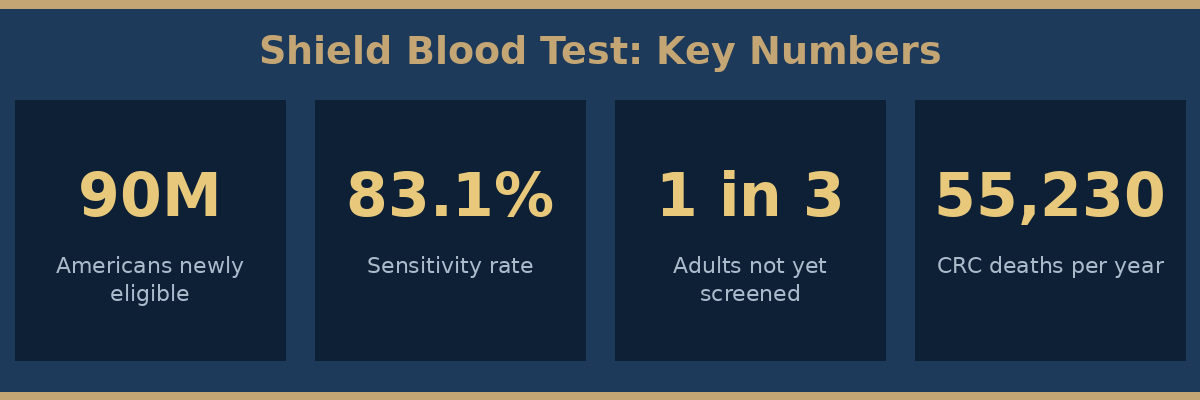
Carelon is the specialty benefits management arm for Blue Cross Blue Shield plans across 26 states, including California, New York, Texas, and Illinois. The effective date is November 15. Because UnitedHealth Group already moved first in August — adding Shield to coverage for its roughly 40 million commercial members — the Carelon announcement pushes the total number of Americans with access to Shield-based colorectal cancer screening to approximately 90 million.
That number is going to keep climbing. Cigna’s EviCore by Evernorth has already announced coverage effective January 1, 2027. Medicare started covering Shield after the FDA approved it as a primary screening modality in 2024. By this time next year, the question won’t be whether your insurer covers this blood test. It will be why you still haven’t had one.
What We’re Actually Talking About
The Shield test is a cell-free DNA (cfDNA) blood-based screening test. It works by detecting methylation patterns — chemical tags on DNA fragments that circulate in your blood after being shed by cells — that are associated with colorectal cancer. You get a standard blood draw during a routine clinical visit. No bowel prep. No sedation. No someone driving you home afterward.
That simplicity is the entire point.
The FDA approved Shield in July 2024 as a primary colorectal cancer screening option for average-risk adults aged 45 and older. It is not a companion diagnostic. It is not just for high-risk patients. It is a standalone screening option designed to compete with — and in some contexts, replace — colonoscopy as the first-line tool.
Shield screens for colorectal cancer specifically, not for precancerous polyps alone. If your result comes back positive, you need a follow-up colonoscopy. If it comes back negative, current guidelines suggest re-screening every three years.
The Clinical Case: What the ECLIPSE Trial Actually Found
The FDA approval was built on the ECLIPSE study (Evaluation of ctDNA Lunar Assay In an Average Patient Screening Episode), a 20,000-plus patient registrational study comparing Shield against screening colonoscopy. The results, published in the New England Journal of Medicine, showed:
83.1% sensitivity for colorectal cancer detection (95% CI: 72.2%–90.3%)
89.6% specificity for non-advanced adenomas, non-neoplastic findings, and negative colonoscopy
13.2% sensitivity for advanced precancerous lesions
That last number deserves attention. Shield is not good at finding polyps before they become cancer. It finds cancer — or more precisely, it finds cancer 83% of the time, and misses it 17% of the time.
Compare that to colonoscopy, which finds both cancer and the precancerous lesions that would become cancer, with sensitivity approaching 95% for advanced adenomas in experienced hands. So if Shield is less sensitive than colonoscopy, why does this coverage news matter? Because colonoscopy only works when people actually show up for it.
The Compliance Problem That Kills People
Here is what the data tells us about colorectal cancer screening in America: 1 in 3 adults between 45 and 75 years old are not being screened as recommended. That is not a fringe number. That is 33% non-adherence at a population level.
Studies show colonoscopy adherence among adults 50 to 75 sits at roughly 60.6%. When stool-based tests are offered as an alternative, cumulative adherence climbs to about 67%. That still leaves a third of the eligible population without any screening at all.
The reasons are familiar to anyone who has tried to schedule a colonoscopy: the prep is miserable, the procedure requires sedation, you need someone to drive you home, you lose a full work day (sometimes two), and insurance navigation is a headache even when coverage technically exists.
The American Cancer Society estimates more than 20 million Americans who are eligible for colorectal cancer screening have never been screened at all. In 2026, colorectal cancer will claim an estimated 55,230 American lives and generate 158,850 new diagnoses. It is now the leading cause of cancer-related death in adults under 50.
When a cancer is catching up with you from behind, a 17% miss rate on a test people will actually take beats a 5% miss rate on a test they won’t.
The Stage Distribution Problem
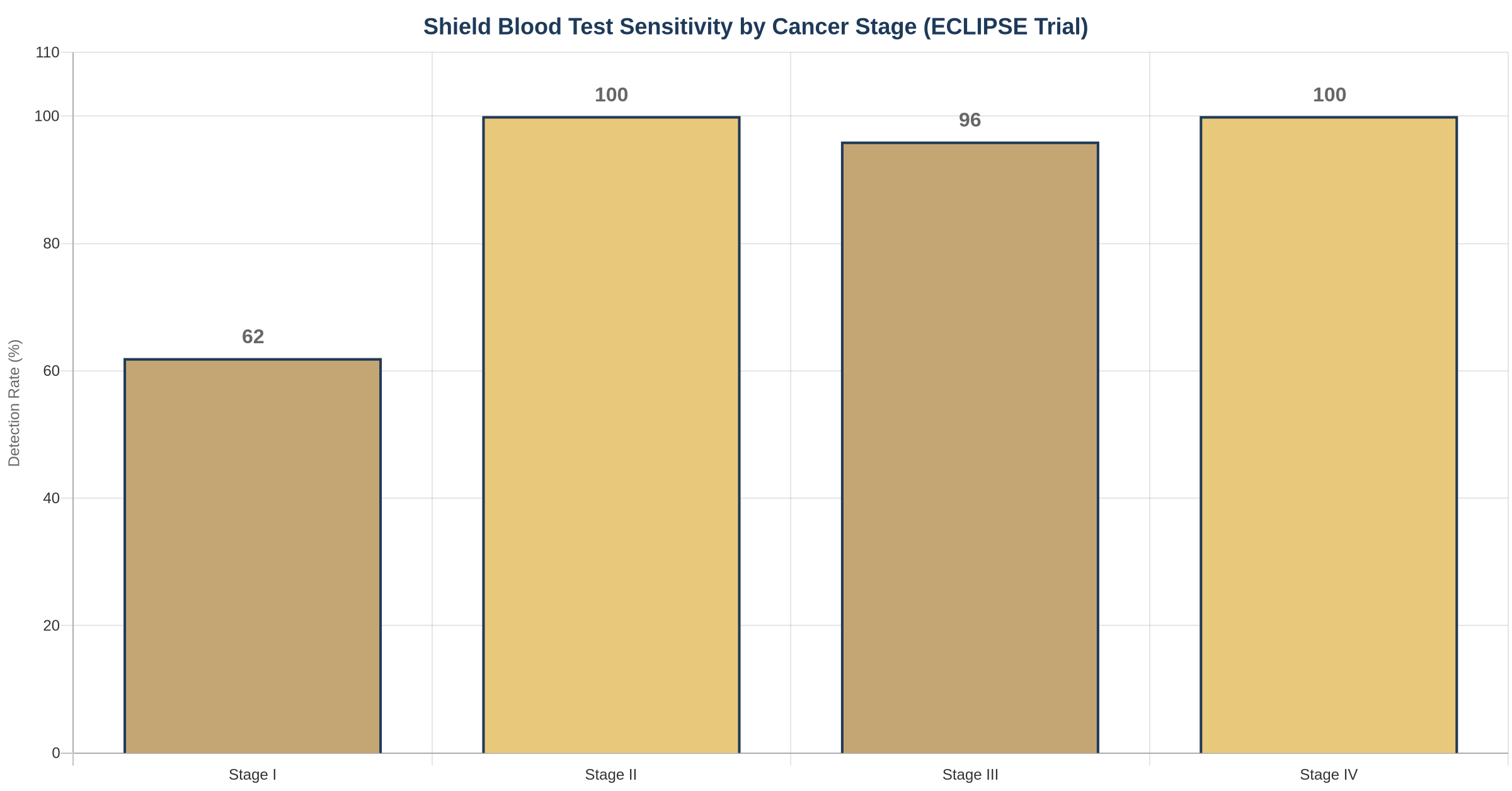
Here is the clinical nuance that got buried in most coverage about Shield: sensitivity is not uniform across cancer stages. In the ECLIPSE trial, stage I CRC detection came in at 62% sensitivity. Stage II was 100%. Stage III was 96%. Stage IV was 100%.
Read that again. Shield is least effective at catching colorectal cancer when it is most treatable. Stage I CRC has a five-year survival rate above 90%. Stage IV drops to around 13%. The whole point of screening is to catch cancer early — and Shield’s weakest performance is precisely at that early stage.
This does not mean Shield is a bad test. It means Shield has a specific clinical profile that providers need to understand before they counsel patients. A negative Shield result means no cancer-associated cfDNA was detected in the bloodstream at this time. It does not mean no polyps, no precancerous lesions, and no cancer at all. Providers who understand this distinction will use Shield correctly.
The Coverage Cascade: What’s Happening and Why
The timeline of major Shield coverage decisions in 2025 and 2026:
Medicare (July 2024): FDA approves Shield as primary CRC screening option. Medicare adds coverage, making it accessible to roughly 60 million beneficiaries.
UnitedHealth Group (August 1, 2026): First major private insurer activates commercial Shield coverage. Coverage requires patients to agree to follow-up colonoscopy if Shield returns a positive result — a key guardrail that gastroenterologists pushed for during coverage negotiations.
Carelon/Blue Cross Blue Shield (effective November 15, 2026): Specialty benefits management for BCBS plans in 26 states adds Shield to clinical guidelines. Total covered lives reaches approximately 90 million.
EviCore by Evernorth/Cigna (January 1, 2027): Coverage activates across Cigna’s network. At that point, three of the five largest commercial insurance networks in the U.S. will cover Shield as a primary CRC screening option.
This is not a gradual rollout. This is a coverage cascade happening across about 18 months. The speed signals something important: payers have run the math and concluded that liquid biopsy-based CRC screening is cost-effective.
The Payer Math
A screening colonoscopy in the U.S. costs an average of $3,000 to $4,000 when it includes anesthesia and facility fees. The Shield test carries a list price of approximately $895.
If a payer covers 10,000 eligible members who would have otherwise never gotten a colonoscopy — because the compliance barrier is too high — and Shield catches even 5% of them with an early-stage cancer, the downstream cost of treating late-stage colorectal cancer ($150,000 or more per patient) makes the math work decisively in favor of coverage.
Add to that: every positive Shield result generates a follow-up colonoscopy. Colonoscopy does not disappear from the picture — it just moves downstream, where it is doing diagnostic work rather than primary screening. That changes the resource allocation calculus for gastroenterology practices, which may see fewer screening colonoscopies offset by a wave of higher-acuity diagnostic procedures.
What Providers Need to Do Right Now
If you are a primary care physician, internist, or gastroenterologist, here is what the coverage cascade means for your practice:
Start educating patients now. Patients will hear about this from their insurers before they hear from their doctors. The conversation you have first shapes how they understand the test’s limitations.
Set expectations about what a negative result means. A negative Shield test is not a clean bill of health. It means no cancer-associated cfDNA was detected at this time. Three-year re-screening is the current recommendation, not a ten-year reprieve.
Know your colonoscopy referral pathway. Every positive Shield result requires a follow-up colonoscopy. GI colleagues need to anticipate new referral patterns coming their way.
Document the discussion. Shared decision-making about cancer screening options — including the relative merits of Shield versus colonoscopy — matters for liability and quality measure purposes.
The Bigger Picture: Liquid Biopsy Is a Transition, Not a Trend
Shield is not the only liquid biopsy product in development for colorectal cancer screening. It is the first with FDA approval and major commercial coverage, but it will not be the last. Multi-cancer early detection (MCED) tests — which screen for multiple cancer types from a single blood draw — are already in late-stage clinical development, and several are approaching regulatory review.
What Shield’s coverage trajectory tells us is that the insurance industry has become willing to pay for liquid biopsy-based cancer screening at scale. If you are planning your health system’s cancer screening program in 2026 or 2027, assume that liquid biopsy is part of your future — not as a replacement for tissue-based diagnosis, but as a front-end triage tool that drives appropriate patients into your diagnostic pipeline.
The Bottom Line
Carelon’s decision to cover the Shield blood test is not just a reimbursement update. It is a signal that the model of cancer screening in America is changing.
For decades, the field treated colonoscopy as the gold standard and then wondered why 1 in 3 eligible adults was not getting screened. The answer was always obvious: the gold standard was too burdensome for widespread adoption. A blood draw is not burdensome. It fits inside a routine physical. It does not require prep, sedation, or a driver.
Shield is not colonoscopy. Its sensitivity for early-stage disease is meaningfully lower. But in a country where colorectal cancer is now the leading cancer killer of adults under 50, a test that gets 90 million people into the screening pipeline — even imperfectly — is worth taking seriously. The clinical data is clear. The coverage decisions are accelerating. The only question left is how fast providers and health systems move to meet them.
—
Jonathan Govette is the founder of Oatmeal Health, a company building AI-powered tools for lung cancer detection and preventive care navigation.