


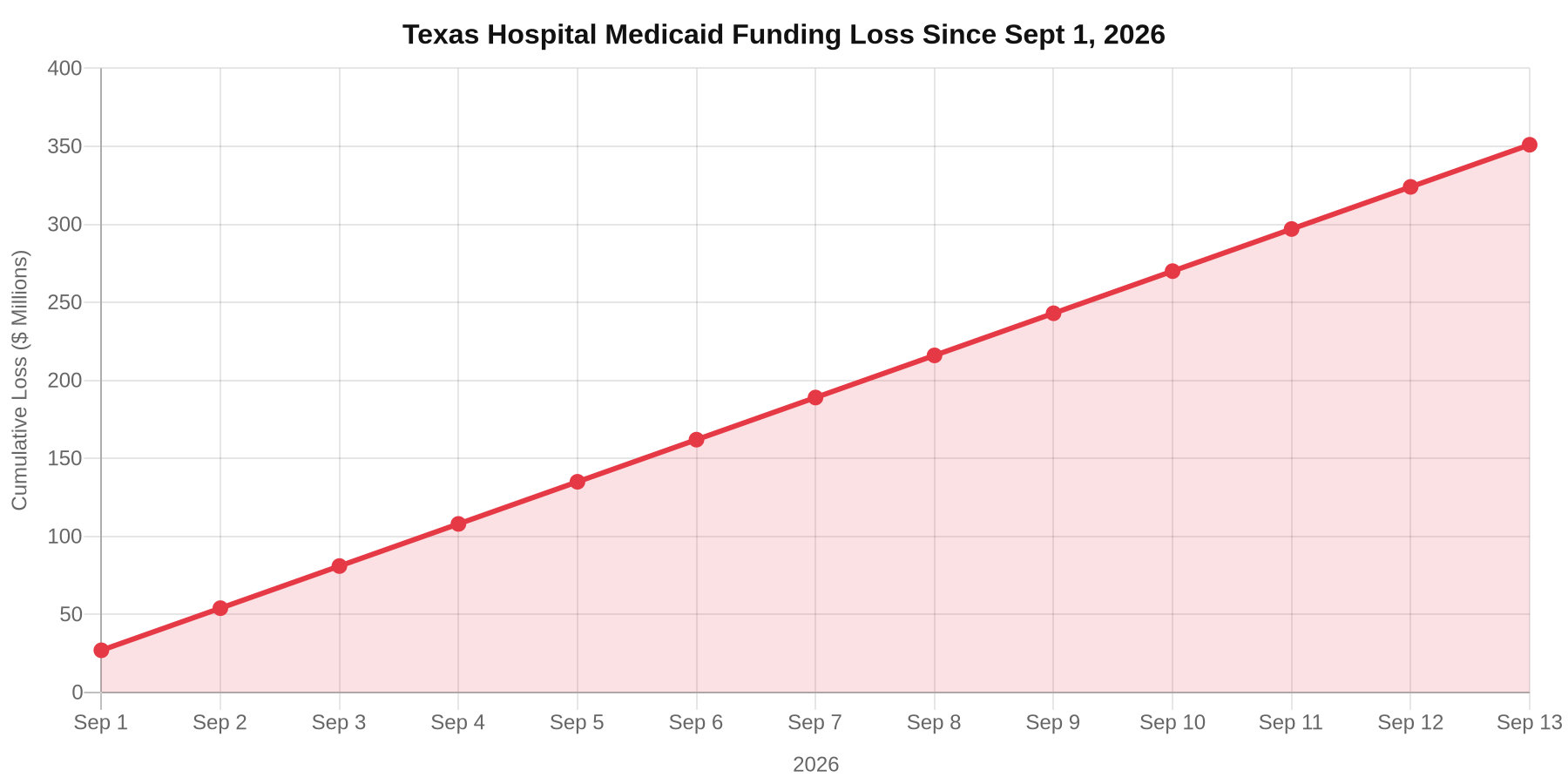
As of September 1, 2026, Texas hospitals are losing $27 million every single day.
Not in the future. Not projected. Right now, today, as you read this.
The Texas Hospital Association confirmed the number. Gov. Greg Abbott wrote a letter calling it an economic "gun to the head." The CEO of Harris Health, Houston's public safety-net system, warned the impacts would be "catastrophic." And the federal agency responsible, the Centers for Medicare and Medicaid Services, has not responded publicly.
This is not a congressional vote. It is not a new Medicaid rule. It is a bureaucratic approval hold, nine months in the making, that quietly crossed into financial catastrophe the moment Texas's new fiscal year began.
If you run a hospital, manage a health system, or invest in healthcare in Texas, you need to understand exactly what broke, why it can't be fixed quickly, and what it means for the next twelve months.
What CHIRP Actually Is (And Why Nobody Explained It Until Now)
The Comprehensive Hospital Increase Reimbursement Program sounds like a payment supplement. It is actually more fundamental than that.
Medicaid pays hospitals for patient care. But in Texas, as in most states, what Medicaid actually reimburses is significantly less than what it costs to deliver care. For years, states have bridged that gap through directed payment programs, or DPPs. These programs work by having local governmental entities, such as county hospital districts, collect taxes from hospitals. The federal government matches those local dollars, and the combined funds flow back to hospitals to cover the difference between what Medicaid pays and what care actually costs.
CHIRP is the biggest of Texas's three directed payment programs. The others, TIPPS (Texas Incentives for Physicians and Professional Services) and RAPPS (Rural Access to Primary and Preventive Services), cover physician and rural care respectively. Together, the three programs account for approximately $9.8 billion in funding for the current fiscal year.
That is not supplemental. That is not extra. For Texas safety-net hospitals, that is operational.
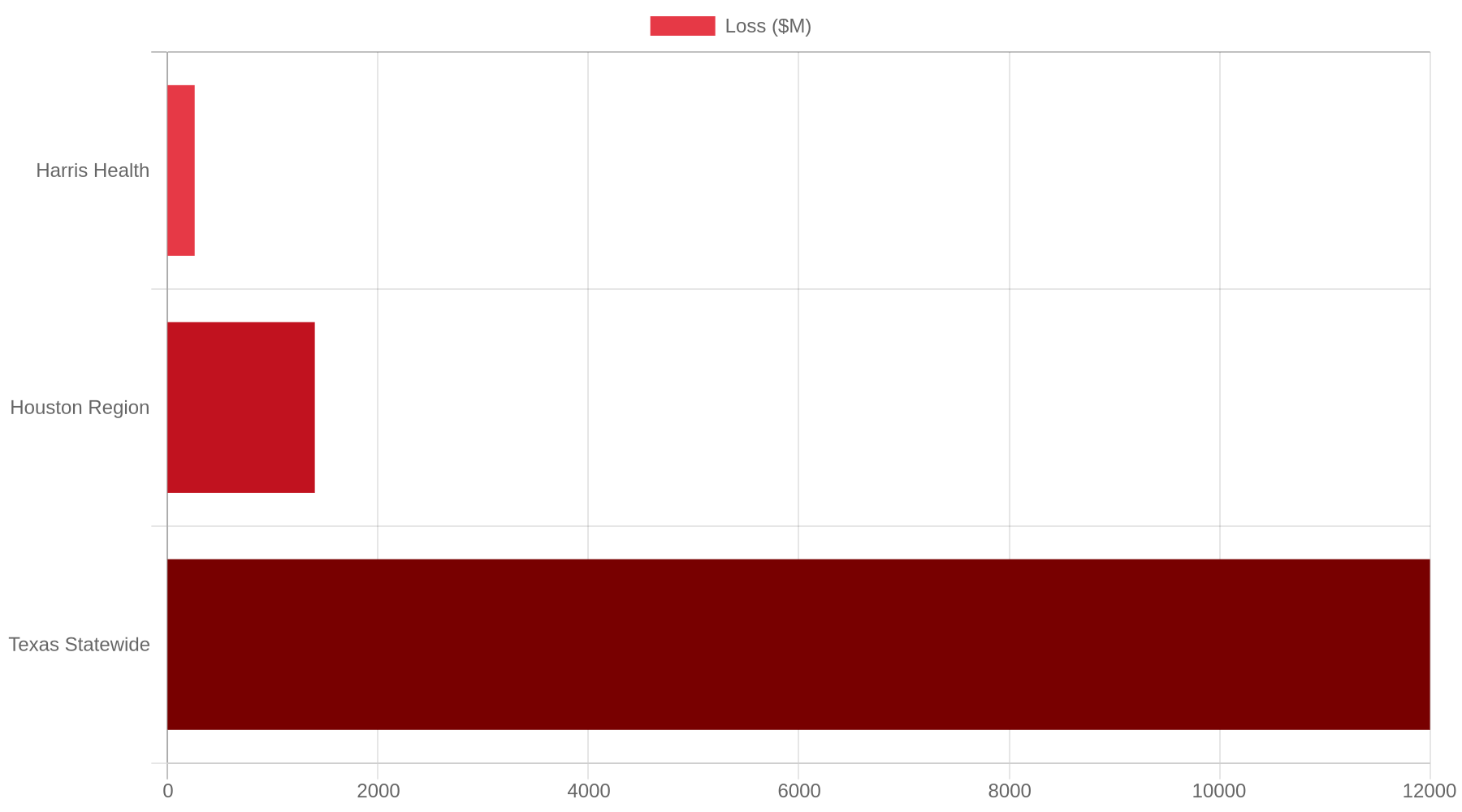
Harris Health, the public health system serving Houston and Harris County, stands to lose a minimum of $258 million. The broader Houston region faces up to $1.4 billion in losses. Statewide, Governor Abbott estimates the total shortfall could reach $12 billion in FY2027.
Now divide $9.8 billion by 365 days. That is your $27 million a day.
How We Got Here: Eleven Rounds of Questions and No Answer
This crisis did not start on September 1. It started in December 2025, when CMS quietly began raising questions about how local jurisdictions in Texas calculate the hospital tax base underlying these programs.
The dispute is technical but consequential. CMS is questioning the methodology Texas uses to calculate what hospitals pay in local taxes, which then becomes the basis for the federal match. Texas says its methodology is legal and compliant with federal law. CMS says it has concerns. Over the next nine months, there were eleven documented rounds of back-and-forth questions between CMS and the Texas Health and Human Services Commission.
Eleven rounds. No resolution.
In late July, HHSC had to explicitly assure CMS that none of the $9.8 billion would be used to pay for healthcare services to non-citizens. On August 17, HHSC stated the state confirms directed payments do not include payments for individuals who have not demonstrated satisfactory immigration status. CMS still has not approved.
On August 7, Governor Abbott wrote directly to HHS Secretary Robert F. Kennedy Jr., not to request consideration, but to assert that CMS's demands were themselves unlawful. "The tax structure previously enacted by the Texas Legislature, and being implemented daily by local governments, fully complies with federal law. What CMS is requesting does not."
Abbott framed any voluntary accommodation as collaborative, not an admission of legal error, and demanded that if Texas restructured anything at CMS's request, the federal government must guarantee Texas would not be penalized later. That letter has not produced a response. September 1 came. The funding did not.
The Safety-Net Is the First Thing That Breaks
Not every Texas hospital feels this equally.
For health systems with a payer mix dominated by commercial insurance, the CHIRP shortfall is painful but survivable. These systems have revenue diversity. They can absorb hits.
For safety-net hospitals, FQHCs, rural critical access hospitals, and children's hospitals, there is no buffer. Medicaid is not a secondary revenue source for them. It is primary.
Harris Health in Houston serves as the clearest example. Dr. Esmaeil Porsa, its president and CEO, did not issue a statement about monitoring the situation. He issued a warning: "We are carefully monitoring every dollar and would be forced to make difficult decisions about maintaining critical services if this impasse continues."
Those "difficult decisions" have a known shape: service line closures, staff reductions, deferred capital, narrowed geographic footprint. When public systems make those cuts, the patients they shed do not disappear. They migrate to emergency departments at other institutions that cannot legally turn them away.
Robert Fries, CFO of Children's Health in Dallas, made the downstream risk explicit: "Delays and uncertainty threaten access to critical pediatric specialty care, behavioral health services and the workforce needed to deliver that care."
Four million low-income Texans are enrolled in Medicaid. Most of them are children.
Rural Hospitals Have Even Less Room
Rural hospitals operate on thinner margins, serve smaller patient volumes, and have almost no capacity to absorb sudden revenue shocks. RAPPS, the directed payment program for rural access, exists specifically because rural Medicaid rates are otherwise unsustainable.
In most rural markets, the hospital is not just the largest healthcare provider. It is frequently the largest employer. When it closes, the community loses healthcare and economic anchor simultaneously.
Texas already has a rural hospital closure problem. Adding a multi-month funding disruption on top of structural financial pressure is not a manageable operational challenge. It is, for some facilities, a liquidation event.
The Texas Hospital Association's Carrie Kroll was direct about the state's inability to backstop these losses: "I think that we are under no assumption that there is a large amount of money in GR [general revenue] ready to save us from the situation."
Texas Thought the OBBBA Protected It. It Didn't.
When H.R. 1, the One Big Beautiful Bill Act, passed a year ago, it included $900 billion in Medicaid cuts nationally over the next decade. Texas health policy watchers paid close attention. The conclusion most reached was reassuring: Texas, as one of the ten states that refused Medicaid expansion under the Affordable Care Act, would be insulated from the worst of it.
What nobody anticipated clearly was the provision that "froze" the tax structures used in directed payment programs. The intent was to prevent states from gaming the system. The effect, combined with CMS's scrutiny of existing programs, put Texas's longstanding CHIRP methodology under federal review at exactly the moment new political pressure existed to find problems with it.
Florida found itself in the exact same position. Florida, like Texas, did not expand Medicaid. Florida, like Texas, uses directed payment programs. Florida resolved its funding dispute, but it took eleven months. At $27 million a day, that is $8.9 billion in lost funding if the dispute takes as long here as it did in Florida.
Even Resolution Won't Be Fast: The Claims Backlog Problem
Assume CMS and Texas reach an agreement tomorrow. The money does not immediately flow.
Anna Stelter, THA's vice president of policy, explained what happens next: "Even if we get an approval soon, there will be a claims backlog that takes at least 90 days to clear. And the bigger the claims backlog, the longer it takes to catch up."
This matters because hospitals are managing cash flow right now. They are not managing a theoretical future shortfall. Smaller systems and rural hospitals do not have lines of credit that make a prolonged gap survivable.
What Healthcare Operators Should Do Right Now
If you operate a Texas hospital or health system, here is the honest operational read:
Do not wait for resolution. The Florida timeline is your planning assumption: eleven months. Model what that means for your cash position, your service lines, and your workforce.
Stress-test your Medicaid dependency. Know exactly what percentage of your revenue depends on CHIRP and the other directed payment programs. If you have not run that calculation recently, run it today.
Engage your banking relationships now, not when you need them. Credit facilities take time to establish. The time to have that conversation is before you need the money, not after.
Preserve your core mission services. If cuts become necessary, triage them toward areas with the most operational redundancy. Protect emergency access, maternal care, and pediatric specialties above all else.
Document everything. If this goes to litigation, Texas hospitals will want detailed records of operational decisions made, services constrained, and financial impacts incurred during the impasse.
Get involved in the political process. The Texas Hospital Association is the central advocacy vehicle. This is not a moment for hospitals to treat the lobbying effort as someone else's problem.
The Bigger Picture: CMS Just Showed Everyone What Federal Leverage Looks Like
Directed payment programs exist in most states. They are a fundamental mechanism for making Medicaid financially viable for hospitals that would otherwise lose money on every Medicaid patient. CMS has known about and approved these programs for years. Texas's CHIRP has existed since 2014.
What changed is not the law. What changed is the political will to use approval authority as leverage.
Whether the current CMS posture is about genuine compliance concerns, immigration enforcement signaling, or negotiating leverage, the result is the same: a state can lose $9.8 billion in previously approved funding because CMS decides to ask questions rather than approve.
If you are a healthcare operator or investor in any state that relies on directed payment programs, which is effectively every state, you now have a new risk to price. Not a legislative risk. Not a regulatory change risk. An administrative approval risk that did not exist a year ago.
The Bottom Line
Texas hospitals are in a genuine crisis. The money is real, the impact is immediate, and the path to resolution is both politically uncertain and structurally slow.
The communities most affected, low-income Texans who depend on Medicaid-funded safety-net care, have no alternative. The institutions most affected, rural hospitals, public health systems, and children's hospitals, have the least capacity to absorb the shock.
The Florida precedent says this gets resolved. It also says it takes nearly a year, and the financial damage during that year is not made whole by eventual resolution.
For healthcare operators in Texas, the operational imperative right now is not to advocate loudly and wait. It is to plan seriously and act.
$27 million a day. The meter is running.