



Texas hospitals were bleeding $27 million a day. That just ended.
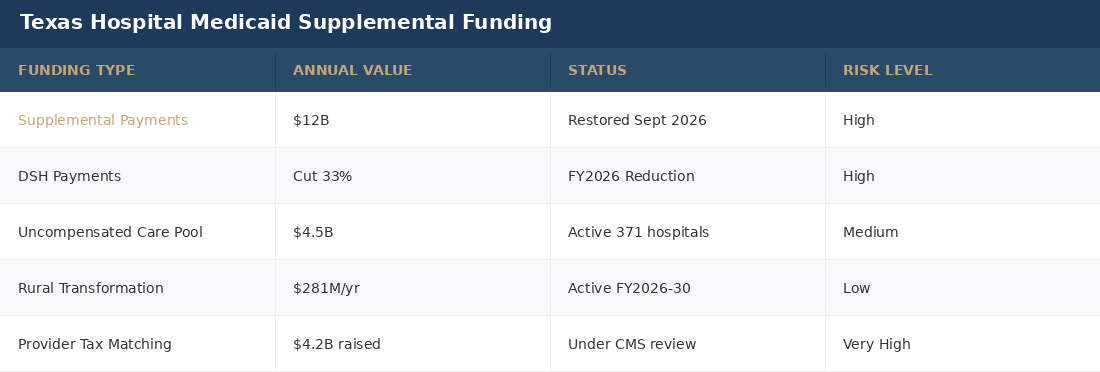
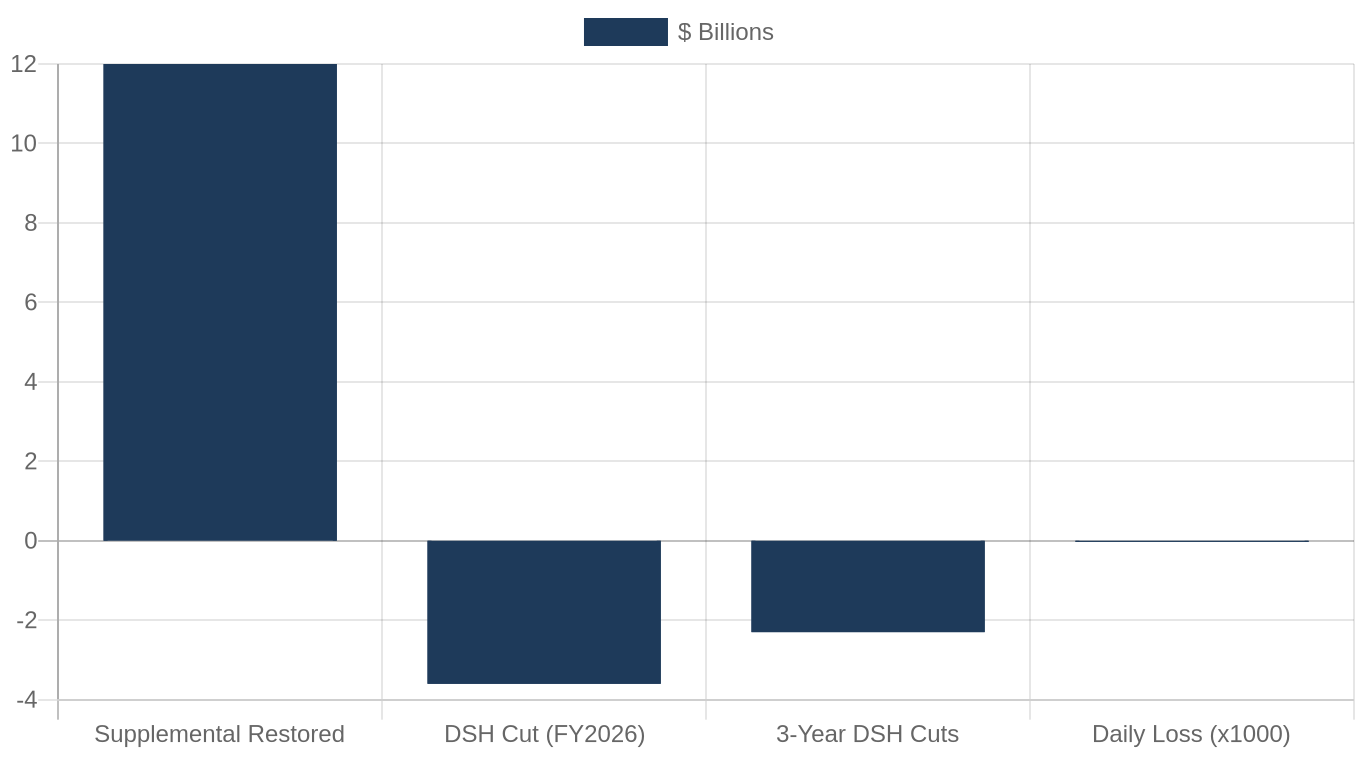
On September 17, 2026, Governor Greg Abbott announced the restoration of nearly $12 billion in Medicaid supplemental funding to Texas hospitals, ending what federal officials confirmed was the first halt to this funding program since it launched in 2014. The pause began September 1, the start of Texas's new fiscal year, and lasted just over two weeks. But the damage to hospital balance sheets - and to trust in the stability of American healthcare finance - is not erased by a wire transfer.
This is not just a Texas story. The underlying dispute - over how states structure provider taxes to access federal Medicaid matching dollars - is now the center of a national rulemaking fight that could permanently reshape how every state funds hospital care for low-income patients. What happened in Texas is a preview. The main event is still coming.
1. What Happened and Why the Freeze Started
The mechanics of Texas's Medicaid supplemental funding are straightforward in theory and politically explosive in practice. Texas raises more than $4.2 billion annually in taxes collected from hospitals and other healthcare entities. Those state dollars are then used to draw down federal Medicaid matching funds - a leverage ratio that has historically allowed Texas to generate far more in supplemental payments than the state puts in.
CMS raised questions late in 2025 about how Texas was structuring those provider taxes. The specific concern: whether the tax arrangements crossed into "hold harmless" territory, a term for when states return tax dollars back to the taxed entities in a way that effectively makes the provider tax a pass-through to federal funds with no real state skin in the game.
Federal law prohibits hold harmless arrangements because they allow states to generate federal matching dollars without bearing real cost. But the line between a legitimate provider tax and a prohibited hold harmless structure has always been contested. Texas argued its arrangements were compliant. CMS disagreed enough to pause approval of the directed payment programs that flow from those taxes.
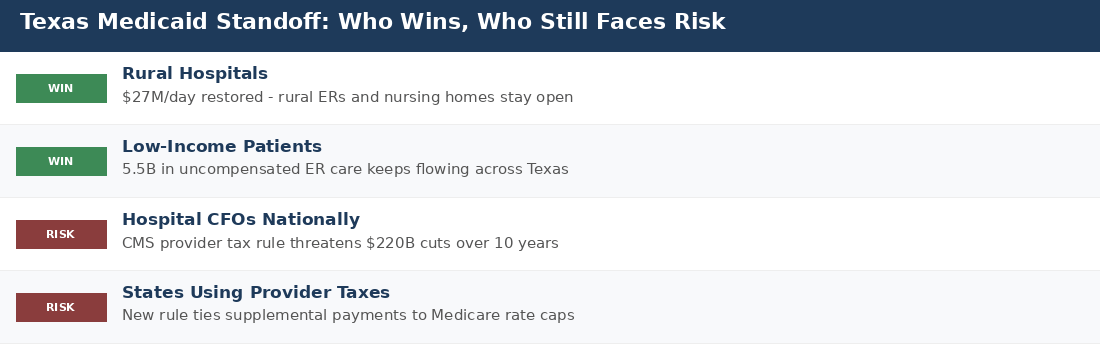
The result was $27 million per day in withheld payments starting September 1. That $27 million was not spread evenly. It fell hardest on the providers that rely most heavily on Medicaid supplemental funding: rural hospitals, nursing facilities, behavioral health providers, and community clinics operating on razor-thin margins.

2. The Mechanics of Supplemental Funding - How This System Actually Works
To understand why this dispute matters beyond Texas, you need to understand what Medicaid supplemental funding actually is and why hospitals depend on it.
Medicaid's base reimbursement rate only covers about 70% of the actual cost of providing care to Medicaid patients. That gap - the difference between what Medicaid pays and what it actually costs to treat someone - is where supplemental payments come in. They are not a bonus. They are the mechanism by which Medicaid-dependent providers stay financially viable.
📊 Texas hospitals provided $5.5 billion in uncompensated emergency room care annually. The uncompensated care pool alone covered 371 Texas hospitals with $4.5 billion in payments in 2024.
There are several types of supplemental payments. Disproportionate Share Hospital (DSH) payments specifically target hospitals serving disproportionately high shares of low-income and uninsured patients. Directed payment programs allow states to target supplemental dollars at specific provider types. Uncompensated care pools cover losses from treating uninsured patients.
The key word in all of these programs is "supplemental." They supplement a base rate that everyone acknowledges is inadequate. Without supplemental funding, providers that serve predominantly low-income and Medicaid populations face a structural revenue deficit every year. The only question is how large the deficit is and whether they can absorb it.
3. Rural Hospitals on the Cliff Edge
The institutions most exposed to this kind of disruption are not major academic medical centers in Houston and Dallas. Those systems have diversified revenue, large endowments, and enough scale to absorb a multi-week funding freeze. It hurts, but they survive.
Rural hospitals are a different situation entirely. A rural critical access hospital in West Texas or the Rio Grande Valley may derive 50% or more of its total revenue from Medicaid and Medicare combined. When supplemental payments freeze, that hospital does not have a rainy-day fund to cover payroll. It has creditors and a thin operating margin that was already negative before the freeze started.
The $1.4 billion Rural Health Transformation Program, allocating approximately $281 million to Texas annually through fiscal year 2030, provides some structural support. But it does not replace supplemental payment infrastructure. And a 33% reduction in DSH payments that Texas hospitals are absorbing in FY2026 - compounding to over $2.3 billion in cumulative cuts over three years - is not absorbed by rural hospitals the way it is by large urban systems.
📊 Medicaid only reimburses approximately 70% of the actual cost of care. The supplemental funding gap is real, structural, and not going away regardless of how a particular impasse is resolved.
The deeper issue is what this funding freeze reveals about the reliability of a system that rural hospitals have no choice but to depend on. A hospital that closes in a rural county does not simply lose revenue. It removes the only emergency room within 50 miles. It eliminates the maternal care unit for a county that already has elevated maternal mortality. It ends the behavioral health crisis stabilization service for a region with no alternative.

4. The Bigger Threat - The CMS Provider Tax Proposed Rule
The Texas funding restoration is welcome news. But focusing only on the restoration misses the larger structural shift that is already in motion.
CMS has proposed a rule implementing new limits on Medicaid provider taxes, required under the One Big Beautiful Bill Act. This is not a minor technical adjustment. It is a fundamental change to how states can finance Medicaid supplemental payments.
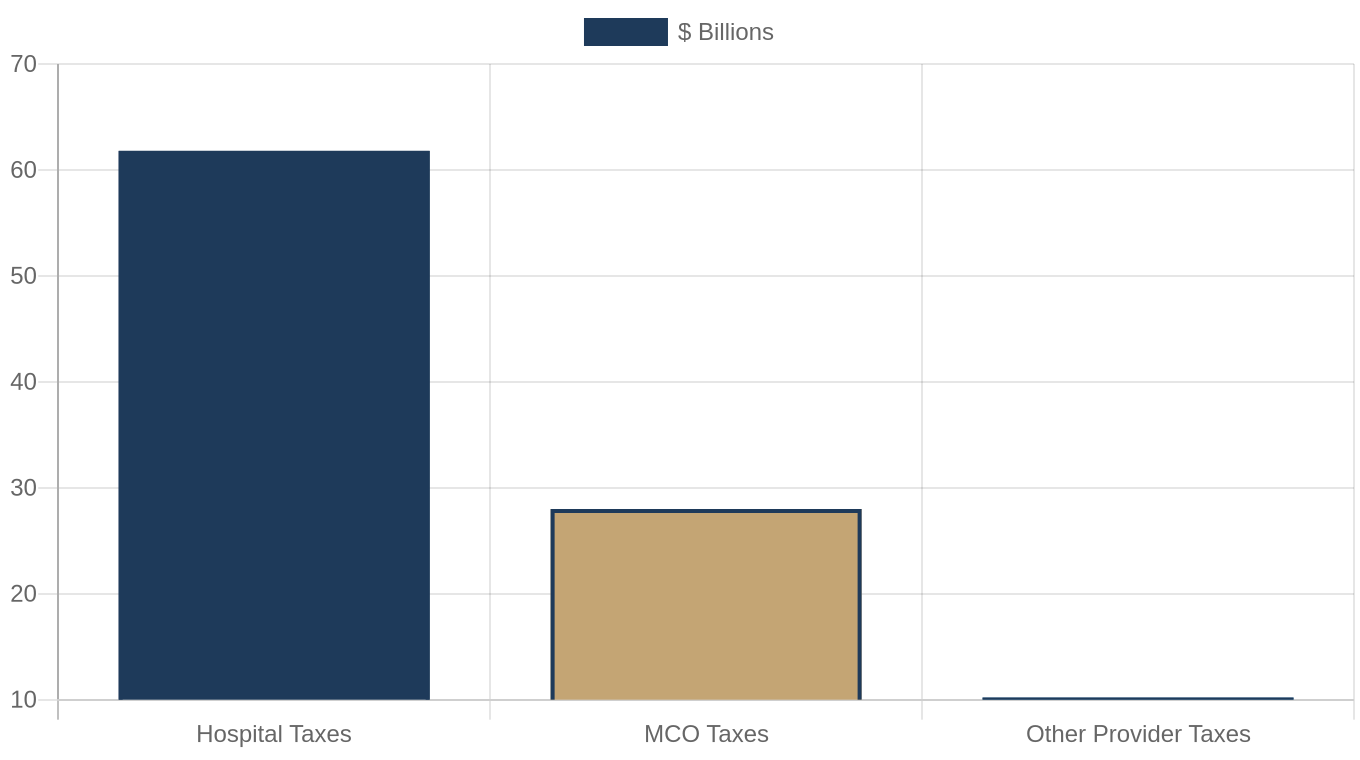
In 2026, provider taxes nationwide generated almost $100 billion, representing more than a quarter of the total non-federal share of Medicaid. Hospital taxes alone totaled $61.8 billion. Managed care organization taxes accounted for another $28 billion. These are the dollars that states use to generate federal matching funds for supplemental payments.
The proposed rule would tie supplemental payment levels to Medicare rates and impose state- and provider-class-specific applicable percentages based on taxes enacted as of July 4, 2025. Comments on the rule were due September 21, 2026 - just days after the Texas restoration was announced.
📊 CMS estimates that the proposed rule would reduce Medicaid payments to providers by $220.3 billion over the next 10 years compared with a scenario in which there is no OBBBA and no proposed rule.
That is not $220 billion in government savings. That is $220 billion in reduced payments to hospitals, nursing homes, physicians, and behavioral health providers who care for Medicaid patients. Some of that reduction will fall on providers that have significant financial cushion. Most will fall on providers that do not.
5. Texas Is Not Alone - A National Problem
Every state that has structured provider tax arrangements to generate federal matching funds for supplemental payments is watching what happened in Texas with quiet alarm.
California, New York, Illinois, Florida - all of them use hospital and managed care organization provider taxes to generate Medicaid supplemental revenue. The CMS proposed rule does not just threaten Texas. It threatens the financial architecture that allows every state to fund care for low-income patients beyond what the inadequate Medicaid base rate provides.
The national provider tax picture is striking. Hospital taxes generated $61.8 billion in 2026. MCO taxes generated $28 billion. These are the dollars at risk under the proposed rule - not all of them immediately, and not all in the same way, but the trajectory is clearly toward lower supplemental payments nationally.
The Texas standoff ended with a restoration. But the proposed rule is permanent policy change, not a temporary dispute. And states that relied on provider tax arrangements that now fall outside the new applicable percentage thresholds will face a funding gap they cannot simply lobby their governor to resolve with a letter to the Secretary of Health.
6. Deep Dive - The Hospital Finance Vulnerability Framework
For health system executives and CFOs, the Texas situation is not just a news story. It is a stress test result. And the result tells you something important about where the vulnerabilities are.
The following framework maps hospital revenue dependency against the stability of each revenue source, based on what Texas just demonstrated.
Category A: High Volume, Low Risk
Commercial insurance, Medicare fee-for-service, and elective private-pay services are high-volume, relatively stable revenue sources. They face their own pricing pressures, but they do not depend on annual federal-state negotiations about provider tax structure. Hospitals that have built strong commercial payer mixes have lower exposure to the supplemental payment risk.
Category B: Moderate Volume, High Risk
Medicaid base-rate revenue falls here. The base rate is inadequate and everyone knows it, but it is at least predictable. The supplemental payments that sit on top of the base rate are where the structural risk concentrates. A hospital that is 30% Medicaid by patient volume and heavily dependent on supplemental payments to break even has Category B risk on a large portion of its revenue.
Category C: Essential, Maximum Risk
Rural critical access hospitals and FQHCs that derive 50%+ of revenue from Medicaid, have no commercial payer mix to fall back on, and are located in communities with no alternative providers face Category C risk. For these institutions, a two-week funding freeze is not a balance sheet disruption. It is an existential event.
The Texas freeze lasted 17 days. A prolonged version of that dispute - or the structural revenue reduction that the CMS provider tax rule would impose over 10 years - would close Category C hospitals. That is not hyperbole. Texas has approximately 5 million uninsured residents, the highest raw number in any state. The providers serving those 5 million people are the ones with the highest Medicaid dependence and the least capacity to absorb revenue disruptions.
What This Means For You
For FQHC executives and community health center leaders: The Texas freeze is a warning signal about directed payment program stability. Review your dependency on supplemental payment programs and model what a 30-60 day interruption would do to your cash position. Build contingency plans now, not after a freeze starts.
For health system administrators and CFOs: The CMS provider tax proposed rule is not an abstract policy concern. It is a structural change to your long-term revenue outlook if your system depends on supplemental payments. Engage your state hospital association on the rulemaking and quantify your exposure to the new Medicare rate caps.
For rural hospital leaders: You have the highest dependency and the least cushion. Advocacy matters here. The comment period on the CMS provider tax rule closed September 21, 2026. If you did not submit comments, connect with your state rural health association to ensure your financial data is represented in the rulemaking record.
For radiologists and pulmonologists: Your compensation at hospitals serving Medicaid-heavy populations is indirectly tied to supplemental payment stability. If your hospital loses supplemental revenue, physician compensation and staffing levels at that institution come under pressure. Understanding your hospital's payer mix and supplemental payment dependency is part of understanding your own financial security.
For healthcare investors and founders: Companies building solutions for Medicaid-heavy providers - revenue cycle management, cost reduction, care coordination - are selling into a market under sustained financial pressure. That is both a product-market fit opportunity and a collection risk. Know your customers' supplemental payment exposure before you book that revenue.
For policy advocates: The OBBBA's provider tax changes are now being implemented through CMS rulemaking. This is the mechanism. Public comment, state-level advocacy, and healthcare industry engagement in the rulemaking process are how the final rule gets shaped. The window is narrowing.
The Bottom Line
Texas hospitals got their $12 billion back. Governors and hospital associations and healthcare workers and community advocates who pushed hard for this restoration did something important. They kept the system from failing in the short term.
But the short term is not the same as fixed. The provider tax proposed rule is a 10-year structural change. The OBBBA is law. The political environment that produced that law has not changed. And the 5 million uninsured Texans who depend on the providers that depend on supplemental funding did not get a policy fix. They got 17 fewer days of financial crisis at the institutions that serve them.
What just ended is the freeze. What has not ended is the question of whether American hospitals that care for low-income patients can depend on the funding structures they have built their operations around.
That question deserves an honest answer, not a press release.
Are you tracking the CMS provider tax rulemaking at your institution? Reply and tell me what your exposure looks like. I read every response.
About the Author
Jonathan Govette is the Co-Founder and CEO of Oatmeal Health, an AI lung cancer diagnostic company catching cancers earlier in the communities that need it most. Oatmeal uses AI to identify unscreened high-risk patients, navigate them to care, and score every lung CT for malignancy risk - billed under CPT 0721T. Stage I survival is 77%. Stage IV is 9%. We work in FQHCs because that gap is largest there.
Jonathan writes daily about radiology, pulmonology, AI diagnostics, health policy, hospital operations, and healthcare startups.
Subscribe to stay ahead of healthcare's most important shifts. Weekly deep-dives on AI, radiology, health policy, FQHCs, and the business of healthcare - written for operators, clinicians, and investors who want the signal, not the noise. Subscribe at oatmealhealthjonathangovette.substack.com
Key References
KERA News: "$12 Billion in Medicaid Funds Restored to Texas Hospitals, Ending Impasse With the Feds" (September 17, 2026) - https://www.keranews.org/text/texas-news/2026-09-17/12-billion-in-medicaid-funds-restored-to-texas-hospitals-ending-impasse-with-the-feds
Texas Hospital Association: "Texas Hospitals Face $27M Per Day Impact" - https://www.tha.org/blog/texas-hospitals-face-27m-per-day-impact/
HFMA: "Medicaid provider tax proposed rule could cut payments by $220 billion over 10 years" - https://www.hfma.org/payment-reimbursement-and-managed-care/medicaid-provider-tax-proposed-rule/
CMS: Medicaid Supplemental Payment and Directed Payment Programs information - https://www.hhs.texas.gov/providers/medicaid-business-resources/medicaid-supplemental-payment-directed-payment-programs
KFF: "5 Key Facts About Medicaid and Hospitals" - https://www.kff.org/medicaid/5-key-facts-about-medicaid-and-hospitals/