

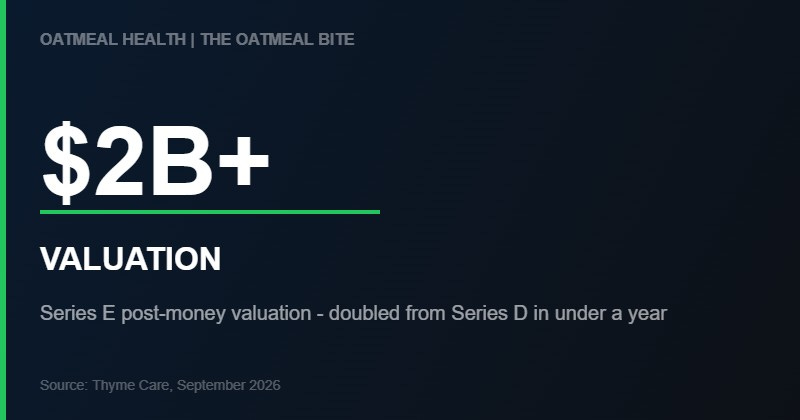
When Thyme Care announced its Series E in September 2026, the headline number was $125 million. The more telling figure was the one that came with it: a valuation north of $2 billion. That is roughly double what the company was worth less than 12 months ago, when it closed its Series D. In a venture market that has been largely unforgiving to health tech since 2022, that kind of trajectory stands out.
Thyme Care is not a hospital. It is not a clinic. It does not own imaging equipment or employ oncologists under its own brand. What it does is navigate cancer patients through the existing care system - helping them understand their diagnosis, connect with the right specialists, manage insurance approvals, prepare for treatment, and avoid the ER when an issue can be handled at home. The company calls itself a virtual oncology navigation platform. The industry is starting to call it a blueprint.
The round was led by Morgan Health, JPMorgan Chase's healthcare innovation arm, with participation from Humana, CVS Health Ventures, AlleyCorp, HealthQuest Capital, and a16z Bio + Health. That investor list is not accidental. These are payers, pharmacy benefit managers, and strategic investors writing checks because they believe Thyme Care can move the math on one of their most expensive problems: cancer.

What Thyme Care Actually Does
Founded in 2020 by CEO Bobby Green and Robin Shah, Thyme Care operates through partnerships with health plans. When a member is diagnosed with cancer, their health plan connects them with a Thyme Care team: a combination of oncology-trained nurses, care coordinators, social workers, and patient advocates accessible by text, phone, or app. No appointment required. No referral needed. Just a human on the other end who knows cancer.
The company handles what the oncology system almost never does well: the space between appointments. When a patient calls their oncologist's office at 7 PM worried about a fever post-chemo, they typically get a voicemail. Thyme Care gives them a person. When a patient does not understand why their insurance denied a PET scan, Thyme Care's team works the appeal. When a caregiver is burning out, a social worker follows up. This kind of coordination is not glamorous, but it is what prevents the 2 AM ER visit that costs $15,000 and traumatizes the patient.
The Numbers That Matter
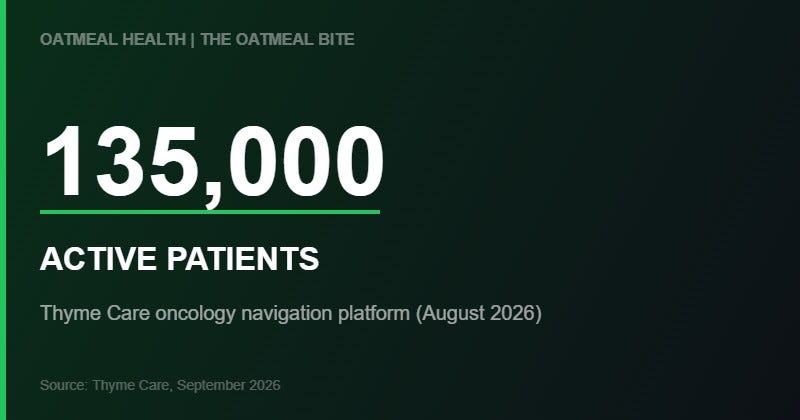
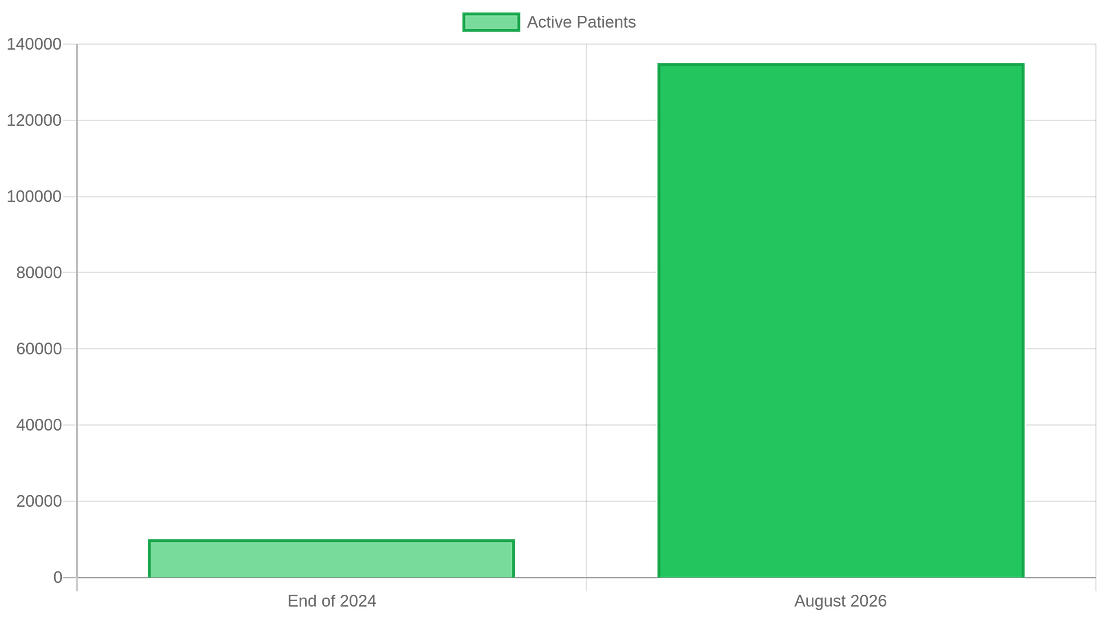
As of August 2026, Thyme Care is actively serving 135,000 cancer patients through more than 70 health plan partnerships. The company manages $7 billion in oncology spend - a figure that contextualizes what "virtual navigation" means in financial terms. This is not a wellness app. It is a care management layer deployed at scale across some of the most complex and expensive patients in the health system.
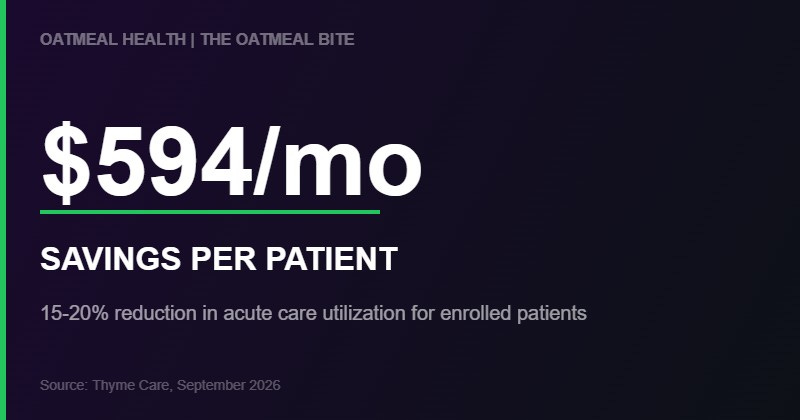
The clinical outcomes are the numbers payers care about most. Thyme Care reports a 15-20% reduction in acute care utilization among enrolled patients - fewer ER visits, fewer unplanned hospitalizations, fewer complications that could have been caught earlier. The per-patient financial impact: approximately $594 per member per month in cost savings. Multiply that across 135,000 patients and you see why Morgan Health led a nine-figure round.
The Investors and What They Are Betting On
The investor mix in this Series E is a deliberate signal. Morgan Health, JPMorgan's healthcare arm, focuses specifically on improving employer-sponsored insurance. Their investment thesis aligns with Thyme Care's model: if you can demonstrably reduce oncology costs for health plans, you create durable enterprise value. Humana and CVS Health Ventures are strategics who can also become distribution partners - health plans that could deploy Thyme Care's navigation services across their member bases.
a16z Bio + Health and HealthQuest Capital bring a different perspective: both invest at the intersection of clinical care and technology. Their presence validates the argument that Thyme Care is not just a services business - it is building a data and infrastructure layer that gets more valuable as it scales. Every patient interaction generates data about what works in oncology navigation, what predicts an ER visit, what interventions reduce hospitalization. That data moat increasingly differentiates virtual-first health companies.
AlleyCorp, founded by Kevin Ryan, rounds out the group as an early-stage technology investor - a signal that Thyme Care's founding team continues to hold confidence from its earliest backers even as the company has grown into a mid-market enterprise business.
Why Virtual Navigation Works at Scale
The core insight behind Thyme Care's model is one that health systems have known for decades but largely failed to act on: cancer patients do not fail because their oncologist was bad. They fail because the system around the oncologist is fragmented, confusing, and deeply unsuited for people who are frightened, sick, and trying to make complex medical decisions in real time. Navigation closes that gap.
The academic literature on oncology navigation is consistent: patients who have access to a navigator have better treatment adherence, better quality of life scores, lower rates of ER use, and in some studies, better survival outcomes. The barrier has always been implementation. Hospital-based navigation programs are expensive to staff, hard to scale, and limited to patients already within that hospital's network. Thyme Care's model flips the equation: deploy navigation through the health plan, reach patients across any provider network, in any geography, at the moment of diagnosis - not six weeks after they have already made their first treatment decision.
The Payer Calculus
For health plans, oncology is a loss leader. Cancer patients represent roughly 2-5% of commercial and Medicare Advantage membership but can account for 15-25% of total spend. An average cancer treatment course can cost $150,000 to $300,000 or more, and unplanned hospitalizations can add $20,000 to $50,000 per event on top of that. Any intervention that demonstrably reduces acute utilization is financially transformative at the plan level.
Thyme Care's model creates a rare alignment of incentives. The health plan pays a per-member-per-month fee for navigation services. Thyme Care generates savings by reducing ER visits and unplanned admissions. The plan keeps a share of the savings. The patient gets better support through treatment. The oncologist gets a patient who shows up prepared, adherent, and less likely to call the office at 3 AM. When everyone at the table benefits from the same outcome, you have built something worth scaling.
"Our goal has always been to make sure every cancer patient has someone in their corner from day one of diagnosis. This round allows us to extend that promise to more patients and to build the infrastructure that makes whole-person cancer care possible at scale." - Bobby Green, CEO, Thyme Care
Thyme Companies: The Next Chapter
The most interesting signal in the Series E announcement is what the capital is earmarked for. Beyond expanding the navigation footprint, Thyme Care is launching "Thyme Companies" - a platform extending into biosimilar oncology drugs, clinical trial enrollment, and advanced care planning. Each represents a meaningful market in its own right.
Biosimilars in oncology represent one of the most underutilized cost-saving opportunities in cancer care. Reference biologic drugs like bevacizumab, rituximab, and trastuzumab have biosimilar equivalents that can reduce costs by 20-40%, but uptake has been slow due to physician inertia and patient concern. A navigation platform with 135,000 cancer patients and trusted relationships with those patients is uniquely positioned to facilitate biosimilar adoption in a way that no pharma company or health plan can do as credibly on its own.
Clinical trial enrollment is the second pillar. Approximately 4% of adult cancer patients in the United States participate in clinical trials - a number researchers and oncologists have been trying to raise for decades. The barriers are practical: patients do not know what trials are available, do not understand eligibility criteria, and do not have help navigating the enrollment process. A trained navigation team with a patient's full oncology context is, functionally, a clinical trial recruitment engine. If Thyme Care can move trial enrollment rates even marginally across its patient base, it creates value for pharma sponsors, payers, and patients who gain access to cutting-edge therapies.
Advanced directives and end-of-life planning is the third pillar - and arguably the most consequential for the health system's long-term cost structure. Roughly 70% of Americans want to die at home but most do not. The primary reason: no one has the conversation early enough. A navigation team embedded in a cancer patient's care from day one of diagnosis is positioned to facilitate that conversation in a way that is both clinically appropriate and financially impactful.
What This Means for the Oncology Market
Thyme Care's $2 billion valuation signals something specific about where the market thinks oncology care delivery is going. The traditional fee-for-service oncology model - where hospitals and cancer centers compete on volume and technology - is under pressure from every direction: payer cost containment, employer scrutiny, site-of-care migration to outpatient settings, and a wave of virtual-first models that can deliver meaningful outcomes without the overhead of a cancer center.
The companies that will define oncology care in the next decade are not necessarily the ones with the best PET scanners or the most beds. They are the ones who can demonstrate, with data, that their intervention changed the patient's trajectory. Thyme Care is betting that navigation - the unsexy, high-touch, deeply human work of guiding someone through cancer - is the highest-leverage place to compete. The $125 million round and the investors who backed it suggest the market is starting to agree.
For health technology companies watching this space, the lesson is not to pivot to cancer navigation. It is to ask a harder question: in the disease areas you are serving, where is the coordination gap? Where does a patient leave their doctor's office and immediately fall off the rails? Where is the system so complex that even motivated patients get lost? That is where the next Thyme Care gets built.
The Oatmeal Health Takeaway
We cover healthcare innovation and digital health here because the most important changes in health care are happening outside the hospital walls. Thyme Care's Series E is a data point in that story. Virtual oncology navigation is not a technology product - it is a care model, built on trust, deployed through health plans, and measured in clinical outcomes. The technology enables the scale. The human touch is what makes it work.
135,000 cancer patients are navigating treatment with support they did not have before. That is not a headline. That is the point.