


The letter will arrive in October. Millions of Medicare beneficiaries will open their Annual Notice of Change, scan the new premium figure, and wonder what happened. Some will pay $5 more a month. Some will pay $20 more. A few will see their plan disappear entirely.
What happened is straightforward: the Trump administration ended the Medicare Part D Premium Stabilization Demonstration on December 31, 2026, one year earlier than originally planned. CMS announced the decision on July 28, 2026. The program had been quietly absorbing a portion of premium costs for standalone prescription drug plans since 2025. Without it, those costs flow directly to beneficiaries.
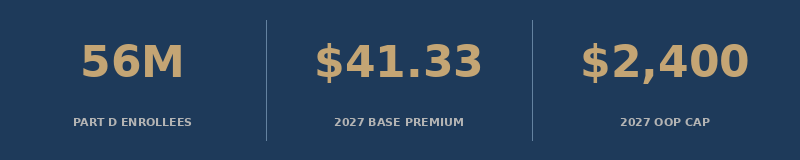
The stakes here are not small. Medicare Part D covers roughly 56 million Americans. About 25 million of them are enrolled in standalone prescription drug plans - the plans most directly exposed to this change. The rest are covered through Medicare Advantage plans with drug benefits, which have different subsidy structures. For the 25 million in standalone PDPs, the math just changed.
1. What the Premium Stabilization Demonstration Actually Did
To understand why this matters, you need to understand what the program was and why it existed in the first place.
The Part D Premium Stabilization Demonstration was created as a bridge. When the Inflation Reduction Act redesigned Medicare Part D in 2025, it fundamentally restructured how costs flow between beneficiaries, plan sponsors, and the federal government. The redesign was broadly positive for enrollees - it introduced a hard out-of-pocket cap, eliminated the catastrophic coverage gap, and required manufacturers to share more drug costs. But the redesign also created short-term pricing uncertainty for plan sponsors, who were suddenly operating under a new cost-sharing model with limited historical data to calibrate their bids.
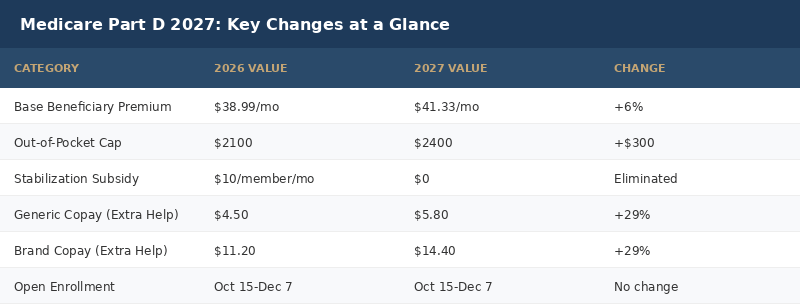
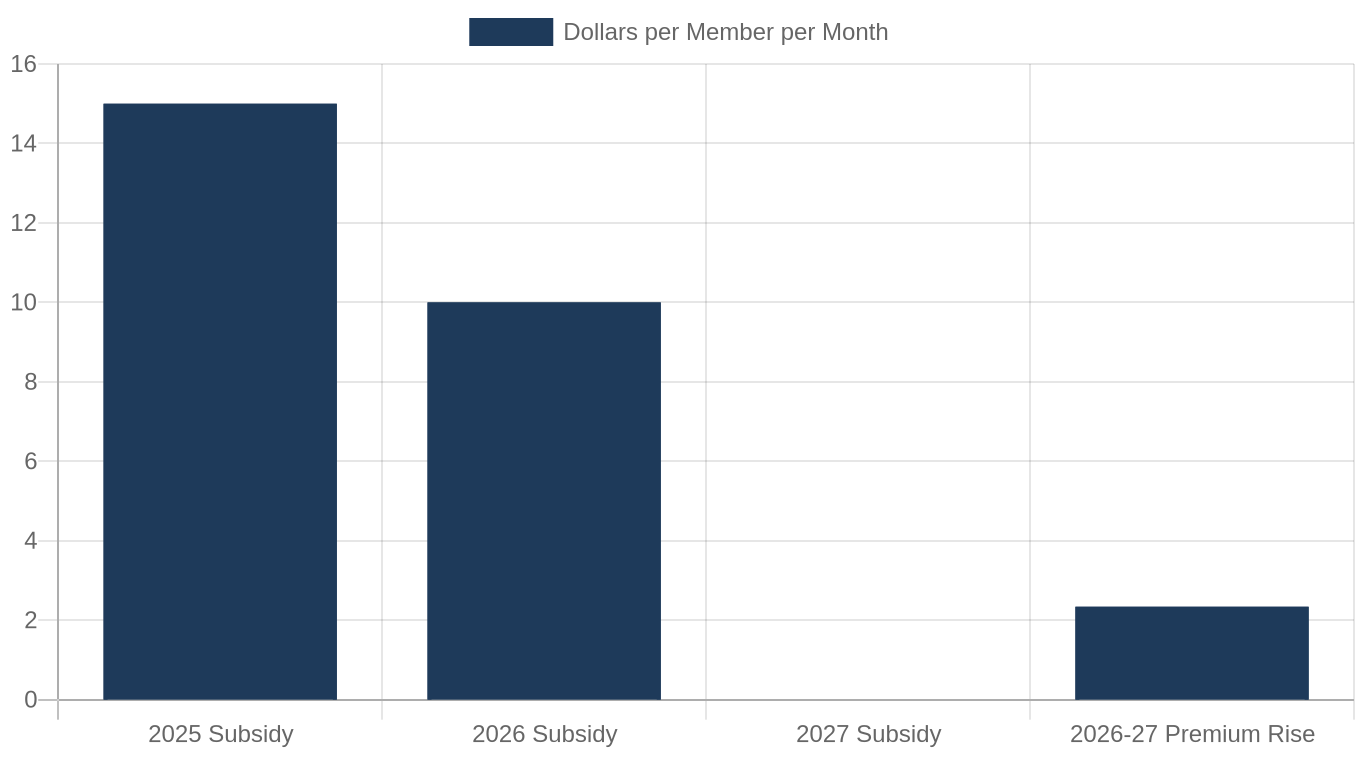
CMS responded by creating the demonstration program. In 2025, the program paid plan sponsors $15 per enrolled member per month to stabilize premiums. In 2026, that dropped to $10 per member per month. The idea was to give plans two years of real-world data under the new benefit design before standing on their own.
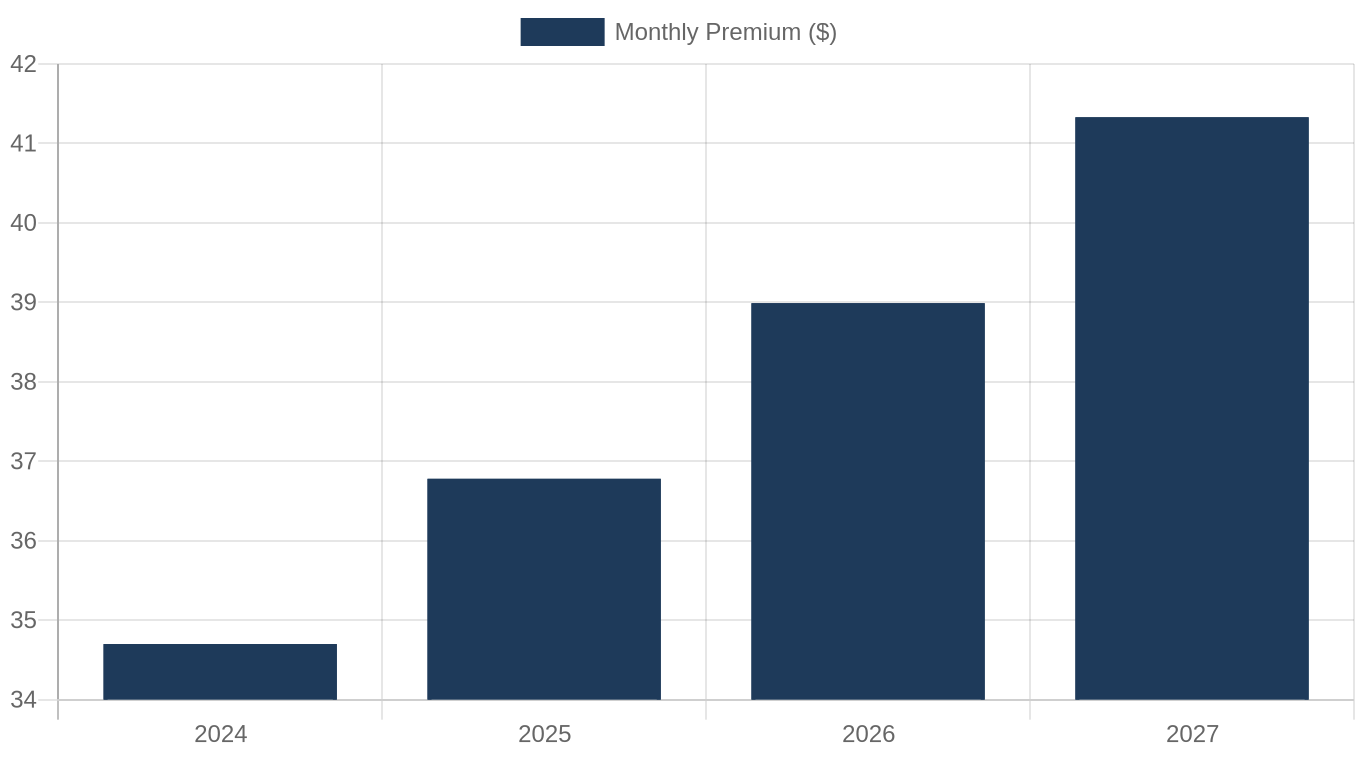
The average standalone drug plan premium in 2026 was approximately $36 per month - noticeably lower than the base beneficiary premium of $38.99, in part because of this subsidy flowing through to plan pricing. When the subsidy disappears in 2027, that cushion is gone.
CMS's official position is that plan sponsors now have sufficient experience with the redesigned benefit to price accurately without support. The 2027 base beneficiary premium is set at $41.33 per month, a 6 percent increase from $38.99 in 2026. CMS projects that most standalone PDP enrollees will see increases of less than $10 per month. Critics, including the Center for Medicare Advocacy, argue that estimate may be optimistic for certain plan categories and geographic markets.
2. The Numbers: Who Pays What
The base beneficiary premium is a useful benchmark but not what most people actually pay. Individual plan premiums vary significantly by insurer, geography, and formulary. The gap between the cheapest and most expensive plans in a given market can exceed $100 per month.
Here is the framework for 2027:
📊 The national base beneficiary premium rises from $38.99 to $41.33 - a $2.34 increase on the official metric. But the real number that matters is the individual plan premium, which the Part D landscape release in September 2026 will show. Some plans will absorb the loss of the subsidy through internal pricing. Others will pass it through.
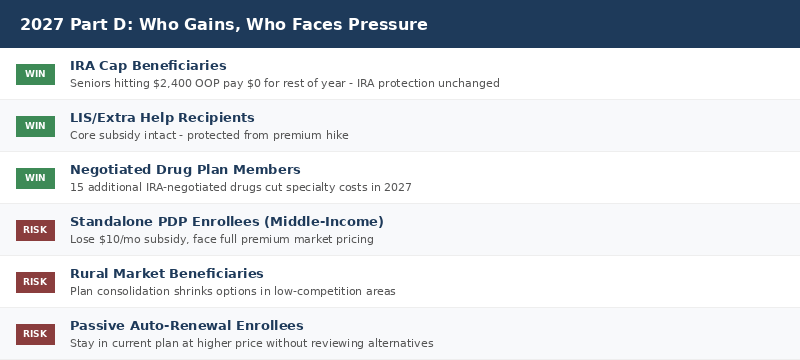
The Inflation Reduction Act's out-of-pocket cap, which was $2,000 when it launched in 2025 and $2,100 in 2026, rises to $2,400 in 2027. That cap is inflation-indexed and protects high-drug-cost beneficiaries from catastrophic spending. Once a beneficiary hits $2,400 in out-of-pocket costs, they pay nothing for the rest of the calendar year. In 2025, approximately 11 million Part D enrollees reached the OOP cap and saved an average of $600 each.
For low-income beneficiaries receiving the Low-Income Subsidy (also called Extra Help), the situation is more protected but not immune. The core LIS benefit is unaffected by the demonstration ending. However, copayment amounts are adjusting upward in 2027: generic copays for Extra Help recipients rise to $5.80, and brand-name drug copays rise to $14.40.
3. Why This Hits Safety-Net Populations Differently
For health system leaders and FQHC executives, the Part D premium increase is a population health problem, not just a household budget problem. Medication adherence is one of the most powerful levers in chronic disease management. When drug costs go up, adherence goes down - and downstream costs go up sharply.
📊 Research consistently shows that even small increases in cost-sharing reduce adherence among low- and moderate-income patients. A $5 monthly premium increase sounds modest in a policy document. For a patient managing hypertension, diabetes, and COPD on a fixed income, it is a real decision point.
FQHCs and community health centers see this dynamic directly. Patients who lose their Part D plans - because a plan exits a market or becomes unaffordable - often delay refilling prescriptions while they navigate re-enrollment. That gap in coverage, even a few weeks, produces emergency department visits, hospitalizations, and worsening chronic disease markers that take months to stabilize.
The populations most vulnerable to this change are the roughly 25 million standalone PDP enrollees who do not qualify for Extra Help and whose plans relied most heavily on the stabilization subsidy. They are often middle-income seniors - above the income threshold for LIS but below the level where premium increases are absorbed without stress. They are exactly the patients FQHCs see regularly.

4. The IRA Effect: The Good News That Competes With the Bad News
The 2027 Part D story is not purely negative. The Inflation Reduction Act provisions in effect since 2025 have fundamentally changed the risk profile for high-drug-cost beneficiaries, and that improvement continues in 2027.
The out-of-pocket cap is the most significant protection. Before the IRA, a Medicare beneficiary on an expensive specialty medication could theoretically face unlimited out-of-pocket drug costs in a given year. That era is over. The $2,400 cap in 2027 means that the worst-case scenario for any Part D enrollee is $200 per month in drug costs - and then zero for the rest of the year.
The IRA also introduced Medicare drug price negotiation. In January 2025, HHS published the list of 15 additional drugs subject to negotiated prices taking effect in 2027. These are brand-name drugs that are not subject to generic competition, and negotiated prices will produce measurable savings for enrollees who take those drugs. CMS estimates total out-of-pocket savings from IRA provisions reached approximately $7.4 billion for 18.7 million enrollees in 2025.
The tension in 2027 is that the IRA's structural improvements operate at the back end of the benefit - protecting people with very high drug costs. The demonstration program's end operates at the front end - raising baseline premiums for everyone. A beneficiary on no chronic medications pays the higher premium and sees no offsetting IRA benefit. A beneficiary on three specialty drugs pays the higher premium but is meaningfully protected by the OOP cap.

5. Plan Sponsor Behavior and Market Consolidation
The demonstration program's end will also accelerate a trend that has been reshaping the Part D market since 2025: plan consolidation.
When plan sponsors face higher unsubsidized costs, marginal plans exit first. The weakest plans - those with thinner margins, smaller enrollment, or less favorable drug mix - do not survive the pricing stress. This is not hypothetical. The Part D market has been consolidating for several years, and the demonstration's end provides additional pressure.
Consolidation has two consequences for beneficiaries. First, it reduces plan choice in some markets, particularly rural areas where plan competition is already limited. A beneficiary who has been happy with their current plan may find it discontinued or significantly repriced in 2027. Second, consolidation tends to push beneficiaries toward Medicare Advantage plans with embedded drug coverage - plans that operate under different subsidy structures and may carry network restrictions that standalone PDPs do not.
📊 Medicare Open Enrollment runs October 15 through December 7 each year. Beneficiaries who do not actively review their plan during this window are auto-renewed into their current plan - at whatever the new premium happens to be. The beneficiaries least likely to shop are often those with the most to gain from switching.
Deep Dive: The Financial Model Behind the Demonstration's End
To understand why CMS ended the program early, it helps to understand how the demonstration was structured and what CMS was measuring.
The Part D benefit redesign under the IRA changed the risk distribution fundamentally. Before the IRA, beneficiaries bore a disproportionate share of catastrophic drug costs. After the redesign, that catastrophic risk shifted primarily to the federal government and drug manufacturers. Plan sponsors actually faced a more predictable cost environment - the catastrophic tail risk was no longer their problem.
CMS's argument for ending the demonstration is essentially actuarial: plan sponsors have had two full years of claims data under the new benefit design, and they now have sufficient information to price their bids accurately without a stabilizing subsidy. The demonstration was a bridge, and CMS believes the destination is reached.
The Counter-Argument
The Center for Medicare Advocacy and other advocacy organizations argue that CMS's $10 monthly increase estimate understates actual impact for specific plan categories. Their concern is that plans which enrolled higher-cost beneficiary populations - those who drove the most Part D spending under the new benefit - will need to increase premiums more aggressively than average to remain solvent. The $10 estimate is an average. In a consolidated market, averages obscure the tails.
What CMS Will Report in September
The final 2027 Medicare Advantage and Part D landscape data will be released in mid-to-late September 2026. That release will show the actual distribution of plan premiums across all markets - and will determine whether the administration's $10 projection holds or understates the true impact.
The FQHC Financial Exposure
For community health centers specifically, the downstream financial exposure from Part D premium increases runs through two channels. First, patients who drop coverage or delay re-enrollment use FQHC services for prescription assistance and medication access programs that are not designed to be primary coverage. That strain is real and is not reimbursed at Part D rates.
Second, FQHCs that operate pharmacies under the 340B drug pricing program face a different dynamic: their 340B savings depend in part on payer mix, and beneficiaries cycling through coverage gaps temporarily change that mix. The 340B program has already faced significant pressure in recent years; adding Medicare Part D volatility compounds the challenge.
What This Means For You
FQHC executives and community health center leaders: - Brief your patient navigators on the 2027 Part D changes now, before October enrollment begins. Proactive outreach during open enrollment (October 15 - December 7) prevents coverage gaps. - Patients who are passively auto-renewing into their current standalone PDP need to be flagged for plan review. The best plan in 2026 may not be the best plan in 2027. - Review your Extra Help/LIS enrollment rates. Patients who qualify but are not enrolled are leaving significant protection on the table - and will feel the premium increase unnecessarily. - Anticipate increased demand for medication assistance programs in Q1 2027, particularly among patients who switch plans during open enrollment and face formulary disruptions in the transition.
Health system administrators and CMOs: - Model the adherence impact of a $5-20 monthly premium increase across your highest-risk chronic disease patient populations. The hospital admission cost of one adherence failure dwarfs years of premium subsidies. - Engage your managed care contracting teams on how 2027 Part D changes interact with your value-based care arrangements. Beneficiaries losing stable drug coverage create quality measure risk.
Radiologists and pulmonologists: - Patients on immunotherapy, targeted cancer agents, and specialty respiratory drugs may reach the $2,400 OOP cap earlier in the year. The cap provides meaningful protection, but premium increases are an additional friction point for already cost-burdened oncology patients. - Lung cancer patients - a core Oatmeal Health population - who are on targeted therapies should be counseled proactively about 2027 plan changes during this fall's clinical visits.
Healthcare investors and founders: - The Part D market consolidation trend creates acquisition opportunity for well-capitalized plan sponsors and pharmacy benefit management companies. Watch the September landscape data for market exit signals. - Medication adherence technology companies have a direct business case to make to health systems navigating coverage volatility. The ROI on adherence interventions rises when drug costs fluctuate.
Policy advocates: - The demonstration's early termination is a policy decision, not a legal requirement. Advocates should pressure CMS to release its actuarial justification for the $10 average increase estimate and to commit to monitoring 2027 actual premium data against that projection. - If actual increases exceed the projection, that creates political pressure to reinstate some form of premium stabilization for 2028 or beyond.
Closing
The Part D Premium Stabilization Demonstration was never designed to be permanent. CMS was always going to end it. The question was when, and whether the market had matured enough to absorb the transition without significant harm to beneficiaries.
CMS says yes. Advocates are skeptical. The September 2026 landscape data will begin to answer the question. The October renewal notices will complete it.
What is certain is this: 56 million people are enrolled in Medicare Part D. Most of them are not following CMS policy announcements. Most of them will not know about the demonstration's end until they open that October letter and see a new premium number. The burden of navigation falls on health systems, FQHCs, pharmacists, and patient advocates who are already stretched thin.
The IRA's structural improvements - the OOP cap, the negotiated drug prices, the elimination of the coverage gap - represent real progress. They should not be dismissed. But progress on catastrophic drug costs does not eliminate the friction of rising monthly premiums for tens of millions of seniors on fixed incomes.
The healthcare system has a roughly six-week window from the September landscape release to the October 15 open enrollment start to prepare beneficiaries. That window is short. The work starts now.
What are you seeing in your patient population around Medicare cost burden? Reply directly to this email - I read every response.
About the Author
Jonathan Govette is the Co-Founder and CEO of Oatmeal Health, an AI lung cancer diagnostic company catching cancers earlier in the communities that need it most. Oatmeal uses AI to identify unscreened high-risk patients, navigate them to care, and score every lung CT for malignancy risk - billed under CPT 0721T. Stage I survival is 77%. Stage IV is 9%. We work in FQHCs because that gap is largest there.
Jonathan writes daily about radiology, pulmonology, AI diagnostics, health policy, hospital operations, and healthcare startups.
Subscribe to stay ahead of healthcare's most important shifts. Weekly deep-dives on AI, radiology, health policy, FQHCs, and the business of healthcare - written for operators, clinicians, and investors who want the signal, not the noise. Subscribe at oatmealhealthjonathangovette.substack.com
Key References
CMS Medicare Part D 2027 National Average Monthly Bid Amount Information (cms.gov)
KFF: CMS Decision to End Temporary Subsidies to Stand-Alone Drug Plans (kff.org)
Center for Medicare Advocacy: Administration Ends Part D Premium Stabilization Demonstration (medicareadvocacy.org)
HHS Out-of-Pocket Cap Savings for Medicare Part D Enrollees (hhs.gov)
Medicare Plan D News: Higher Monthly Premiums in 2027 - elderlawanswers.com (September 1, 2026)