

The Part D Premium Stabilization Demonstration just ended. Here is what 56 million beneficiaries - and everyone who cares for them - needs to do before October 15.
For the past two years, a quiet federal program kept Medicare drug plan premiums from spiking. Most beneficiaries never knew it existed. They just noticed that their prescription drug costs stayed manageable even as the entire Medicare Part D benefit was restructured under the Inflation Reduction Act.
That program ends after December 31, 2026.
The Part D Premium Stabilization Demonstration is over. And the 56 million Americans enrolled in Medicare Part D are about to find out what that means on their October premium notice.
Here is what is actually happening, what the numbers show, and what every person who works with older adults, manages Medicare-covered patients, or advises beneficiaries on benefits needs to know before open enrollment opens on October 15.
What Was the Part D Premium Stabilization Demonstration?
To understand what is changing, you need to understand why this program existed in the first place.
The Inflation Reduction Act of 2022 made sweeping changes to Medicare Part D, including the $2,000 annual out-of-pocket cap on prescription drugs that took effect in 2025. These were meaningful improvements for beneficiaries who take expensive medications.
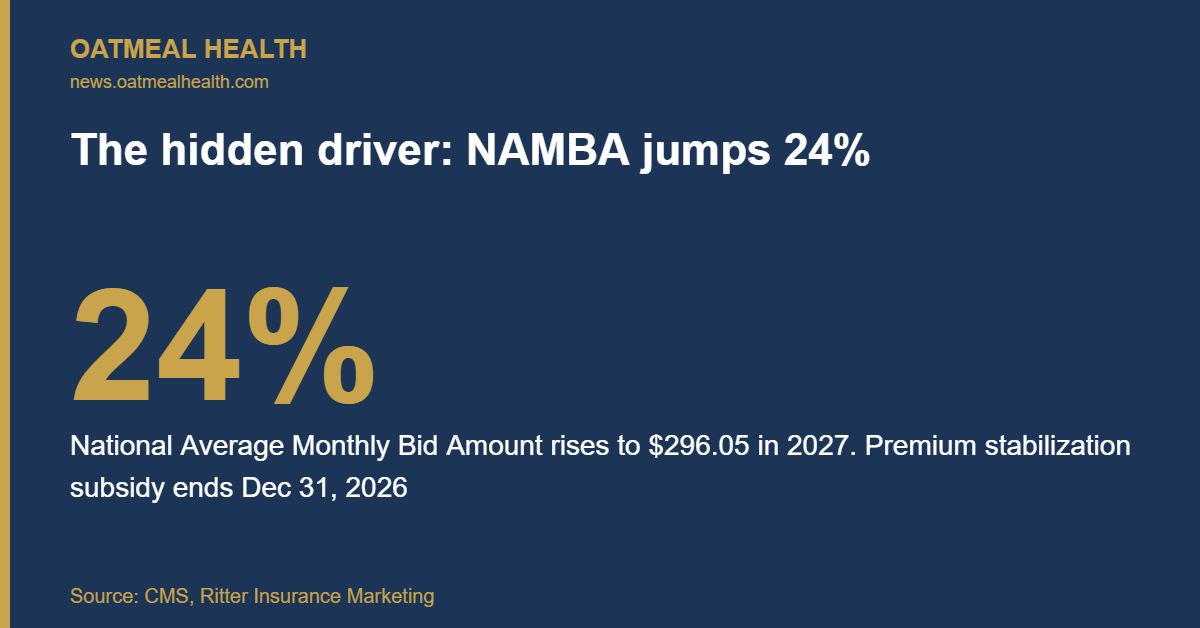
But the redesign created a financial problem for insurers offering stand-alone prescription drug plans. The structural changes shifted costs in ways that made it harder for PDP sponsors to accurately price their premiums. To prevent massive premium hikes during the transition, CMS created the Part D Premium Stabilization Demonstration - a temporary federal subsidy program that gave participating PDP sponsors additional financial support.
In 2025, the subsidy was $15 per member per month. In 2026, it was $10 per member per month. The demonstration totaled $9.8 billion across those two years.
CMS's position: PDP sponsors now have "sufficient experience" to support accurate bid development without the extra support. The training wheels are coming off.
Whether or not that assessment is accurate is a separate debate. What matters practically is this: the subsidy that kept premiums stable is gone.
The Numbers: What Is Actually Changing in 2027
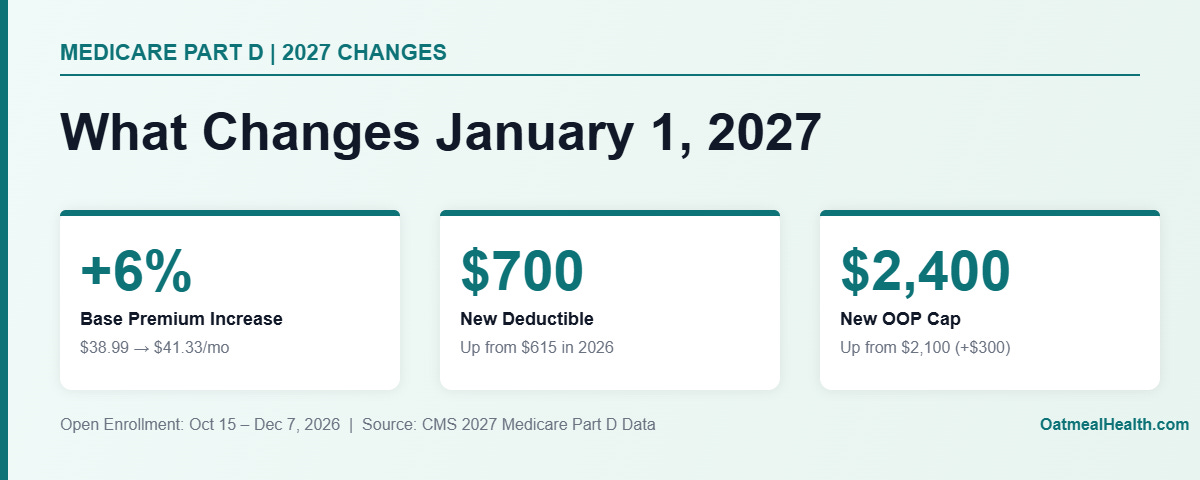
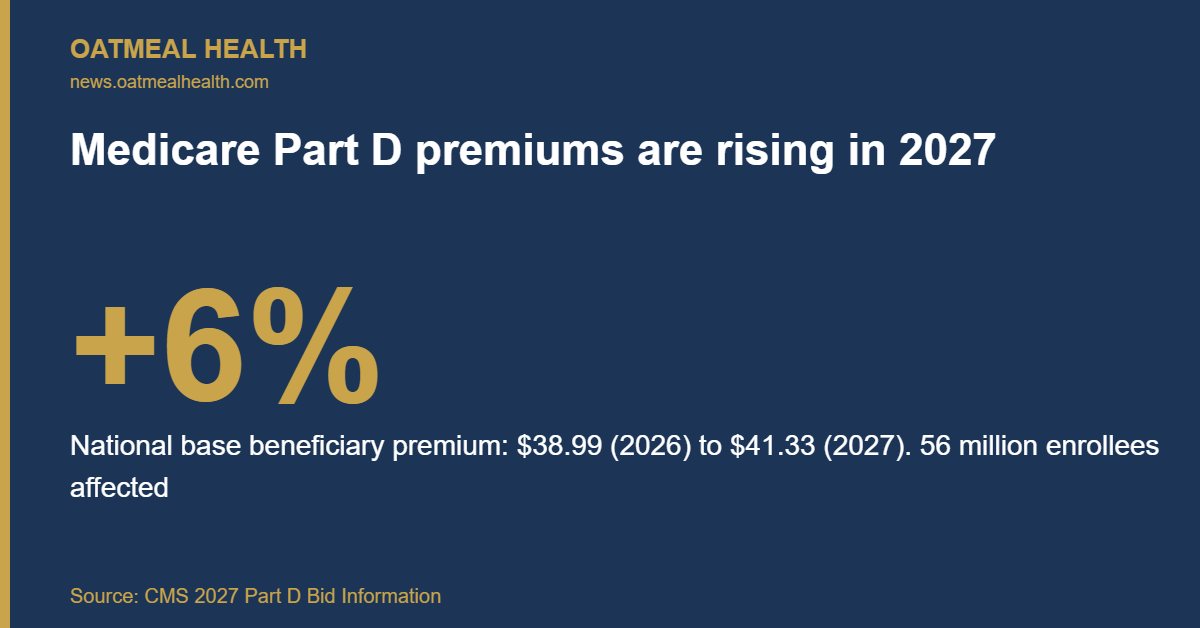
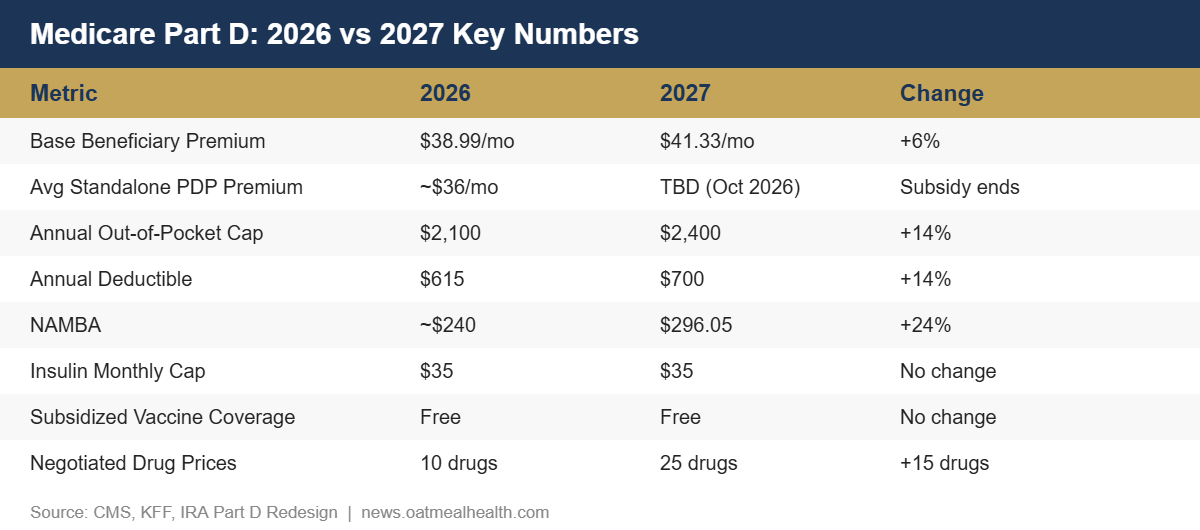
The national base beneficiary premium for Part D is rising from $38.99 per month in 2026 to $41.33 per month in 2027 - a 6 percent increase.
But the base beneficiary premium is not what most beneficiaries actually pay. Individual plan premiums vary widely by plan and by region. KFF analysis makes this clear: the stabilization subsidy had lowered the average drug plan premium to approximately $36 a month in 2026. Beneficiaries in plans that relied most heavily on the subsidy are the most exposed when it disappears.
Roughly 75 percent of stand-alone PDP enrollees will see their premiums increase in 2027
About 30 percent of PDP enrollees will see increases of less than $10 per month
About 45 percent of PDP enrollees will see increases in the $11 to $20 per month range
Plan-specific 2027 premiums will not be published until mid-to-late September 2026
.
The Out-of-Pocket Cap Change Nobody Is Talking About
In 2026, once a Medicare Part D enrollee reaches $2,100 in qualifying out-of-pocket drug spending, they enter catastrophic coverage and pay nothing more for covered drugs for the rest of the year. In 2027, that threshold rises to $2,400 - a $300 increase, a 14.3 percent jump in one year.
The standard Part D deductible is also increasing, from $615 in 2026 to $700 in 2027.
For a beneficiary managing multiple chronic conditions - a cancer patient, someone on biologics for an autoimmune disease, a person on multiple specialty drugs - this is significant. They reach catastrophic coverage $300 later before the zero-cost floor kicks in.
Who Gets Hit Hardest
Stand-alone PDP enrollees. Stand-alone prescription drug plans face the most direct premium adjustment.
Beneficiaries in heavily subsidized plans. If your patient is enrolled in a plan that offered below-average premiums because of the subsidy, they are the most likely to see a double-digit monthly increase.
Patients with high drug costs. The OOP cap increase means they pay more before protection kicks in.
Low-income beneficiaries who may not know Extra Help exists. The Extra Help program is not ending. But millions of eligible beneficiaries do not apply because they do not know it exists.
What Extra Help Covers and Who Qualifies
Extra Help is a federal program that provides significant financial assistance with Part D costs to beneficiaries with limited income and resources. Beneficiaries who receive Extra Help pay little to no Part D premium and face lower deductibles and copayments.
In 2027, projected resource limits for full Extra Help are approximately $17,150 to $17,350 for an individual and $34,250 to $34,600 for a married couple.
If you work with patients or clients who are on Medicare, take multiple medications, and struggle with costs: do not assume they do not qualify. Ask. Help them apply. Apply at SSA.gov or call 1-800-MEDICARE.
SHIP - the State Health Insurance Assistance Program - offers free, unbiased counseling. Find your state's program at shiphelp.org.
What Open Enrollment Actually Means This Year
Open enrollment runs October 15 through December 7, 2026. Any changes take effect January 1, 2027.
Step 1: Read the Annual Notice of Change. Every beneficiary enrolled in a Part D plan should receive this by mail in late September. Do not throw it away.
Step 2: Compare plans on Medicare.gov. A plan that was optimal in 2026 may not be optimal in 2027.
Step 3: Check for Extra Help eligibility. Income and resource limits are broader than many people expect.
Step 4: Contact SHIP for free help. Find them at shiphelp.org.
What This Means for Healthcare Providers and Advisors
For primary care practices: Consider a patient communication initiative for Medicare-enrolled patients explaining that Part D premiums may increase and encouraging them to review plan options during open enrollment.
For specialty practices with high-cost drug patients: Flag the OOP cap increase for patients approaching the catastrophic coverage threshold. The number moves from $2,100 to $2,400.
For social workers and benefits navigators: Be proactive about Extra Help screening. With premiums rising, more beneficiaries may newly qualify.
For employers managing Medicare-eligible retirees: Ensure benefits communications include guidance on the 2027 Part D changes and point retirees to Medicare.gov and SHIP before October 15.
The Bigger Picture
The decision to end the Part D Premium Stabilization Demonstration is a policy choice. And policy choices about Medicare Part D have real human consequences at scale.
Fifty-six million beneficiaries. Fixed incomes. Rising rents, rising food prices, rising everything. And now rising drug premiums on top.
The $300 increase in the out-of-pocket threshold is not a rounding error for a cancer patient on a biologic. The $15-per-month premium increase at a heavily subsidized plan is not trivial for someone on $1,500 a month in Social Security income.
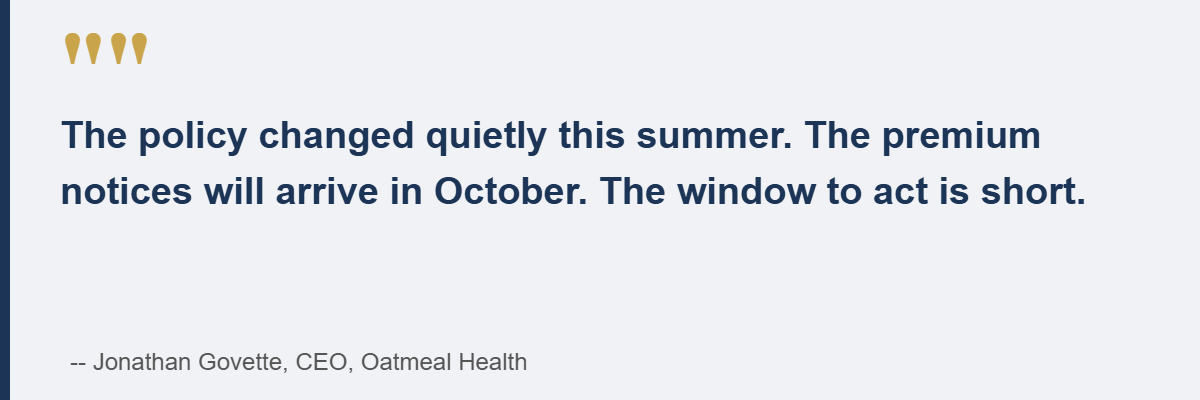
The policy changed quietly. The impact will not be quiet at all.
Key Dates and Numbers for 2027
Open enrollment: October 15 - December 7, 2026
2027 base premium: $41.33/month (up from $38.99; +6%)
2027 deductible: $700 (up from $615)
2027 OOP cap: $2,400 (up from $2,100)
Extra Help: Apply at SSA.gov or call 1-800-MEDICARE
SHIP counselors: shiphelp.org
Plan comparison: medicare.gov/plan-compare
The Bottom Line
Most Part D enrollees will see their premiums rise in 2027. Some will see increases in the $11-20/month range. The out-of-pocket cap rises from $2,100 to $2,400 and the deductible rises from $615 to $700.
Open enrollment runs October 15 through December 7. Extra Help continues. SHIP counselors provide free, unbiased help.
The people most at risk are the ones who will not know any of this is happening until a premium notice arrives in the mail. If you can get information to them before October 15, that is the intervention that matters.
Sources: CMS Medicare Part D 2027 National Average Monthly Bid Amount Information; KFF Medicare Part D analysis; Elder Law Answers; Center for Medicare Advocacy; Ritter Insurance Marketing 2027 PDP analysis.