


Lung cancer is now the leading cause of cancer death among people living with HIV in the United States.
Read that again.
Not AIDS-defining illnesses. Not opportunistic infections. Lung cancer. A disease with a proven, covered, widely recommended early-detection tool. A disease where screening reduces mortality by approximately 20%. A disease that, if caught early, is survivable.
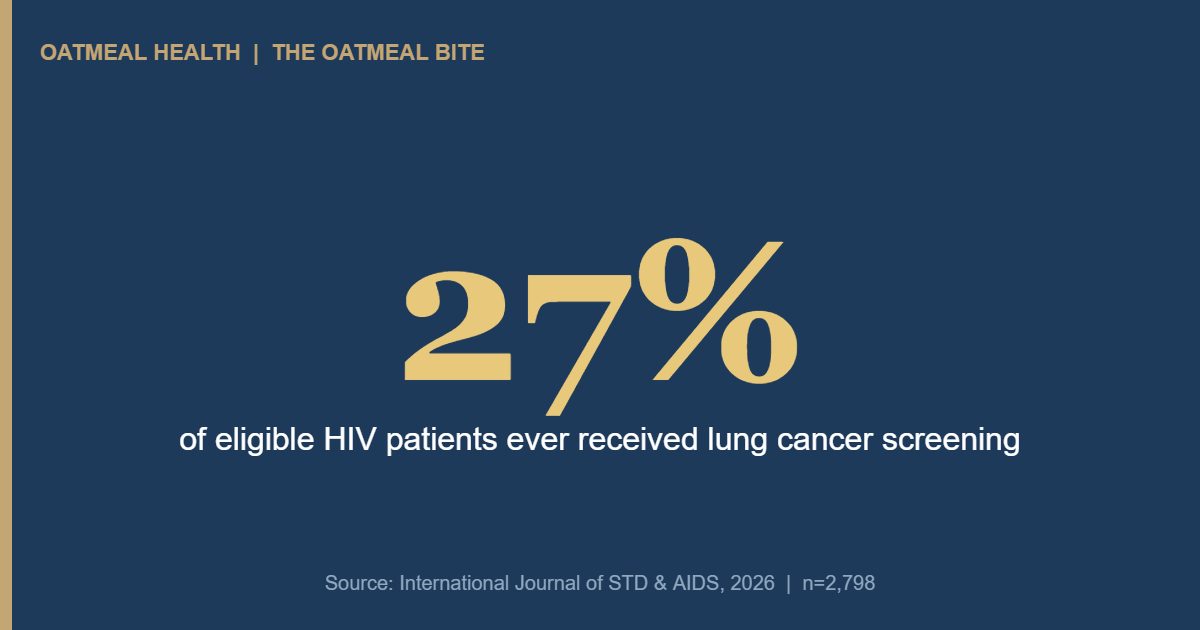
And yet a new study published in the International Journal of STD & AIDS — covered by The American Journal of Managed Care in October 2026 — found that fewer than 3 in 10 eligible patients living with HIV ever received a low-dose CT scan during a six-year study window.
That is not a guideline failure. The guidelines improved substantially in 2021.
That is not a coverage failure. Low-dose CT screening is covered for qualifying patients.
That is not a contact failure. These patients were already engaged in care, regularly seeing providers for antiretroviral therapy management.
That is an execution failure. And execution failures in healthcare are always preventable.
The Study Behind the Numbers
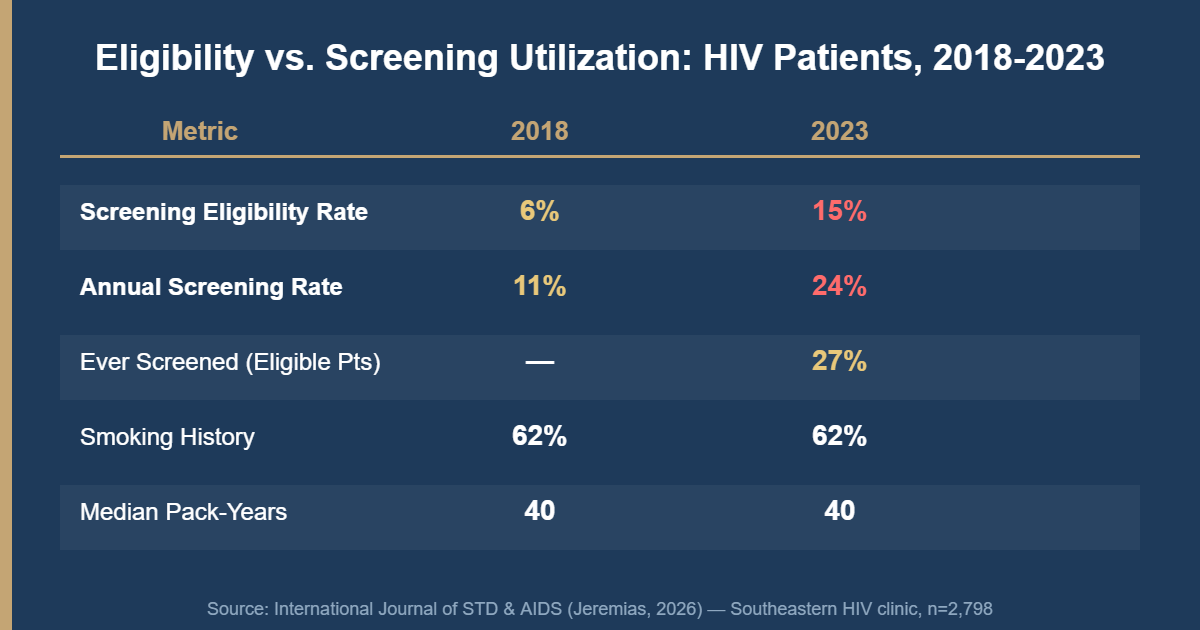
Researchers at a tertiary HIV clinic in the Southeastern United States tracked 2,798 people living with HIV across six annual snapshots from 2018 to 2023. The population was 74% male, 57% non-Hispanic Black, with a median age of 48 years. Sixty-two percent had a smoking history, with a median of 40 pack-years. Of those with a smoking history, roughly half — 51% — were still active smokers at the time of the study.
This is a high-risk population by any measure.
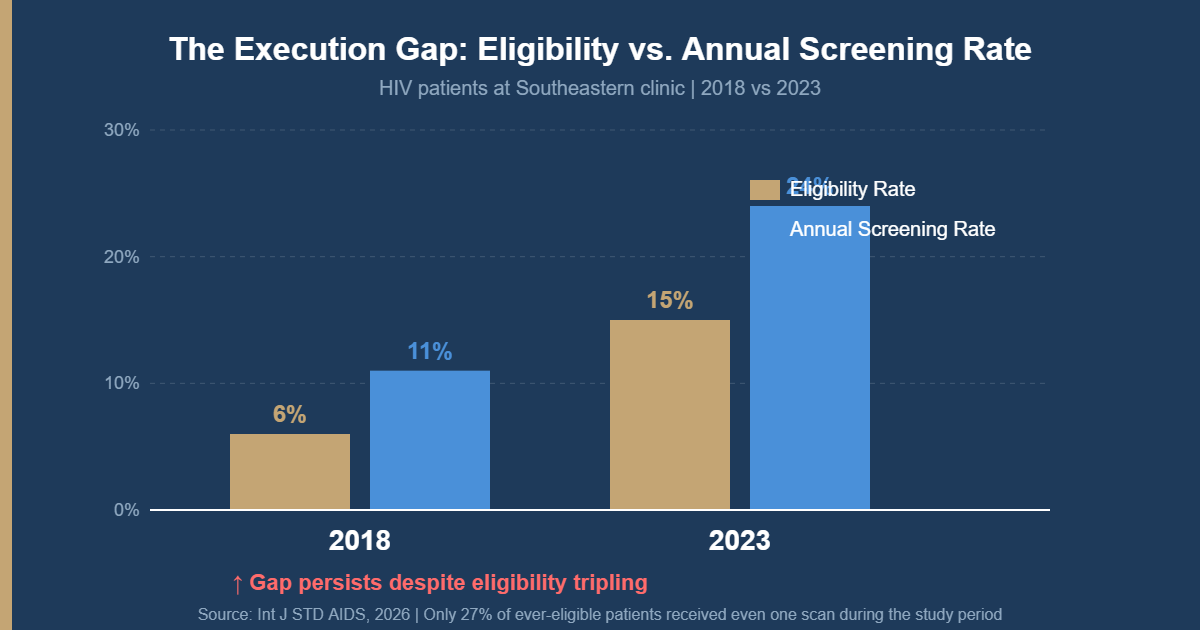
What happened to screening eligibility over those six years? It more than doubled. Eligibility jumped from 6% of the cohort in 2018 to 15% by 2023, driven largely by the 2021 USPSTF guideline revision that expanded criteria to include more patients.
What happened to actual screening utilization over those same six years? Almost nothing.
Annual screening rates moved from 11% in 2018 to 24% in 2023 — and that trend was not statistically significant. Fewer than 27% of ever-eligible patients received even a single low-dose CT scan during the entire study period.
The gap between who should be screened and who actually gets screened did not close as eligibility expanded. It simply got larger in absolute terms, because more people qualified while the system's capacity to convert eligibility into action stayed roughly the same.
The USPSTF Expansion That Changed the Landscape
To understand why eligibility nearly tripled, you need to understand the 2021 USPSTF revision.
Before 2021, the USPSTF recommended annual low-dose CT screening for adults aged 55 to 80 with at least a 30 pack-year smoking history who currently smoked or had quit within the past 15 years. That criteria excluded a meaningful portion of high-risk smokers — particularly those who started smoking earlier, those in younger age brackets, and disproportionately, Black adults who tend to develop lung cancer at lower smoking intensities.
The 2021 update lowered the age threshold to 50 and reduced the required smoking history to 20 pack-years. The impact was significant. The new criteria were expected to cover substantially more patients in previously underserved populations — including non-Hispanic Black patients who historically faced one of the largest eligibility gaps relative to their actual cancer risk.
For people living with HIV, the 2021 expansion was particularly meaningful. This population often has higher smoking rates than the general population, begins smoking earlier, and faces immune dysregulation that may independently elevate lung cancer risk beyond what pack-years alone would predict.
And yet the expansion of criteria did not translate into expanded uptake. In the study cohort, eligibility grew faster than screening. The gap widened.
Who This Population Is — and Why They Were Already in the Room
Here is the detail that makes this finding especially frustrating: people living with HIV are not hard to reach.
They are already patients. They have providers. They have regular appointments — often every three to six months for antiretroviral therapy management, lab monitoring, and care coordination. They are, on average, more engaged with the healthcare system than the general population precisely because effective HIV care requires ongoing clinical contact.
In other words, this is a population that was already in the room. Eligible patients were showing up. Clinicians were seeing them. Opportunities existed at nearly every appointment to flag eligibility and initiate the screening pathway.
What did not exist, in enough of those encounters, was the systematic process to convert that contact into a screening referral.
This matters enormously for how we think about the solution. When a person with HIV who qualifies for lung cancer screening does not get a low-dose CT scan, it is rarely because they are impossible to reach or disengaged from care. It is because no reliable mechanism existed to identify their eligibility in the workflow of an already-demanding clinical visit, prompt the provider, navigate the referral, and follow up to confirm the scan actually happened.
The average HIV clinic visit is dense. Viral load management, medication adherence, mental health screening, STI testing, opportunistic infection monitoring, social determinants assessment. Adding lung cancer screening eligibility calculation to that cognitive load, without system support, is asking providers to do something they are not resourced to do consistently.
The Three-Part Framework for Understanding the Gap
The study's findings point to a structural problem that shows up wherever high-risk populations and screening programs intersect. It can be organized into three reinforcing failures:
1. Eligibility expansion without embedded workflows creates the illusion of progress.
When guidelines expand — as they did in 2021 — the natural assumption is that more patients will now get screened. That assumption is wrong unless eligibility criteria are operationalized inside the workflows clinicians actually use. A guideline update that lives in a PDF is not an intervention. It is information. Information without a workflow is inert.
In the study cohort, eligibility tripled over six years. The system did not develop a proportional capacity to act on that expanded eligibility. The gap grew.
2. High-contact patient populations are screened at the same rate as low-contact populations when navigation is absent.
People living with HIV have far more clinical touchpoints than the average adult. More touchpoints theoretically means more opportunities to identify eligible patients and act. But touchpoints without navigation systems produce no better outcomes than rare touchpoints — because the identifying, prompting, and follow-through steps are not happening at any of them.
The result is a paradox: a deeply engaged patient population with access to regular providers still gets screened at rates indistinguishable from populations with no regular care contact. The frequency of contact is irrelevant without the workflow that converts contact into action.
3. EHR prompts, care navigation, and reminder workflows are not optional features. They are the intervention.
This is the core reframe. The scan itself is the clinical event. But the true intervention — the thing that produces the outcome — is the system that identifies the eligible patient, alerts the provider, facilitates the referral, tracks the order, confirms the appointment, and follows up when the scan does not happen.
In the absence of that system, screening eligibility is a number on a spreadsheet, not a life saved.
What the Evidence Says About EHR-Based Solutions
The research on EHR interventions for lung cancer screening has grown substantially in recent years, and the findings are instructive.
A patient-facing EHR tool called MyLungHealth, studied in a randomized clinical trial published in JAMA Oncology in December 2025, enrolled more than 31,000 adults aged 50 to 79 across University of Utah Health and NYU Langone Health. The intervention integrated detailed smoking history collection into patient portals and provided personalized lung cancer screening education — available in both English and Spanish.
The results were meaningful: among patients whose eligibility was previously unclear, the MyLungHealth intervention more than doubled the likelihood that eligibility would be clarified. Among already-eligible patients, low-dose CT ordering increased from 19.2% to 20.5%. Modest, but statistically and clinically real.
Separate research has found that EHR workflow prompt interventions — where ordering providers receive an alert when a patient meets screening criteria — can increase lung cancer screening by approximately 30%. The challenge is that even a 30% improvement still leaves more than half of eligible patients unscreened. EHR prompts are necessary but not sufficient.
What the evidence consistently points toward is a layered approach: identification via EHR criteria plus a prompt for the provider, combined with active patient navigation and reminder follow-through when orders are placed but scans are not completed.
For HIV clinics specifically, the study authors recommended integrating screening prompts directly into routine HIV care visit workflows, combined with patient navigation and reminder systems embedded in the HIV primary care infrastructure.
The Pattern That Repeats Across Every High-Risk Population
People living with HIV are not the only population where this gap exists. They are one of the clearest illustrations of it.
The same dynamic appears in rural communities where patients drive two hours to see a specialist and leave without a lung cancer screening referral because no one in the workflow was tasked with checking eligibility.
It appears in Federally Qualified Health Centers, where patients may be in care specifically because they are uninsured or underinsured — precisely the population where smoking rates are highest, where pack-year histories are most significant, and where a diagnosis of late-stage lung cancer is most likely to be catastrophic — and where the bandwidth for systematic screening identification is most constrained.
It appears in populations with high Medicaid churn, where coverage gaps interrupt the continuity needed to complete a screening pathway even when the referral was made.
The common thread is not a shortage of eligibility. The common thread is a shortage of systematic execution.
At Oatmeal Health, this is the gap we exist to address. The communities we serve — people who are uninsured, underinsured, facing Medicaid coverage uncertainty, with high tobacco exposure and competing life demands — qualify for lung cancer screening on paper. But paper does not get anyone a scan. They qualify. They show up to appointments. They are willing to be screened. What fails them is the absence of the infrastructure that converts willingness into an actual scan.
The Operational Playbook
For healthcare leaders designing or evaluating lung cancer screening programs for high-risk populations, the evidence points to a clear set of operational requirements:
Eligibility identification must be automated. Provider recall and manual chart review will not scale. EHR-based criteria matching that flags patients at the point of care — or generates a worklist before the visit — is the floor, not the ceiling.
The prompt must reach the right person at the right moment. A best-practice advisory that fires during prescription ordering is not the same as a flag that appears when the provider opens the visit note. Placement, timing, and alert fatigue all determine whether a prompt changes behavior.
Navigation must bridge the gap between referral and completion. Referral completion rates for cancer screening are consistently lower than the rates at which orders are placed. A patient who received an order for low-dose CT but never made the appointment or never showed up for it is not screened. Navigation — human or automated — that confirms the appointment was made and the scan was completed is what converts an order into an outcome.
Reminder workflows must close the loop. If a patient does not complete the scan, a reminder workflow should re-engage them. If the next clinical visit arrives without a completed scan, the eligibility flag should resurface. Passive screening programs that wait for the patient to act on a referral will not produce population-level outcomes.
Data must be tracked and reviewed. Screening rate by provider, by visit type, by patient risk category. Without measurement, improvement is invisible and accountability is impossible.
The Bottom Line
The study of lung cancer screening in people living with HIV published in October 2026 is not primarily a story about HIV. It is a story about the gap between policy and practice — between who qualifies and who gets served.
The 2021 USPSTF expansion was the right call. Expanding eligibility is how you draw a larger net. But the net only catches patients if something is running it systematically through the water.
Fewer than 3 in 10 eligible patients getting a scan is not a guideline problem. It is a systems problem. And systems problems have systems solutions.
EHR-embedded workflows. Patient navigation. Reminder and follow-up infrastructure. Screening rate measurement. These are not expensive moonshots. They are operational decisions. The question for every healthcare leader overseeing a high-risk population is not whether this gap exists in their system. It almost certainly does.
The question is whether they are going to build the infrastructure to close it.
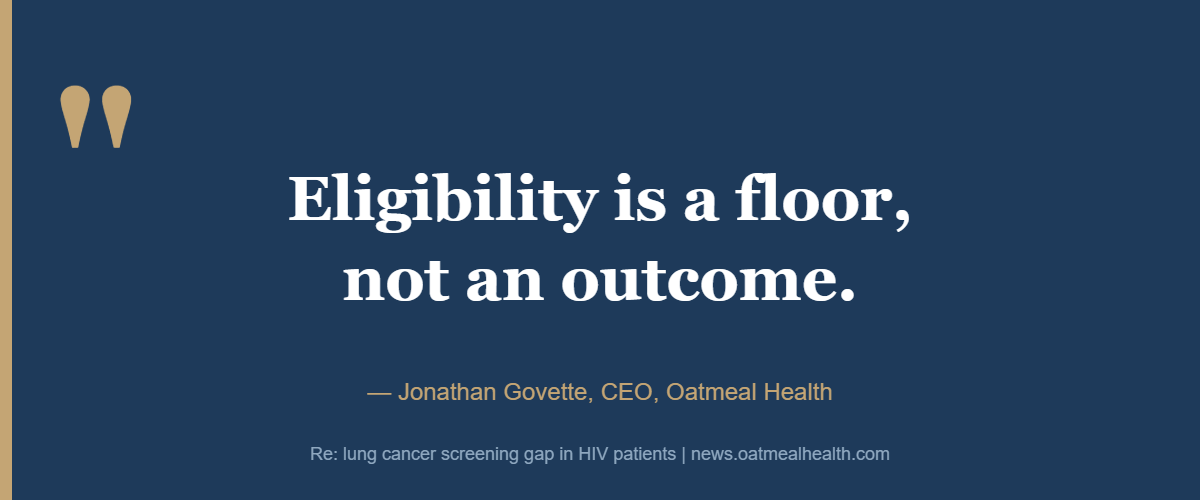
Eligibility is a floor, not an outcome.
Jonathan Govette is the CEO of Oatmeal Health, which delivers lung cancer screening access to uninsured and underinsured communities. For daily healthcare insights, follow Jonathan on LinkedIn. Deeper dives are published in The Oatmeal Bite on Substack.