


Every week since the One Big Beautiful Bill passed in July, a new headline has warned about the coming collapse of community health centers. Clinics closing. Rural hospitals on the brink. Safety-net providers disappearing from underserved communities.
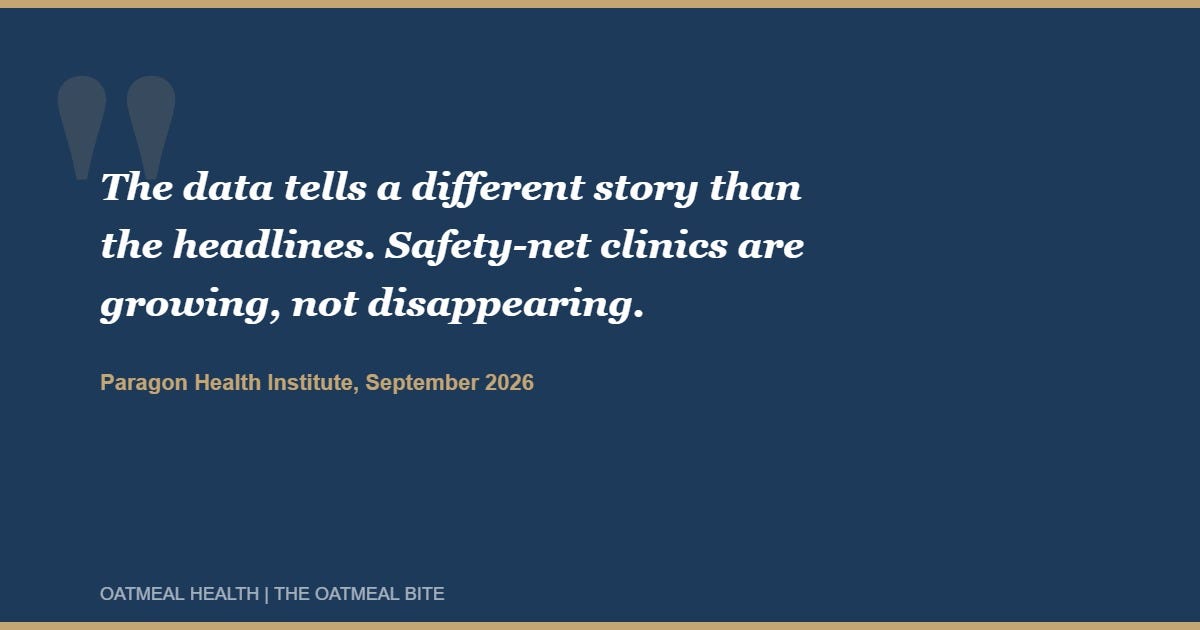
The problem with that narrative? The data does not support it. At least not yet.
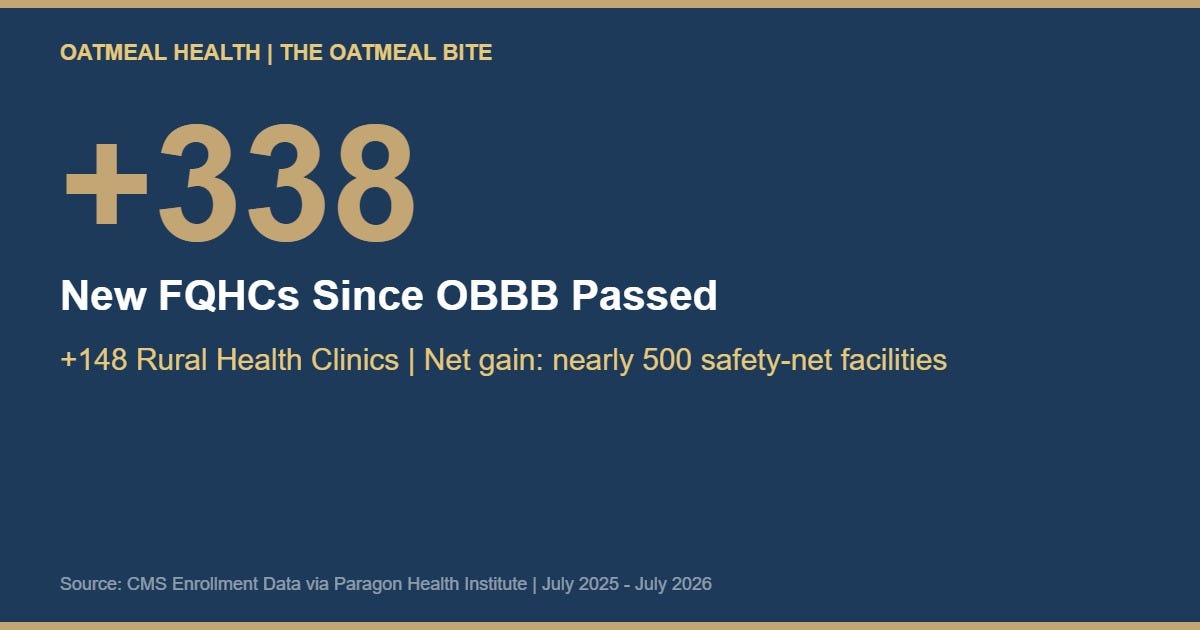
New enrollment data from CMS, analyzed by the Paragon Health Institute and published September 1, 2026, shows that Federally Qualified Health Centers and Rural Health Clinics have actually grown since OBBB passed. Not by a little. By nearly 500 net new facilities.
That does not mean everything is fine. The financial threats embedded in the legislation are real. But the panic about immediate mass closures appears premature. Here is what the numbers actually show, and why the real danger is more subtle than the headlines suggest.
The Data: +338 FQHCs. +148 RHCs.
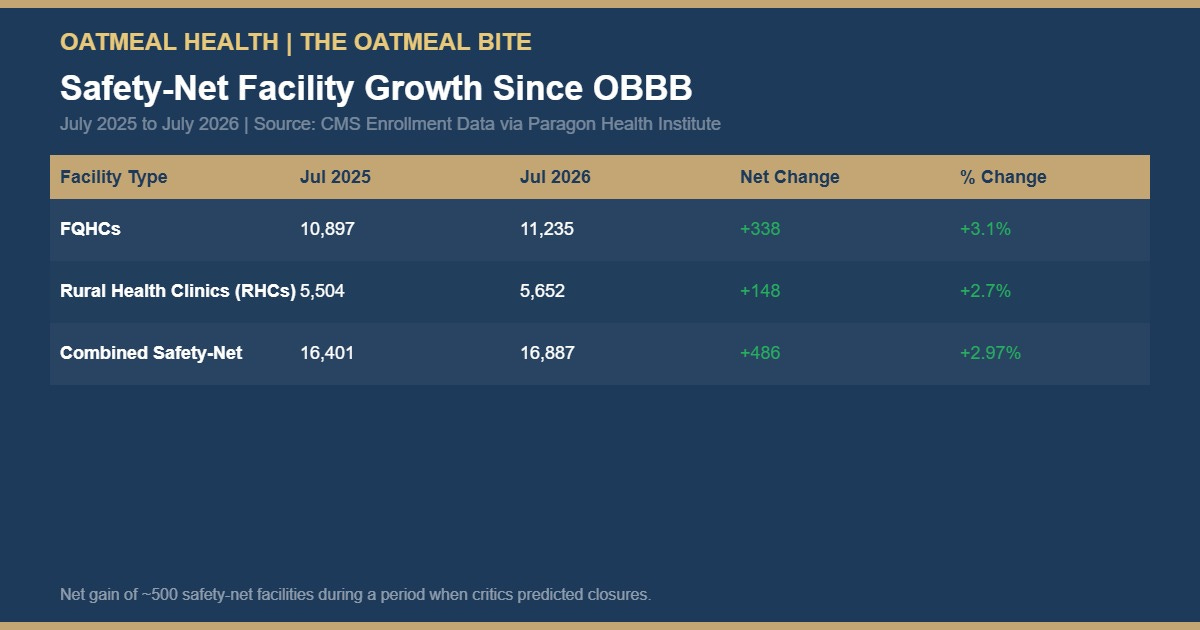
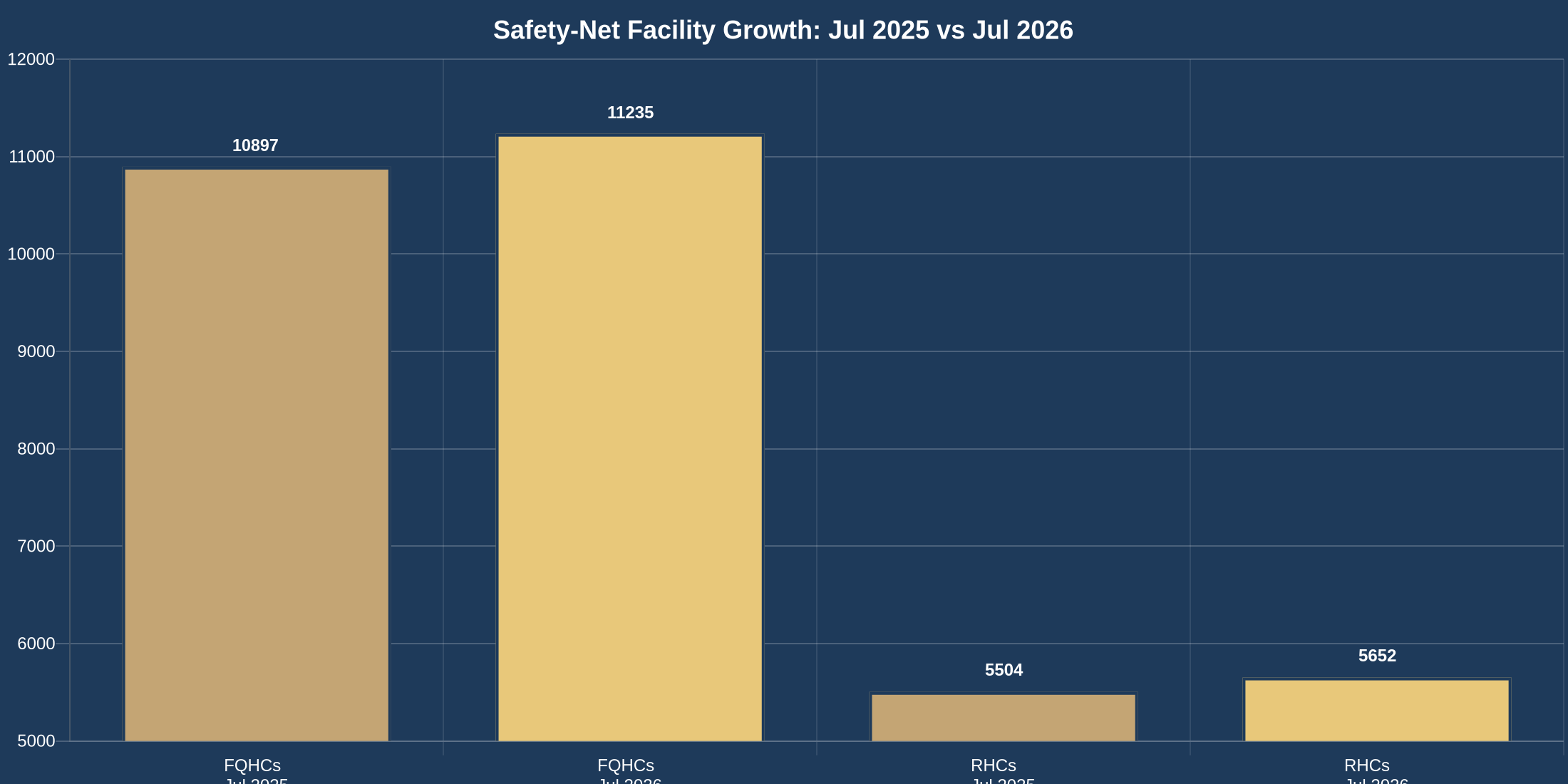
From July 2025 to July 2026, active FQHC counts rose from approximately 10,897 to 11,235. That is a net gain of 338 facilities, representing 3.1% growth in a single year.
Rural Health Clinics grew from roughly 5,504 to 5,652, a net gain of 148 facilities and 2.7% growth over the same period. Combined, the safety-net provider universe added nearly 500 facilities during a window when critics predicted the opposite.
Since Q4 2023, FQHCs have added roughly 1,400 net facilities. RHCs have added approximately 400. The community health center infrastructure has been expanding for years, and that expansion continued even as the legislative environment shifted.
Why Are FQHCs Growing if Medicaid Is Being Cut?
Lag effect: Medicaid cuts embedded in OBBB are phased in over years, not weeks. The projected $911 billion in reductions over 10 years does not hit all at once. Facilities opened before OBBB was signed are still operating on pre-cut revenue assumptions.
Rural Health Transformation Program: OBBB includes $10 billion annually from 2026 through 2030 specifically for rural health infrastructure. That investment is already incentivizing clinic expansions and new facility applications in rural markets.
Counts vs. finances are different metrics: A clinic can be open and growing its patient count while operating at a loss. The FQHC sector ran at a negative 2% average margin in 2024, before the OBBB cuts fully materialized. More facilities does not mean more financial stability.
Pipeline lag: Many of the 338 new FQHCs counted in July 2026 were in the HRSA approval pipeline long before OBBB passed. Approval cycles run 12-18 months. The growth we see today reflects decisions made in 2024 and early 2025.
Winners and Losers Under OBBB
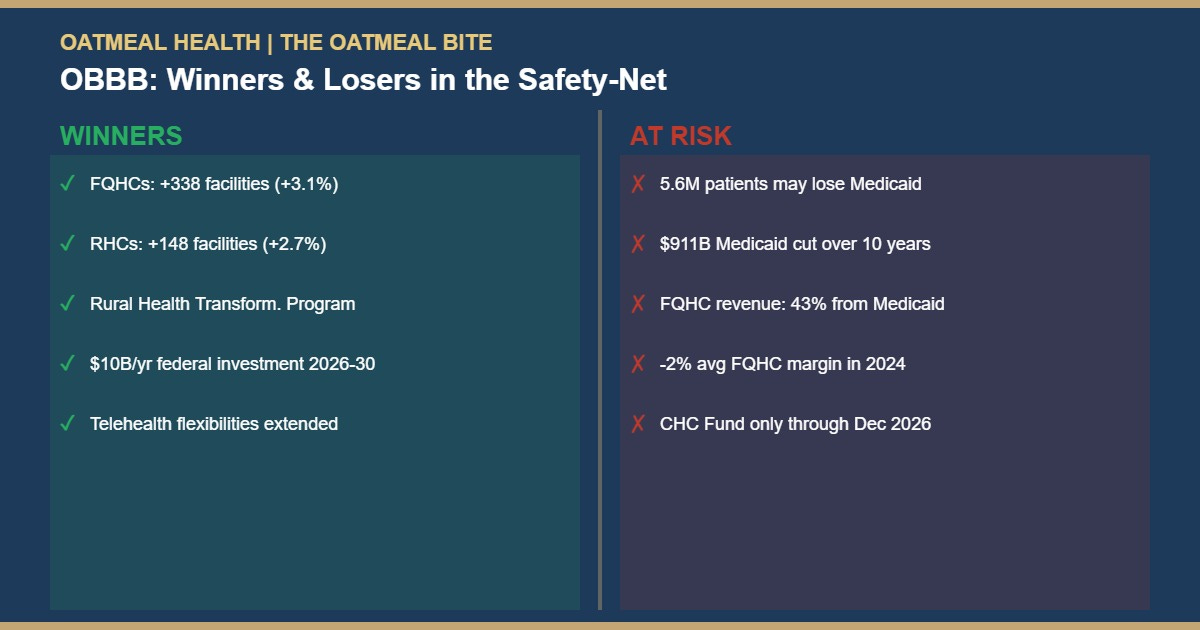
On the winning side: Rural providers with access to the Rural Health Transformation Program, telehealth-forward practices, and larger FQHC networks with diversified revenue and cash reserves. These organizations have the resources and runway to adapt.
On the risk side: Smaller urban FQHCs serving Medicaid-heavy populations, clinics operating on negative or near-zero margins, and organizations relying on the Community Health Center Fund, which is only authorized through December 2026. The $4.6 billion CHC Fund provides critical support for roughly 1,400 health centers.
The Commonwealth Fund estimates 5.6 million patients could lose Medicaid coverage under OBBB. Even if facilities stay open, a drop in covered patients directly reduces reimbursement revenue. An FQHC running at negative margin with 20% fewer covered patients does not survive long.
The Financial Architecture Is the Real Story
Raw facility counts look healthy. But pair them with financial data and a different picture emerges. FQHCs depend on Medicaid for 43% of their operating revenue. That is not a minority stream. That is the pillar holding up the business model.
The Community Health Center Fund provides direct federal support, but it is time-limited. If CHC Fund renewal becomes contested in late 2026, organizations that assumed it would continue will face an unexpected funding cliff in mid-2027.
What to Watch
CHC Fund reauthorization: Heats up in Q4 2026. A failure to reauthorize would be more immediately damaging than any Medicaid cut, hitting cash flow at hundreds of centers simultaneously.
FQHC margin trends in 2027: The 2026 numbers will still look relatively stable. 2027 is when Medicaid eligibility reductions start biting in earnest. Q1 2027 financials will be the first real signal.
Rural vs. urban divergence: The $10B Rural Health Transformation Program creates a structural split. Investment and partnership strategies should reflect it.
Strategic consolidation: Financially stressed smaller FQHCs will become acquisition targets for larger health systems and FQHC networks with capital and operational scale.
The Bottom Line
The narrative that OBBB immediately devastated community health centers is not supported by enrollment data. FQHCs and RHCs are growing, not shrinking, and the net addition of nearly 500 safety-net facilities since the legislation passed is a material data point that alarm-bell coverage has largely ignored.
That does not make the concerns wrong. The financial architecture of the FQHC sector is genuinely threatened by Medicaid cuts and CHC Fund uncertainty. The real story is not mass closure today but structural financial fragility arriving in 2027.
The organizations that thrive through this period will read the data clearly, not the headlines. The window to diversify revenue, build cash reserves, and position for strategic moves is open now. It will not stay open indefinitely.
The Oatmeal Bite covers healthcare economics, policy, and investment intelligence for executives and investors who need clarity, not noise. Subscribe below.