

The prior authorization process in American healthcare has functioned like a toll booth operated by someone who hates cars. Before a specialty drug reaches a patient, a physician must submit a request, a payer reviews it against criteria, a reviewer may ask for more documentation, the practice follows up, and eventually, days or weeks later, a decision arrives.
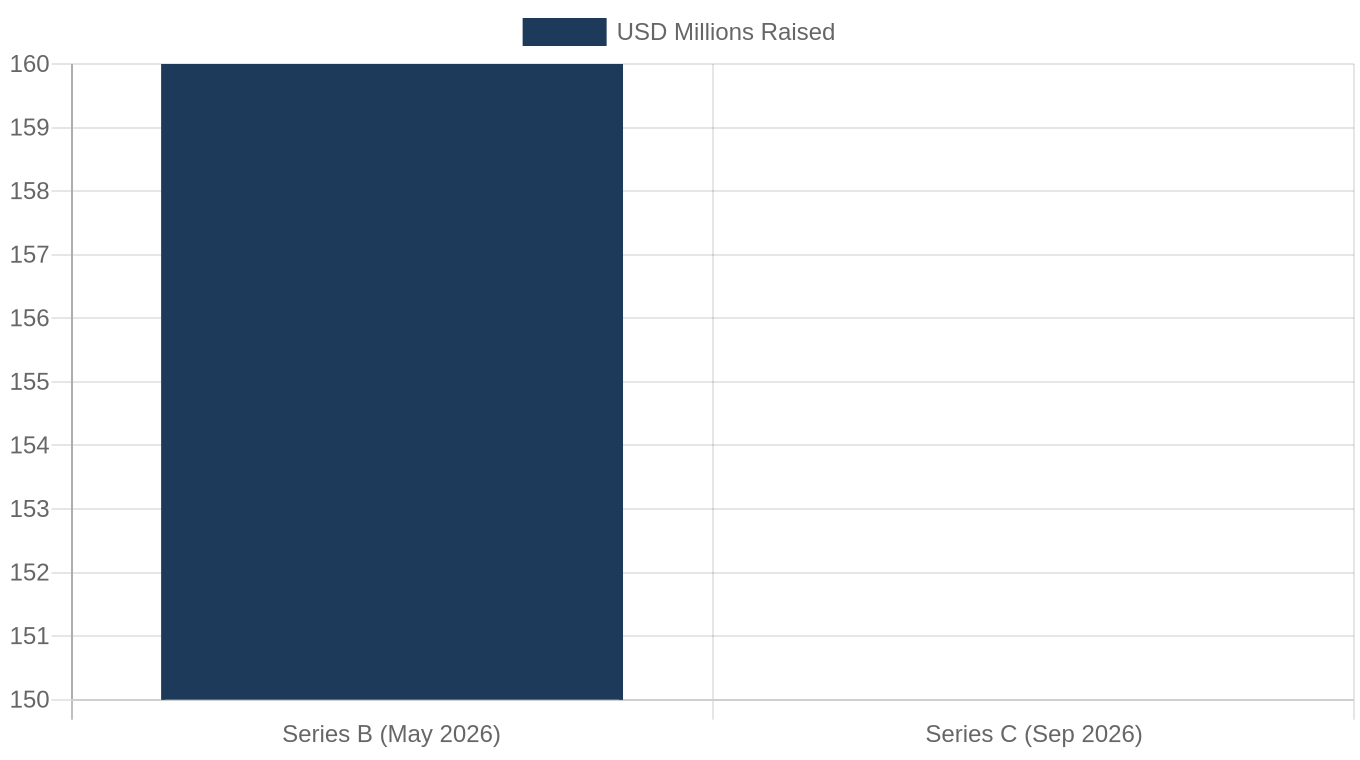
Forus Health built the AI infrastructure to collapse that timeline from weeks to hours. On September 13, 2026, the company announced a $150 million Series C funding round at a $3 billion valuation. Five of the top ten biopharma companies in the world are paying customers. The round was led by existing investors and marks the third major funding event for a company that did not exist three years ago.
This is not a story about automation for its own sake. It is a story about where the money flows in healthcare and why a company that sits at the intersection of biopharma revenue cycles and clinical workflow just became a $3 billion business.
What Forus Actually Does
Forus built an AI system that handles prior authorization submission from start to decision. The platform integrates with electronic health records, reads the clinical notes, identifies the relevant payer criteria, populates the authorization form, and submits the request. When the payer asks for additional documentation, the system handles that too.

The business model has two distinct revenue streams. Specialty medical practices pay a software subscription to use the platform. Biopharma companies pay Forus for patient support programs, because faster prior authorization means patients get on therapy sooner, which means biopharma companies recognize revenue sooner. The alignment between payer, practice, and manufacturer is unusually clean.
Forus was founded in 2023. By May 2026, it had raised a Series B that valued the company at $1 billion. Four months later, that valuation tripled.
The Prior Authorization Problem Is Not Small
Prior authorization was designed as a utilization management tool. In practice, it became one of the largest sources of administrative burden in outpatient medicine.

The American Medical Association estimates that physicians and their staff spend an average of 14 hours per week on prior authorization tasks. For specialty practices treating patients on complex biologics or branded specialty drugs, that number is higher. A single prior authorization request for a biologic therapy can require clinical notes, lab values, previous treatment history, and physician attestation, all assembled and transmitted to a payer in a specific format.
Practices that do this at scale develop specialized staff. Those staff spend their days on hold, navigating payer portals, and assembling documentation packets. When the volume of specialty patients grows, the bottleneck does not go away.
Forus removes the bottleneck. The AI reads the EHR data, knows the payer criteria, and handles the submission without manual assembly.
The Biopharma Revenue Angle
The most important thing to understand about Forus's business model is why biopharma companies pay for it.
When a physician prescribes a specialty biologic, the drug manufacturer does not recognize revenue until the patient is dispensed the drug. If a prior authorization takes three weeks, that revenue is delayed three weeks. If the prior authorization is denied, the drug may never be dispensed. If the patient abandons the prescription during the waiting period, the manufacturer loses the sale entirely.
Prior authorization abandonment, the rate at which patients simply stop pursuing a prescription when the process drags on, is a meaningful revenue risk for biopharma companies selling specialty drugs. Faster authorization means lower abandonment and faster revenue recognition.
Five of the top ten biopharma companies in the world now pay Forus for patient support programs built on this logic. The company does not disclose exact revenue figures, but sources close to the company describe annualized revenue running above $50 million.

What the Customer Data Shows
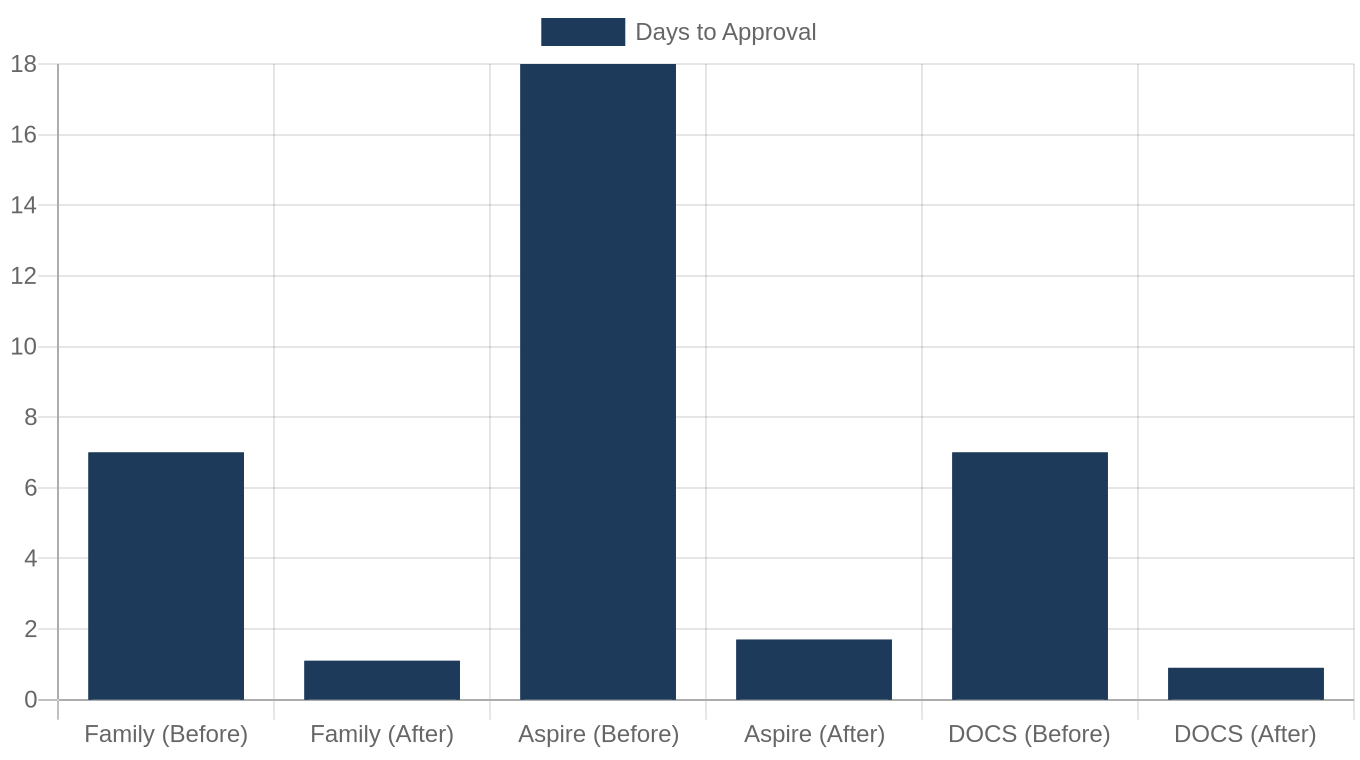
Forus has published outcome data from three high-profile specialty practice customers, each of which deployed the platform and measured the impact on turnaround time.
Family Allergy and Asthma treated prior authorization as a nursing workflow. The practice was spending significant nursing time assembling and submitting PA requests. After deploying Forus, median prior authorization turnaround dropped from more than seven days to 1.1 days. Nursing administrative burden fell 70 percent.
Aspire Allergy and Sinus described a process that could take two to four weeks from prescription to drug in hand. After Forus, the average turnaround was 1.7 days, with submissions occurring in under 24 hours.
DOCS Dermatology Group measured something different: patient access to medication. After deploying Forus, 80 percent more patients reached the point of actually starting their medication compared to the pre-deployment period. The implication is that a significant share of patients who were prescribed a specialty drug were never getting it, and the PA bottleneck was the reason.
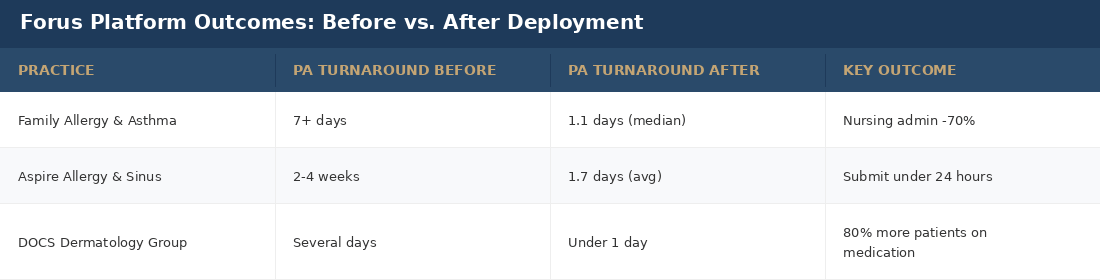
These are not marginal improvements. A 70 percent reduction in administrative burden, compressed from weeks to under two days, is the kind of performance gap that makes specialty practice adoption a straightforward decision.
Why the Valuation Tripled in Four Months
A $1 billion to $3 billion move in four months is unusual. Three factors explain it.

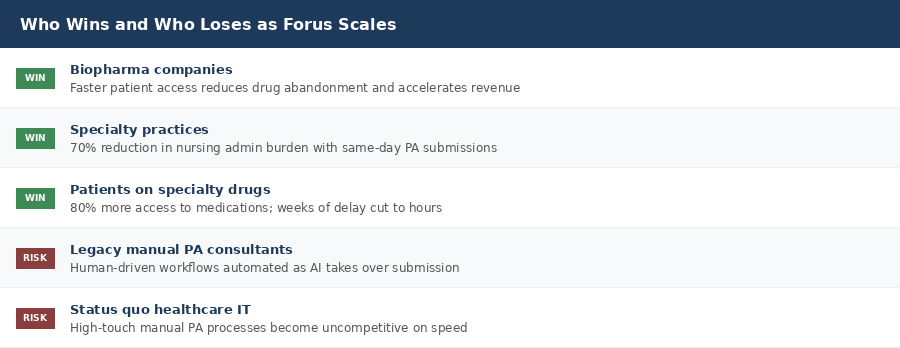
First, the biopharma revenue stream scales differently than the practice subscription business. As Forus adds biopharma partners, each partnership brings a patient population across all practices prescribing those drugs. The company does not need to sell to each practice independently to grow biopharma revenue. This is a leverage point that was probably undervalued in the May 2026 Series B.
Second, Forus announced 85 percent U.S. ZIP code coverage across all 50 states. Coverage at that scale means the platform can serve the entire national footprint of large specialty networks. It removes a geographic constraint on enterprise deals.
Third, five of the top ten biopharma companies are already paying customers. Investors can see the revenue concentration, the contract structure, and the renewal dynamics. The revenue quality implied by large biopharma contracts with alignment to patient access programs is high.
The AI-in-Healthcare Credibility Test
Most AI-in-healthcare companies fail on one of two vectors: they cannot demonstrate clinical workflow integration, or they cannot demonstrate measurable outcomes. Forus passes both tests.
The platform integrates with existing EHR systems, which is the first filter any health IT vendor must clear. Integration at scale with major EHR platforms is technically difficult and requires sustained engineering investment. Forus built this infrastructure from the ground up between 2023 and 2026.
The outcome data is measured in business terms that both practices and biopharma companies understand. Days to authorization, nursing hours saved, and percentage of patients reaching therapy are numbers that appear in practice management reviews and biopharma access program reports. They are not constructed metrics.
The combination of technical integration and measurable outcomes, delivered at a scale covering 85 percent of U.S. ZIP codes, explains why five of the top ten biopharma companies are paying customers rather than running pilot programs.
Deep Dive: How the Platform Works
Forus's technical architecture reflects a fundamental insight about prior authorization: the information required to complete an authorization request already exists in the patient record. The prior authorization process fails not because the information is unavailable but because assembling and transmitting that information requires manual labor.
Forus addresses this by treating prior authorization as an information retrieval and formatting problem. The AI ingests EHR data, identifies which elements of that data are relevant to the payer's criteria for the specific drug being authorized, formats that information according to the payer's submission requirements, and initiates the request.
When a payer requests additional documentation, the system identifies what was missing, pulls the relevant information from the EHR, and submits the peer-to-peer or additional documentation response. Human staff monitor exceptions rather than managing the full queue.
The biopharma integration layer adds a second data stream. When a biopharma company partners with Forus, the platform can incorporate drug-specific criteria, assistance program eligibility, and patient support resources into the authorization workflow. A patient whose PA is submitted through Forus for a drug from a biopharma partner gets the manufacturer's patient support resources surfaced at the point of authorization rather than as a separate downstream step.
What This Means For You
If you run a specialty practice, you already know the problem Forus is solving. The question is not whether AI can handle prior authorization. The outcome data from Forus customers is clear on that. The question is timing and switching cost.
The practices that deployed Forus early are seeing 70 percent reductions in nursing administrative burden and median turnaround times under two days. The practices that are still running manual processes are losing patients to abandonment at rates they may not be measuring.
If you work in specialty pharma, the math is straightforward. Faster prior authorization means faster time on therapy, which means faster revenue recognition and lower abandonment. The biopharma companies already in the Forus ecosystem have made this calculation. Five of the top ten have made it. The question for the other five is how long they wait.
If you are watching healthcare AI from an investment perspective, the Forus model offers a template: find a workflow where the information already exists but the labor cost of assembly and transmission is high, build AI infrastructure that eliminates that labor, and create a revenue model that aligns with the economic interests of every party in the transaction.
The Funding Numbers
Total funding for Forus now exceeds $300 million. The Series B in May 2026 valued the company at $1 billion. The Series C in September 2026, four months later, valued the company at $3 billion.
The round was led by existing investors. No new lead investor was named, which typically indicates that existing investors exercised conviction to maintain or increase ownership at a higher valuation rather than bringing in new capital to validate the price.
The $150 million Series C follows a $160 million Series B. The funding pace, more than $310 million across two rounds in less than five months, is consistent with a company deploying capital against a large, addressable market with demonstrated revenue.
*The Oatmeal Health newsletter covers healthcare AI, digital health, and health policy news that matters for clinicians, operators, and investors. Published daily at news.oatmealhealth.com.*
*Jonathan Govette is the co-founder and CEO of Oatmeal Health, an AI-powered lung cancer screening startup helping radiologists identify malignant nodules on low-dose CT scans.*