


For the first time, there's a cross-vendor, independent channel for reporting clinical AI failures in imaging. What it means for how you buy, deploy, and oversee AI tools.
Here's a scenario that probably sounds familiar.
Your radiology department added an AI-assisted detection tool six months ago. The vendor showed you validation data. FDA clearance was confirmed. Sensitivity numbers looked strong. You ran a pilot, clinicians gave mixed feedback but nothing alarming, and you rolled it out.
Six months later, you still don't have a clean picture of how often the AI is wrong in your specific environment, on your patient mix, with your protocols. When errors happen — and they do — they get absorbed into the normal QA loop or they don't get captured at all. If the vendor's AI is systematically underperforming on a certain case type, you might not find out for months. You'd have no way of knowing whether the same thing is happening at other hospitals using the same tool.
That information gap is precisely what ECRI just started trying to close.
On August 25, 2026, ECRI — the independent, nonprofit patient-safety organization that has run a problem-reporting network for medical devices since 1972 — announced it was expanding that network to explicitly capture errors, malfunctions, and near misses involving AI tools and AI-enabled devices in patient care. That includes diagnostic imaging AI. That includes the tools running on CT, MRI, and chest X-ray reads at your institution right now.
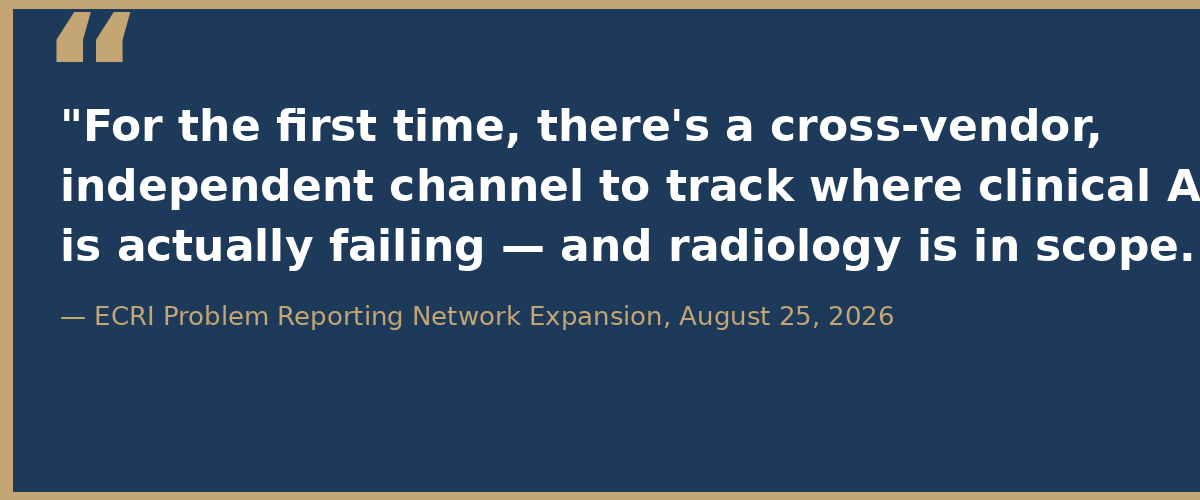
This is the first independent, cross-vendor channel built specifically to track clinical AI failures in real-world use. And it changes the vendor evaluation question significantly.
The Survey Numbers That Explain Why ECRI Did This
ECRI didn't build this in a vacuum. They paired the announcement with survey data that makes the case for why it matters.
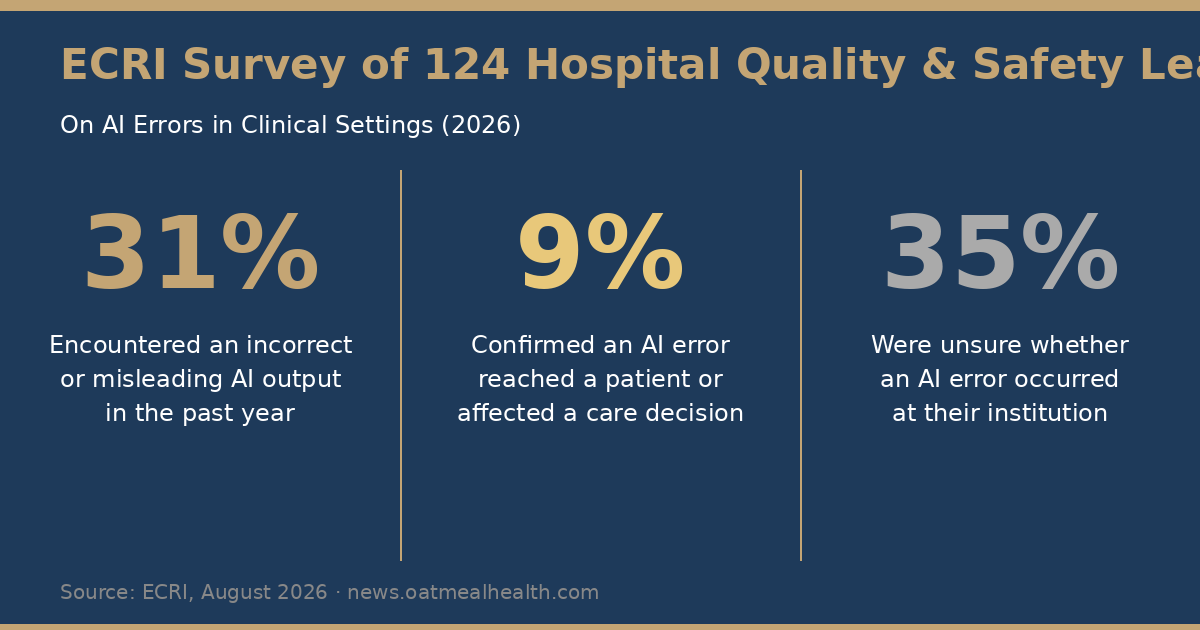
Of 124 hospital quality, safety, risk, and compliance leaders they surveyed, 31% said they had encountered an AI output they believed was incorrect or misleading over the past year. That's nearly one in three hospital quality leaders saying: yes, I have personally seen a clinical AI tool produce something wrong.
The number that should give you pause is the one after that: 9% said an AI error actually reached a patient or affected a care decision. Not just a near miss. Not just a flag that a radiologist caught before it went anywhere. An error that made contact with patient care.
And then there's the third number: 35% said they simply weren't sure whether an AI error had occurred at their institution.
Read those three numbers together and you get a picture of an industry where nearly a third of quality leaders have seen a wrong AI output, one in ten have seen that error reach a patient, and more than a third don't have enough visibility to know either way.
"Although we appreciate AI's tremendous potential, we don't yet have a clear picture of its downstream impact in healthcare," said Scott Lucas, PhD, ECRI's vice president of devices, therapeutics, and technology. What it means in practice is that the field has deployed clinical AI broadly without a systematic mechanism to understand where it fails.
ECRI's network is intended to be that mechanism. It accepts reports on any AI tool a provider encounters — not just products from vendors who opt in. It's free and confidential for the organizations submitting reports. ECRI's clinical and engineering staff triage what comes in, investigate, and issue hazard reports back to manufacturers, providers, and regulators when they find a real safety risk.
This Isn't the First Time ECRI Flagged the Problem
Context matters here: ECRI flagged AI diagnostic risk as its #1 patient safety concern for 2026. Not one of ten concerns. The top one.
Their annual Top 10 Patient Safety Concerns report, released in March 2026, put AI diagnostic risk at the head of the list — above sepsis identification, above surgical complications, above medication errors. Some of the specifics they cited are worth sitting with.
In simulated evaluations, some machine learning models failed to recognize 66% of critical or deteriorating health conditions. Not a small gap in performance. Two-thirds of the most urgent cases, missed.
ECRI also flagged that certain cancers and rare diseases remain particularly difficult for AI to detect in radiology studies — which is exactly the clinical context where a missed detection carries the highest stakes. If your AI is adding false confidence on a case type where sensitivity is lowest, the human review that should catch it becomes less likely to happen.
Why FDA Clearance Doesn't Answer the Question You're Actually Asking
This is the conceptual shift that ECRI's network forces.
FDA clearance — typically via the 510(k) pathway for AI-assisted diagnostic tools — is a premarket determination. It answers one question: does the evidence submitted before launch support this device's claimed use case well enough to reach the market? It evaluates the data the vendor brings to FDA before the product ships.
It does not continuously monitor how the tool performs once it's running in your PACS, on your patient population, with your radiologists reviewing its outputs.
That postmarket gap is where clinical AI failures actually live. A model can pass a premarket validation with a specific dataset and then perform differently on real-world data that looks slightly different — different scanner protocols, different population characteristics, different case mix. Vendors have their own internal QA programs, but those are proprietary and reported on the vendor's own terms.
Until now, there was no cross-vendor, healthcare-specific mechanism to catch systematic patterns in postmarket AI failures. That's exactly what ECRI is building. It's not a regulatory body and it's not replacing FDA oversight. It's a voluntary reporting channel with independent triage and investigation.
What Radiology Specifically Is Facing
Radiology is both the leading edge of clinical AI adoption and the clinical context where the stakes of an error are highest.
The commercial AI market for radiology has expanded significantly — there are now more than 170 commercially available AI products for radiology with published scientific evidence, spanning chest imaging, neuroradiology, MSK, and beyond. Major health systems have deployed AI for chest X-ray triage, CT pulmonary embolism detection, intracranial hemorrhage flagging, nodule tracking, and mammography screening.
Automation bias in radiology is a documented phenomenon: radiologists reviewing AI-assisted reads have been shown to be more likely to miss findings the AI misses, and to accept AI flags that are incorrect, compared to unassisted reading. The AI shapes what gets attention. That's feature and risk at the same time.
ECRI's network doesn't eliminate automation bias. But it creates, for the first time, a mechanism to discover when a specific tool is generating systematic errors that affect the reads that happen on top of it.
The Vendor Evaluation Question This Changes
For anyone responsible for selecting, contracting with, or overseeing a radiology AI vendor, ECRI's expansion changes the checklist.
The default first question in vendor evaluation has been: is this FDA-cleared? That's still the right baseline. But on its own it tells you only that the tool passed a premarket bar. It doesn't tell you what happens the day it produces a wrong output on a patient at your institution.
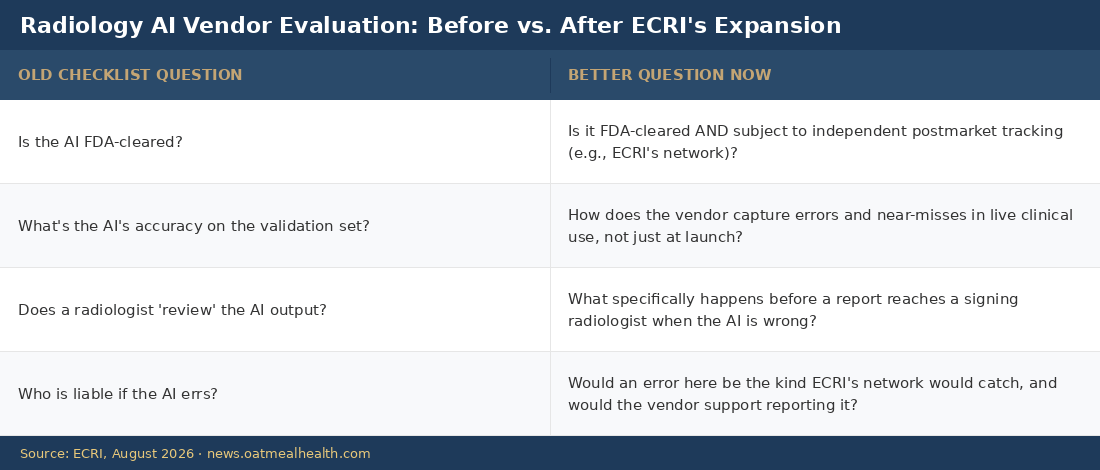
The third question on that table is the most important one for day-to-day clinical governance. "Does a radiologist review the output" is the wrong frame because it describes a role, not a process. What you actually want to know is: at what point in your specific workflow does a qualified clinician review the AI output before it becomes actionable? What's the escalation path when the AI flags something uncertain?
What This Means for Payers
Payers are paying for radiology reads that increasingly involve AI assist, and in some cases paying for AI-specific services. The ECRI development is relevant to payer coverage and quality oversight for at least two reasons.
First, if AI diagnostic tools are contributing to clinical decisions that drive utilization — a tool that over-flags nodules driving more follow-up imaging, for example — payers have an interest in whether those tools are performing as intended in the real-world patient populations they insure. The postmarket surveillance gap ECRI is trying to fill is a payer problem too, not just a provider problem.
Second, as prior authorization processes evolve and AI plays a larger role in both prior auth decisions and the clinical documentation supporting them, the question of AI accuracy in clinical contexts becomes directly relevant to payer risk.
Payers writing or renewing coverage policies for AI-assisted diagnostic services should be watching what emerges from ECRI's reporting network.
What Health Systems and Radiology Groups Should Do Right Now
This isn't a watch-and-wait situation. Five actions worth taking in the next 90 days:
Audit what you have deployed. If your radiology department has multiple AI tools running across modalities, map them. Who owns oversight for each? Who reviews performance? Is there a postmarket tracking process that sits outside the vendor's own QA reporting?
Update your vendor contracts. Add language requiring vendors to notify you when ECRI or any other independent body issues a hazard report on their product. Require vendors to disclose known performance variations across patient populations or imaging protocols.
Review your human-review checkpoints. For each AI tool in your radiology workflow, confirm there is a documented, enforced step where a qualified clinician reviews the AI output before it becomes actionable. Not assumed. Documented.
Start reporting. ECRI's network accepts reports from clinicians, health systems, and risk management leaders. If you have encountered an AI error or near miss, report it. The 35% who said they weren't sure if an AI error had occurred are exactly the organizations ECRI needs to hear from.
Ask vendors the new checklist questions. At your next vendor review, specifically ask what the vendor's process is when a hazard report is issued about their product. Ask how they capture and act on postmarket errors that aren't in their own internal QA system.
The Bigger Picture
What ECRI built is infrastructure. It doesn't immediately fix the postmarket surveillance gap. It creates the mechanism through which data about that gap can flow.
The historical analogy is instructive. Aviation built its incident reporting culture over decades — mandatory reporting for certain events, voluntary reporting protected from punitive use, independent investigation of patterns. The result is a safety record that's dramatically better than most industries operating equally complex technology at comparable scale.
For clinical AI specifically, there was no industry-wide reporting mechanism at all until August 2026. ECRI's expanded network won't produce aviation-level data overnight. But the direction is right.
For radiology — the clinical specialty that has adopted AI fastest and built the most direct cognitive reliance on it — this matters more than anywhere else. The tools reading your CT scans are generating outputs that shape clinical decisions. Now there's a place where what goes wrong gets tracked across every vendor, every hospital, every scan.
The question now is whether the institutions deploying these tools will use it.
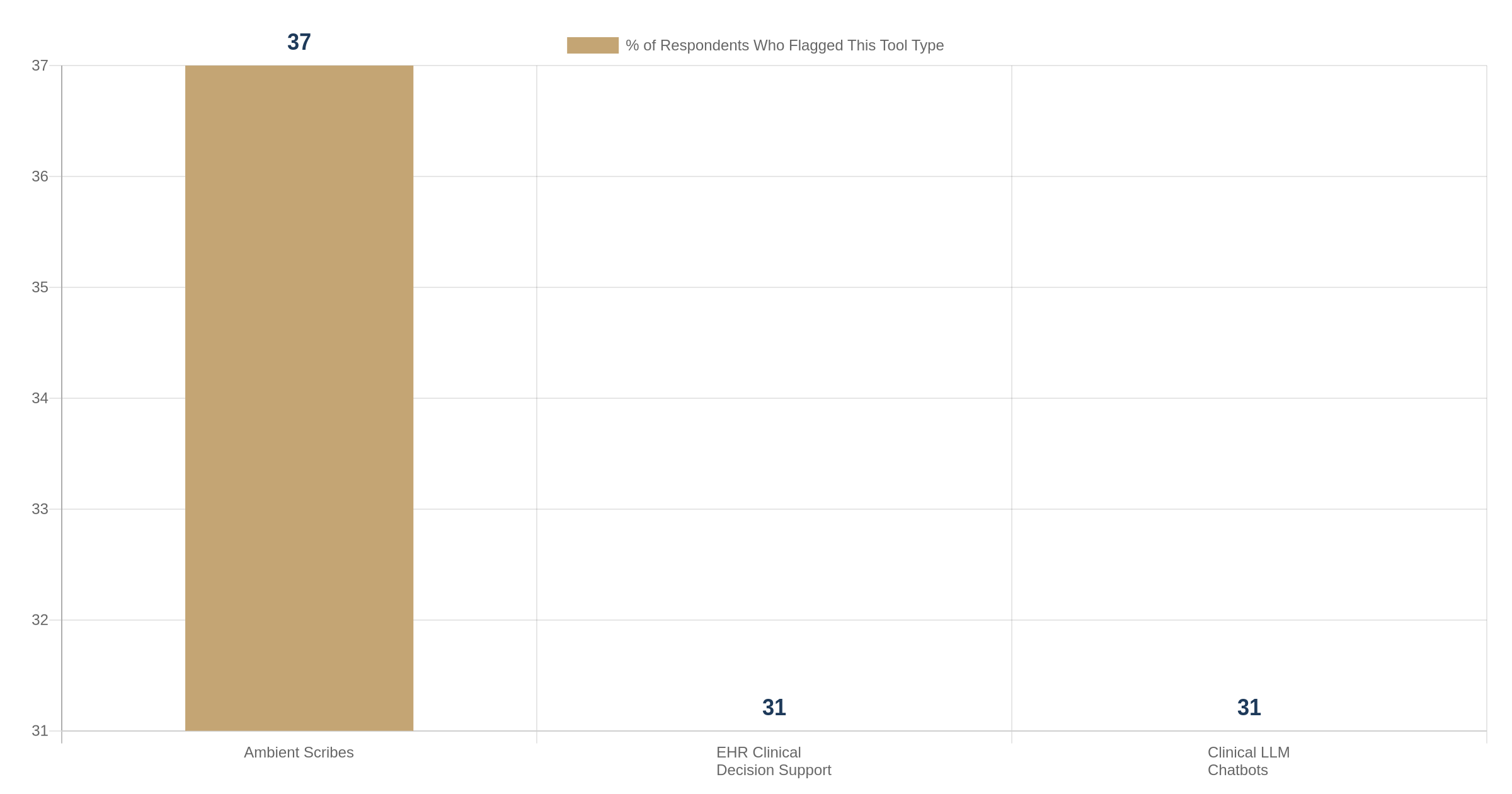
ECRI's Problem Reporting Network is free and confidential for healthcare providers. Reports can be submitted at ecri.org. The expanded network covers AI tools and AI-enabled devices across diagnostic imaging, clinical decision support, and ambient documentation.
Sources: ECRI press release (PR Newswire, August 25, 2026); AuntMinnie, "ECRI expands reporting network to track AI errors in patient care" (August 2026); Association of Health Care Journalists, "AI diagnostic risks top ECRI's 2026 patient safety concerns" (March 2026).