
Congress just introduced a bill that could reshape how 300 million Americans receive medical care. The Doctors Not AI Act (H.R. 10210), introduced September 1, 2026 by a bipartisan group of lawmakers, takes direct aim at one of the most contentious issues in modern healthcare: the use of artificial intelligence to deny insurance claims.
The bill's name is blunt. So is its intent. Insurers cannot let an algorithm have the final say over whether you get surgery, a specialist referral, or a life-saving scan. A licensed human physician must review and sign off. That sounds obvious. It is not yet law. This bill aims to make it so.
The Problem: AI Rubber-Stamping Denials at Scale
Prior authorization (PA) was designed as a cost-control mechanism: before a physician performs a procedure, they ask the insurer for approval. In theory, a qualified clinician reviews the request and approves or denies based on medical evidence. In practice, that review is increasingly being done by an algorithm trained to protect the insurer bottom line.
The American Medical Association 2026 Prior Authorization Physician Survey documented the scale of the problem in stark terms.
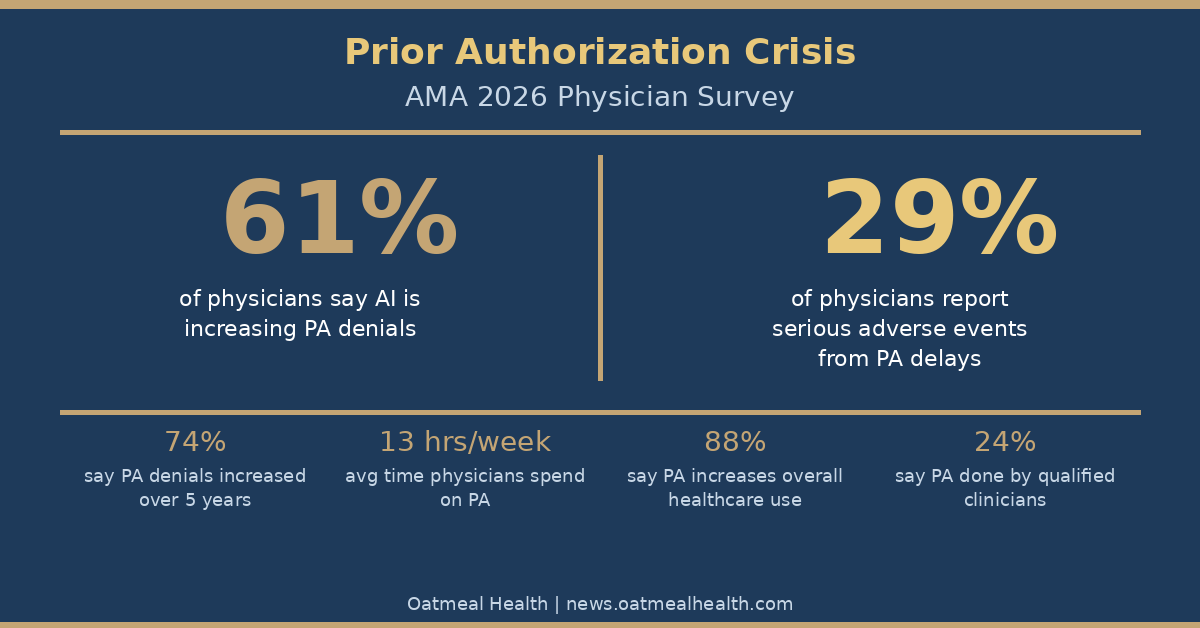
61% of physicians say AI tools are increasing the number of prior authorization denials they face. That is not a fringe concern from a handful of disgruntled doctors. It represents the consensus view of the people at the frontlines of patient care.
More alarming: 29% report serious adverse patient events directly attributable to PA delays. The AMA defines serious adverse events to include patient death. Twenty-nine percent. One in three physicians has watched a patient suffer real, documented harm because an insurer system said no.
Physicians spend an average of 13 hours per week on prior authorization work, time pulled directly from patient care. And 74% say the number of PA requirements has increased significantly over the past five years, precisely as insurers have deployed AI at scale. Only 24% of physicians believe their PA requests are reviewed by a clinician with the appropriate qualifications.
The Insurers: Denial by Design
The PA denial crisis does not happen uniformly. Some insurers are far more aggressive than others, and the data reveals a troubling pattern.
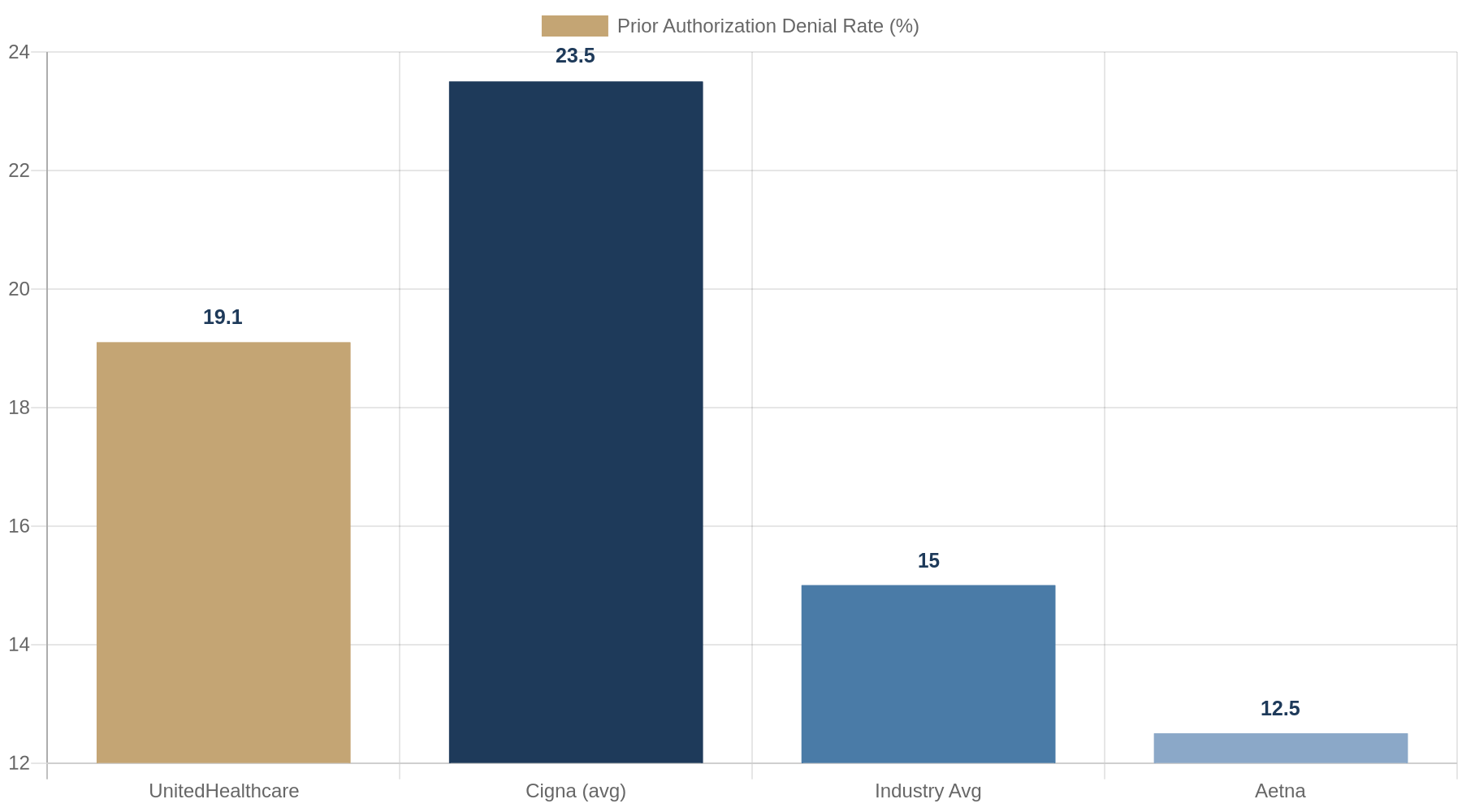
UnitedHealthcare, the largest U.S. health insurer, maintains a denial rate of 19.1% across its claims. Cigna rates vary widely, reaching 30% in some markets. Industry averages hover around 15%, but averages obscure the reality for millions of patients on plans with higher rates.
AI-driven PA decisions carry denial rates 40% higher than human-reviewed decisions, according to AMA analysis. The math is unambiguous: deploy AI, deny more claims, save money in the short run. The human cost does not appear on the insurer balance sheet.
UnitedHealth Group is spending approximately .5 billion on AI in 2026. A portion of that investment runs directly through the prior authorization pipeline. That is not inherently wrong. AI can speed legitimate reviews and catch fraud. The problem is when AI makes the final call on whether a patient gets care.
H.R. 10210: What the Bill Actually Does
The Doctors Not AI Act was introduced by Representative Greg Landsman (D-OH), with bipartisan cosponsors Representative Buddy Carter (R-GA), Representative Kim Schrier (D-WA), and Representative Tom Barrett (R-MI). It was referred to the House Committees on Energy and Commerce, Ways and Means, and Education and Workforce.
The bill core provisions:
1. AI cannot issue final denials. No group health plan or health insurance issuer may use an AI system to make or finalize a clinical determination that results in a denial of a claim. The algorithm can flag, filter, and recommend, but it cannot decide.
2. Licensed human clinicians must review. Every PA denial must be reviewed and signed off by a licensed physician or other appropriate healthcare professional. The reviewer must hold credentials relevant to the medical specialty involved in the claim.
3. AI output cannot be presumptively valid. Insurers cannot treat the output of an AI system as automatically correct or as the default position in a coverage dispute. AI recommendations are inputs, not conclusions.
4. Patients must be informed. When AI is used in the review of a claim, patients must be notified. Transparency requires disclosure.
5. Mental health and substance use disorders are specifically protected. The bill includes explicit protections for behavioral health PA requests, an area where algorithmic denial has been particularly prevalent and harmful.
Why This Matters for Lung Cancer Screening
At Oatmeal Health, we focus on low-dose CT (LDCT) lung cancer screening for high-risk patients. LDCT is one of the most evidence-backed preventive interventions in modern medicine, with a Grade B recommendation from the U.S. Preventive Services Task Force. It saves lives. It is also routinely denied.
Prior authorization barriers are one of the primary reasons eligible patients do not complete LDCT screening. Physicians order it. Insurers PA systems flag it. Physicians fight the denial. Patients wait. Sometimes the cancer does not.
The ECLIPSE trial and other landmark studies have demonstrated that LDCT screening can identify early-stage lung cancer when it is still curable. Stage I five-year survival rates exceed 90%. Stage IV rates fall below 10%. The stage at which cancer is caught is largely determined by whether the patient was screened.
When an AI system denies an LDCT screening request in 0.3 seconds based on billing code pattern matching, it is not doing clinical medicine. It is doing cost accounting. The Doctors Not AI Act would require a qualified human clinician to make that call.
The Political Reality
The bill faces significant headwinds. Insurance industry lobbying is substantial, and arguments about AI efficiency and fraud prevention will be deployed aggressively. The bill is in early committee stage with a long road ahead.
The bipartisan framing is its strongest asset. Healthcare access is not a left-right issue for the patients being denied care. Republicans and Democrats alike have constituents who have fought insurance denials. The bill cosponsors reflect that reality.
There is also a broader regulatory tailwind. The Centers for Medicare and Medicaid Services has increased scrutiny of Medicare Advantage prior authorization practices. Several states have passed or are advancing PA reform legislation. The federal momentum is building, even if this particular bill does not become law in this session.
What Should Happen Next
The Doctors Not AI Act reflects a correct diagnosis. The treatment should be proportionate. AI in healthcare is not inherently dangerous. AI making unsupervised final decisions about patient care is.
The right framework distinguishes between AI as a tool and AI as a decision-maker. Algorithms can surface relevant clinical evidence, flag potential drug interactions, identify records that warrant closer review. What they should not do is substitute for the clinical judgment of a licensed professional who has reviewed the actual patient circumstances.
For insurers, voluntary adoption of the bill principles ahead of any legal requirement would be both ethically appropriate and strategically sound. The reputational damage from well-publicized AI-driven denials is accumulating. Proactive reform is preferable to reactive damage control.
For patients, the practical message is to document everything. If you receive a prior authorization denial, request the specific clinical criteria used to deny the claim and whether a human clinician reviewed it. Many states require disclosure. Use the appeals process. Denials are frequently overturned on appeal, which itself demonstrates that the initial AI review was wrong.
For physicians, the 13 hours per week spent on PA is not an immovable fact. It is a policy choice. Advocacy through the AMA, state medical societies, and direct engagement with congressional offices moves the needle. The Doctors Not AI Act needs physician voices in its support.
The Bottom Line
Prior authorization was always a blunt instrument. Automating it with AI tuned to minimize approvals has made it a blunt instrument that operates at machine speed, at scale, with minimal accountability. Patients are being harmed. Physicians are burning out. The system is failing the people it was designed to serve.
The Doctors Not AI Act does not ban AI from healthcare. It draws a clear line: the final decision about whether a patient receives care must be made by a human being with the training and the accountability that comes with a medical license.
That is not anti-technology. That is medicine.
About the Author: Jonathan Govette is the founder and CEO of Oatmeal Health, a company dedicated to connecting high-risk patients with life-saving lung cancer screening. Oatmeal Health works with health systems, payers, and primary care providers to close the screening gap and catch lung cancer when it is still curable. Follow the newsletter at news.oatmealhealth.com.