


On August 11, 2026, the Centers for Medicare and Medicaid Services finalized a rule that has generated more heat than light. Social media called it a ban. Advocacy groups called it an attack. Opponents called it overdue. The actual 212-page document, published in the Federal Register on August 13, is considerably more specific than any of those descriptions.
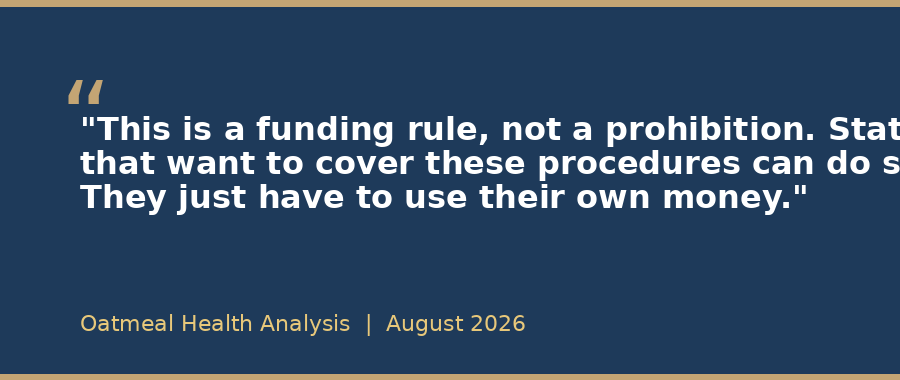
Here is the one-sentence version: CMS has removed federal Medicaid and CHIP matching funds from gender-transition procedures for minors. The federal government will no longer pay its share of those costs. States that still want to cover these procedures can do so. They just have to use their own money.
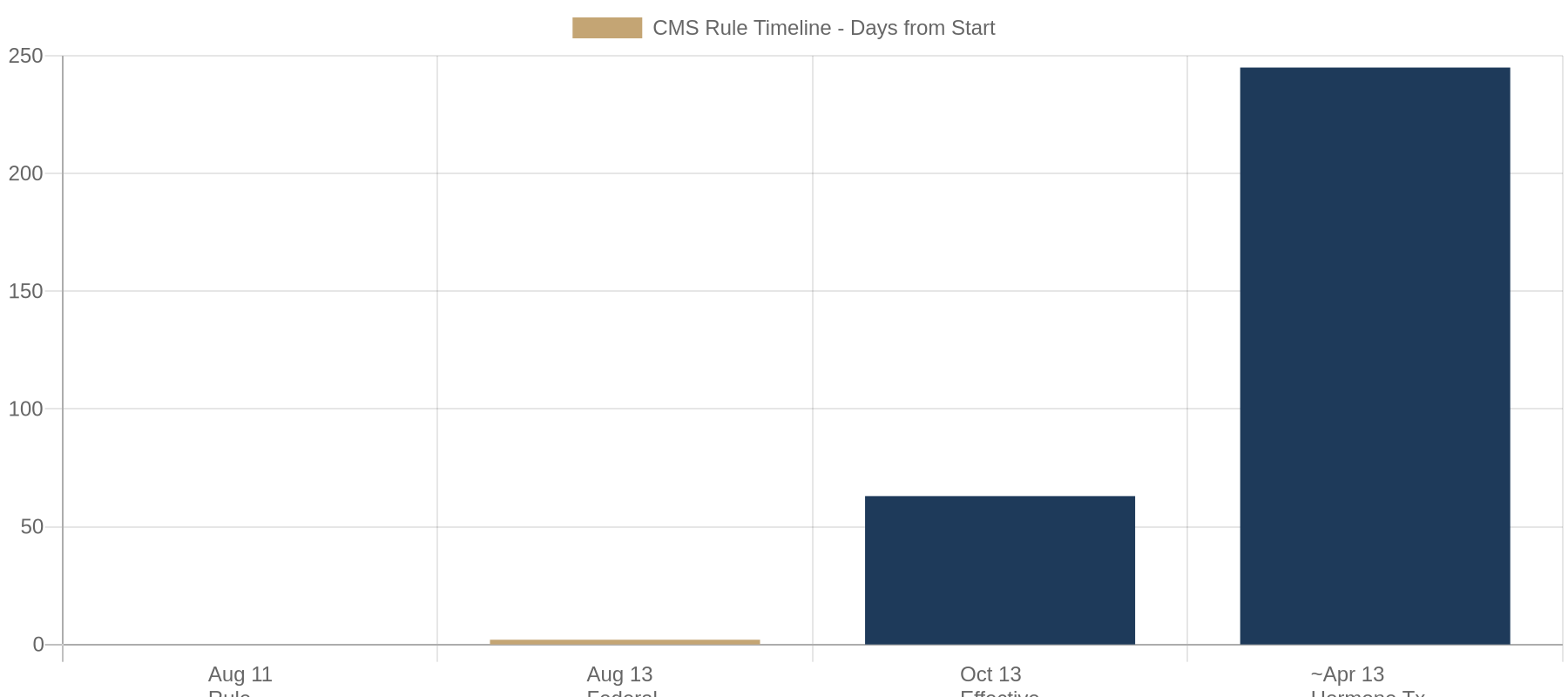
That distinction matters enormously, and it is where most of the commentary has gone wrong. This is a funding rule, not a prohibition. The practical effects will vary enormously depending on which state a child lives in, what their state legislature decides to do next, and whether any of the anticipated legal challenges succeed before the rule takes effect on October 13, 2026.
Understanding the mechanics of Medicaid is essential to understanding this rule. The program is jointly funded by states and the federal government, with the federal share determined by the Federal Medical Assistance Percentage, or FMAP. For most services, states bill the federal government for their share automatically. This rule simply removes certain gender-transition procedures from the list of services eligible for that federal match.
What happens next depends on 50 different state legislatures making 50 different decisions.
1. What the Rule Actually Does
The CMS final rule amends 42 CFR parts 441 and 457, the regulatory sections governing Medicaid and CHIP benefits. The amendments add a categorical prohibition on federal matching funds for what the rule terms "sex-rejecting procedures" for individuals under 18 (Medicaid) or under 19 (CHIP).
The procedures covered by this prohibition include three categories: puberty suppression treatments, which include gonadotropin-releasing hormone agonists used to delay the onset of puberty; cross-sex hormone therapy, which includes estrogen for biological males and testosterone for biological females; and surgical procedures intended to alter a minor's physical characteristics to align with a gender identity different from their sex at birth.
The rule explicitly states that it does not prohibit providers from furnishing these procedures. It does not prevent states from covering them. It does not cut off access to mental health services, which remain fully eligible for federal matching funds. The scope is narrowly limited to these three categories of physical interventions.
📊 The rule amends 42 CFR parts 441 (Medicaid) and 457 (CHIP), effective 60 days after Federal Register publication on August 13, 2026.
The HHS evidence review underlying this rule was conducted in May 2025 and finalized in November 2025. CMS cited that review in justifying the funding change, concluding that the evidence base for pediatric gender transition was insufficient to justify continued federal expenditure. Medical organizations including the American Academy of Pediatrics have sharply disputed that characterization, describing the decision as "a baseless intrusion into the patient-physician relationship."
2. The Transition Window: Six Months for Existing Patients
The rule includes one significant accommodation for current patients: a six-month transition period for minors already receiving cross-sex hormone therapy.
State Medicaid and CHIP agencies may continue to claim federal matching funds for hormone therapy medications for beneficiaries already receiving that treatment at the time the rule takes effect. The window runs for six months from the effective date, which puts the cutoff around mid-April 2027.
This transition provision does not apply to puberty blockers or surgeries. It applies only to cross-sex hormone therapy and only to patients already enrolled in treatment before October 13, 2026.
The practical implication is that states which want to continue covering hormone therapy for existing patients will need to decide well before April 2027 whether to do so with state-only dollars. States that let the transition window expire without making that decision will effectively terminate federal-match-eligible coverage for those patients.
📊 Transition window: 6 months from October 13, 2026, for cross-sex hormone therapy patients already in treatment. Cutoff: approximately April 13, 2027.
3. The Map: 27 States Already There, 17 With Exposure
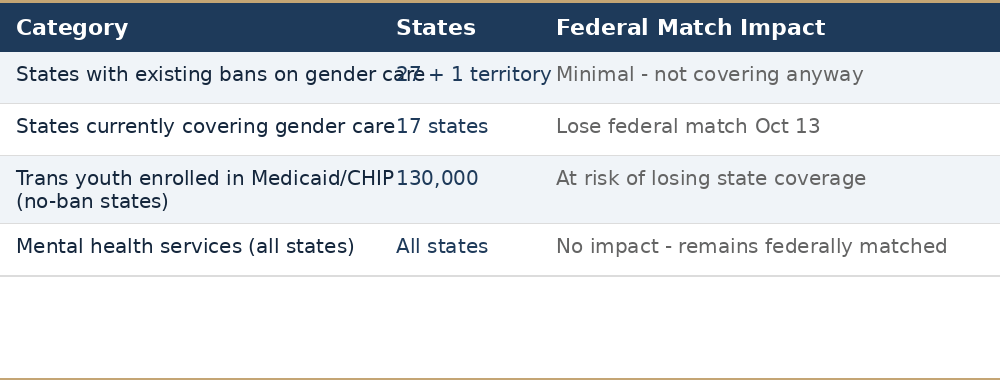
The rule's practical impact depends heavily on geography. By the time this rule was finalized, 27 states and one territory had already enacted laws restricting or banning gender-transition procedures for minors. For those states, this CMS rule changes very little: they were not covering these procedures under Medicaid anyway.
The states facing genuine exposure are the 17 that currently cover some degree of gender-affirming care for minors under their Medicaid and CHIP programs. Those states had been receiving federal matching funds for those services. As of October 13, 2026, that match disappears.
The financial math is not trivial. CMS projects the rule will reduce federal outlays by approximately $175 to $235 million over the next decade. That is the federal government's share of these costs. The states' share of those costs will not disappear from anyone's budget. States that choose to continue coverage will absorb the federal share themselves. States that drop coverage will shift those costs onto families.
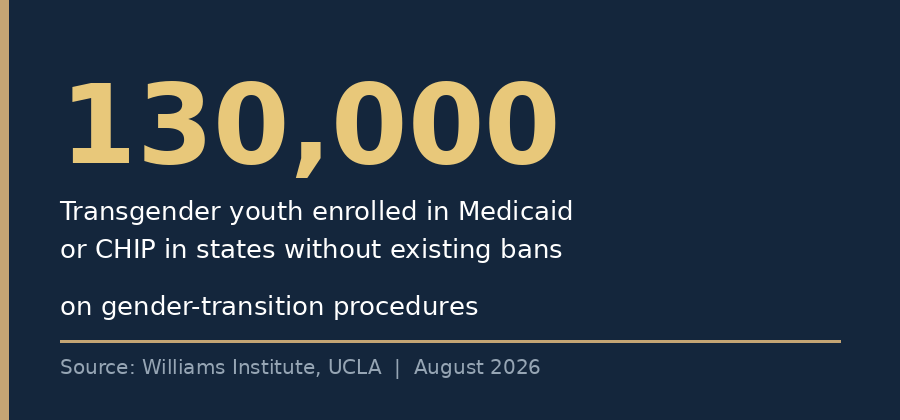
For the 130,000 transgender youth currently enrolled in Medicaid or CHIP in states that have been covering gender care, this is a moment that will define their access to healthcare for the foreseeable future.
4. What States Will Actually Do
This is the question that matters most and is hardest to answer.
Some states will almost certainly drop coverage. States where legislatures have been seeking to restrict gender-transition care for years now have a straightforward path: simply do not appropriate state-only funds to replace the lost federal match. No new legislation required. Budget silence becomes policy.
Other states have already signaled the opposite. California, New York, Colorado, Washington, Oregon, and several other states that have positioned themselves as havens for transgender healthcare are unlikely to eliminate coverage just because the federal match disappears. The more likely outcome in those states is a state legislative or regulatory action to replace the lost federal dollars with state funds.
Some states will be genuinely uncertain. States with divided legislatures or moderate governors may face real political battles over whether to fund these services from state coffers. Those battles are likely to play out over the next 12 to 18 months.
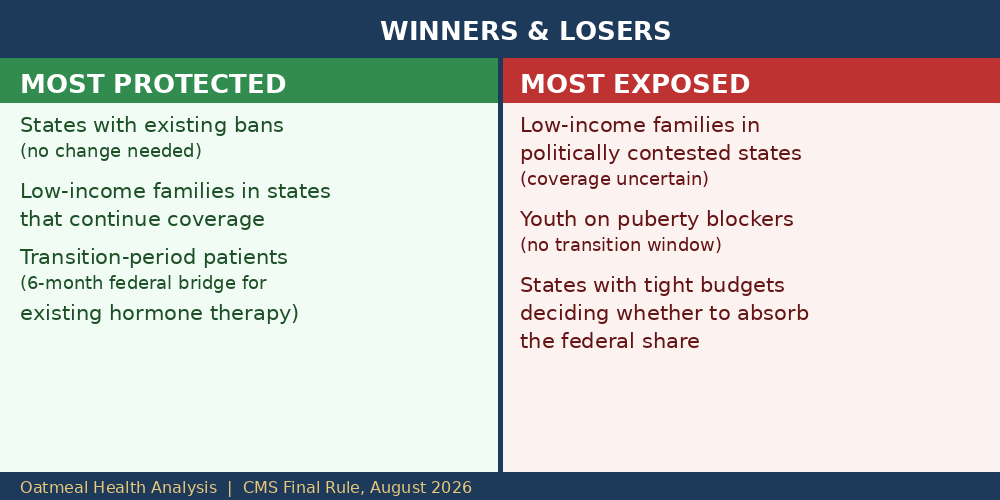
The Medicaid equity dimension here is significant. Transgender youth with private insurance will generally continue to have access to these services through their plans, which are not affected by this rule. The population most affected is low-income transgender youth whose families rely on Medicaid or CHIP. The access gap between insured and Medicaid populations could widen substantially depending on state decisions.
5. The Legal Landscape
Legal challenges are expected before the rule takes effect in October 2026, and the coalitions are already forming.
A group of approximately 20 state attorneys general, including Oregon, Washington, New York, California, Colorado, Connecticut, Delaware, Illinois, Maine, Maryland, Massachusetts, Michigan, Minnesota, Nevada, New Jersey, New Mexico, Pennsylvania, Rhode Island, Vermont, and Wisconsin, are expected to challenge the rule in federal court. Washington Attorney General Nick Brown has described the rule as an attempt to "rob them of care that is lifesaving in some instances."
Legal challenges are expected to focus primarily on the Administrative Procedure Act, arguing that the HHS evidence review was procedurally deficient and that the rule is arbitrary and capricious. Constitutional challenges relating to equal protection are also anticipated.
Legal experts note that the administration's approach here, restricting the use of federal funds rather than directly prohibiting procedures, stands on relatively firmer legal ground than earlier executive actions that attempted to condition Medicare and Medicaid participation on hospitals refusing to perform these procedures. The Spending Clause gives Congress and the executive branch broad authority to attach conditions to federal funding. Spending Clause challenges are historically difficult to win.
That said, courts have enjoined multiple prior actions in this space. The outcome of any litigation is genuinely uncertain, and it is possible the rule will be blocked before its effective date.
📊 Legal note: Spending Clause challenges face a high bar. Courts have historically upheld broad federal discretion to define what Medicaid covers.
6. The Evidence Question
The rule's stated rationale is an evidence-based one: HHS conducted a systematic review of the clinical literature on pediatric gender-transition interventions and concluded that the evidence base was insufficient to justify continued federal expenditure.
This evidence review is contested. Major medical organizations, including the American Academy of Pediatrics, the American Medical Association, the Endocrine Society, and the American Psychological Association, have reached different conclusions from the same literature. They argue that the HHS review selectively weighted certain studies and ignored the substantial clinical experience of providers who work with this population.
The HHS review itself drew heavily on recent reviews from European countries, including Sweden, Finland, and the United Kingdom, that have tightened their own clinical protocols for youth gender care in recent years. Those countries have moved toward more cautious approaches for some patient subgroups, particularly prepubertal children, while continuing to offer treatment to older adolescents who meet stricter criteria.
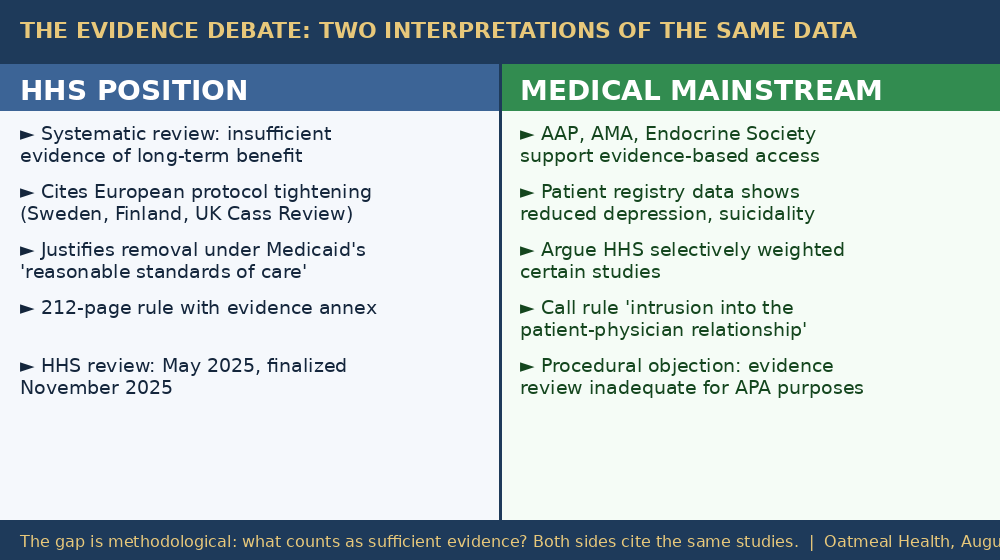
The gap between the HHS interpretation and the mainstream medical organization position is not primarily factual. Both sides are looking at the same studies. The gap is methodological: what counts as sufficient evidence, what study designs are required, and how to weigh observational data against the absence of long-term randomized controlled trials. Those are genuinely contested questions in evidence-based medicine, not questions with obvious right answers.
What is clear is that the 212-page rule does not change what any provider is permitted to do. Physicians, hospitals, and clinics can continue offering these services. The question the rule answers is only: who pays.
Deep Dive: How Medicaid Financing Actually Works
Medicaid is an entitlement program jointly funded by states and the federal government. Every state operates its own Medicaid program under federal guidelines, and the federal government reimburses states for a share of covered medical services based on that state's per-capita income. Richer states get a lower federal match rate. Poorer states get a higher one. The match rates range from 50 percent to approximately 83 percent, meaning the federal government pays between half and four-fifths of the cost of every covered service.
The federal government defines a baseline of mandatory services that all Medicaid programs must cover and allows states to add optional services on top of that baseline, with federal matching funds available for the optional services too. Gender-transition procedures for minors were among those optional services in states that covered them.
This rule removes those procedures from the list of optional services eligible for federal matching funds. It does not touch mandatory services. It does not affect coverage for any other population or any other service.
The consequence is that states covering these services have been effectively receiving a federal subsidy. When that subsidy goes away, the full cost of coverage falls on state budgets. State health officials will have to make budget decisions about whether to absorb those costs, and those decisions will happen in the context of constrained state budgets, competing health priorities, and significant political pressure from both directions.
For children on Medicaid, the practical result is that their access to care will be determined by geography in a way that was not true before. A child in Massachusetts will likely have different access than a child in Texas, not because of anything that changed in clinical medicine, but because of where they happen to live and what their state legislature decides to do.
What This Means for You
For providers in states that will continue coverage: expect that your state Medicaid program will need to issue updated billing guidance before October 13, 2026. The administrative pathway for covering these services with state-only dollars may require new state plan amendments or legislative appropriations. Monitor your state Medicaid agency's communications closely.
For providers in politically contested states: prepare for coverage uncertainty. You may have patients currently receiving care whose coverage status will be unclear for months. Clinical decisions should not be deferred while coverage questions are resolved, but billing and authorization workflows may need to adapt rapidly.
For patients and families: the most important near-term question is what your state decides to do. If your child is currently receiving cross-sex hormone therapy, the six-month transition window provides some buffer. Contact your state Medicaid office and your provider before the October 13 effective date.
For payers and managed care organizations: if you operate Medicaid managed care plans in affected states, you will need to update your benefit structures by the effective date and understand how state funding decisions affect your capitation arrangements.
For policy analysts: the financial projections ($175 to $235 million over a decade) are modest relative to overall Medicaid spending. The political significance is far larger than the fiscal significance. Watch for states to use this rule as a catalyst for broader Medicaid restructuring.
The Bottom Line
The 212-page rule does one thing: it changes who pays. It does not close clinics, prohibit physicians, or force any provider to stop practicing. It shifts a financial obligation from the federal government to state governments and, potentially, to families.
The downstream effects of that shift will be real and consequential for the 130,000 children in Medicaid-enrolled households whose states have been covering these services. Whether those effects are predominantly negative or predominantly positive depends almost entirely on one's view of the underlying clinical evidence and the appropriate role of federal health spending.
What is not in dispute is the timeline. October 13, 2026, is less than two months away. Legal challenges may delay implementation. State decisions about replacement funding may take months to resolve. In the meantime, the most practical thing anyone connected to this issue can do is understand exactly what the rule says, read the document rather than the headlines, and make decisions based on what it actually changes.
The politics of this issue are loud. The rule itself is much more specific.
About the Author: Jonathan Govette covers healthcare policy, digital health, and the business of medicine at Oatmeal Health. Oatmeal Health tracks the intersection of federal health policy and AI-driven clinical tools.
Key References
CMS Press Release: CMS Ends Federal Medicaid and CHIP Funding for Sex-Rejecting Procedures
AJMC: CMS Final Rule Ends Federal Medicaid, CHIP Funding for Youth Gender-Affirming Care
STAT News: How will legal challenges fare against CMS rule?
Medical Daily: A New Federal Rule Cuts Medicaid Money for Gender Care in Minors
The Hill: Trump administration finalizes rule restricting trans healthcare for minors on Medicaid
Williams Institute UCLA: Public Comment on CMS Rule
Time: Donald Trump's New Medicaid Rule Targets Gender-Affirming Care for Minors