


Between 2023 and 2026, three numbers moved a lot. The share of physicians who use AI at work rose from 38% to 81%. The FDA now lists more than 1,600 authorized AI-enabled devices. And digital health venture funding reached $14.2 billion in 2025, with AI-enabled companies taking 54% of it. By almost any adoption measure, clinical AI is no longer a pilot.
Yet three other numbers barely moved. Predictive AI use in hospitals went from 66% to 71% across the same two survey years. Independent hospitals still trail system-affiliated hospitals by about 49 points. And the first major claims study of billable medical AI found that a handful of procedures drove nearly all volume, concentrated in wealthy, urban, academic markets. Use is rising faster than proof, and access is rising slower than use.
This is the October 2026 edition of a series built on the Wu et al. NEJM AI claims study of clinical AI adoption. It rebuilds the picture from 2023 to 2026 using newly checked sources: the FDA device list, AMA physician surveys, ASTP/ONC hospital data, Rock Health and Menlo Ventures funding data, and CMS and AMA reimbursement changes. It is written for health system leaders, FQHCs, radiologists, and benefits teams who have to decide what to buy, what to measure, and what to ignore.
1. The baseline: what the claims study found
The study that anchors this series, "Characterizing the Clinical Adoption of Medical AI Devices through U.S. Insurance Claims," came from Kevin Wu, Eric Wu, Brandon Theodorou, Weixin Liang, Christina Mack, Lucas Glass, Jimeng Sun, and James Zou at Stanford, the University of Illinois Urbana-Champaign, and IQVIA. NEJM AI published it on November 9, 2023, with funding from the Chan-Zuckerberg Initiative. It asked a simple question: which medical AI tools are clinicians actually billing for?
The authors tracked CPT codes created for medical AI in the IQVIA PharMetrics Plus for MedTech claims database, which covers more than 210 million enrollees, mostly in commercial plans. They analyzed 11 billion claims from January 1, 2018 to June 1, 2023. They found 16 medical AI procedures billable under 32 unique CPT codes. At the time, the paper notes, more than 500 AI devices had gone through FDA evaluation.
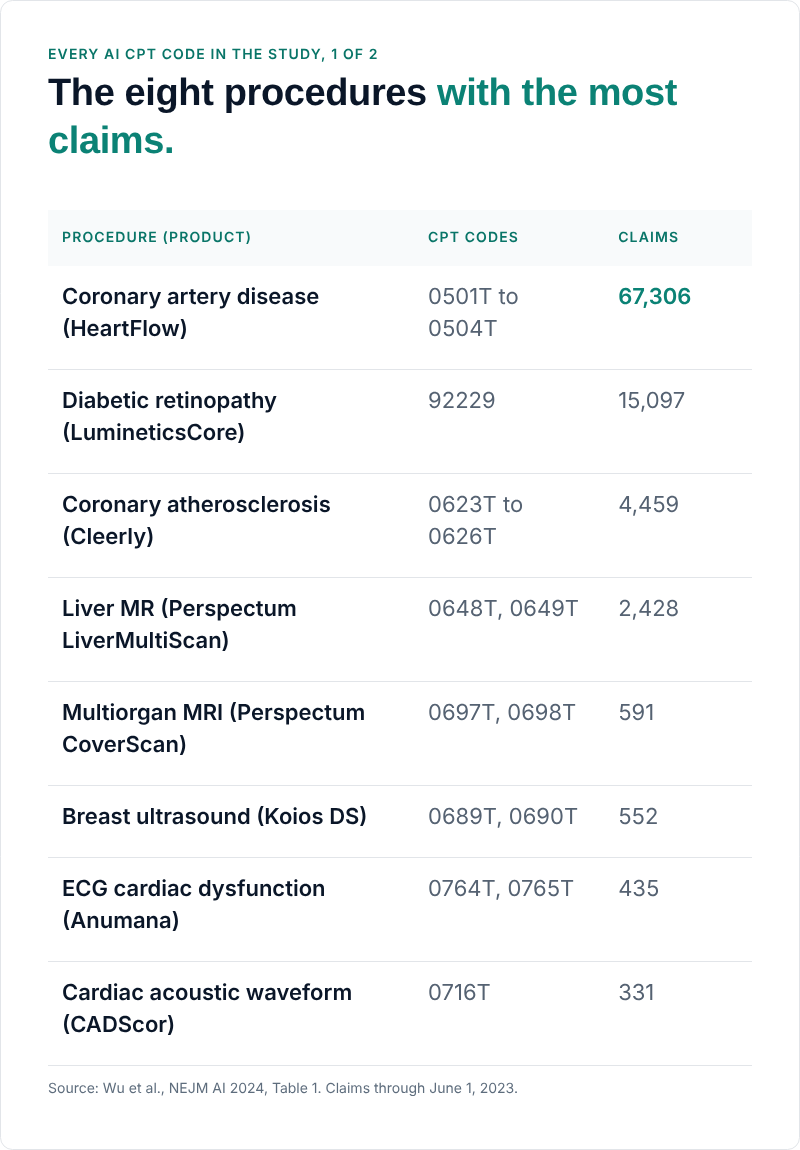
The pattern was concentration. Only 4 of the 16 procedures had more than 1,000 total claims, and only coronary artery disease analysis and diabetic retinopathy screening had passed 10,000. Coronary artery disease analysis (HeartFlow FFRCT, CPT 0501T to 0504T) led with 67,306 claims, followed by diabetic retinopathy (LumineticsCore, CPT 92229) at 15,097, Cleerly's coronary CT analysis at 4,459, and liver MR (Perspectum LiverMultiScan) at 2,428. Fifteen of the 16 procedures were created in 2021 or later, and the median procedure was about 374 days old.
📊 Data point: 15 of 16 billable medical AI procedures were less than three years old when the study window closed in mid-2023, and only 4 had more than 1,000 claims.

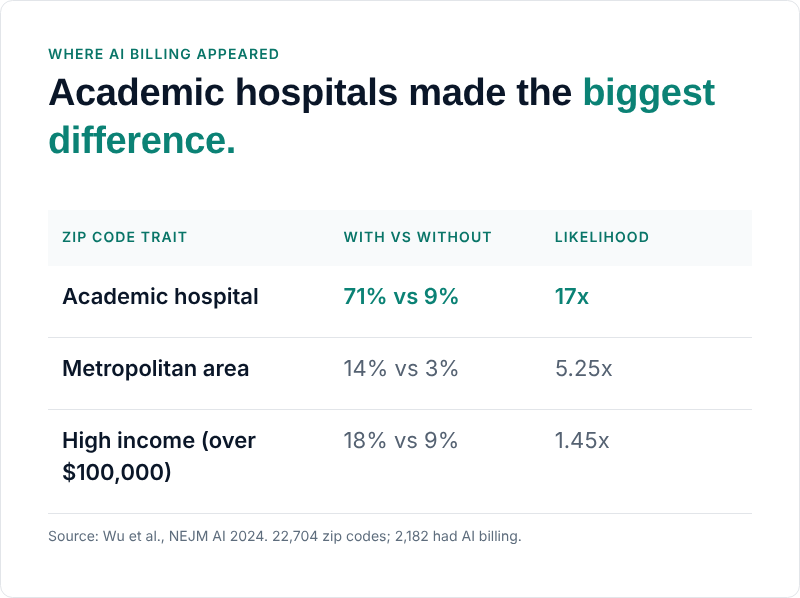
The geography was the part that should change how leaders buy. The authors looked at 22,704 zip codes with at least one institutional provider, and 2,182 had at least one medical AI billing. In a logistic regression, a zip code with an academic hospital was 17 times more likely to have AI billing, a metropolitan zip code 5.25 times more likely, and a high-income zip code (median household income above $100,000) 1.45 times more likely. All three were significant at P<0.001. Of zip codes with an academic hospital, 71% had at least one AI billing, versus 9% of those without.
📊 Data point: 71% of zip codes with an academic hospital had AI billing in the study, compared with 9% of zip codes without one.
Here is the full list. The 16 procedures and their 32 CPT codes, with claims through June 1, 2023, are below. Nearly everything sits in Category III, the AMA's temporary tier for emerging technology, which is why most had no Medicare price.
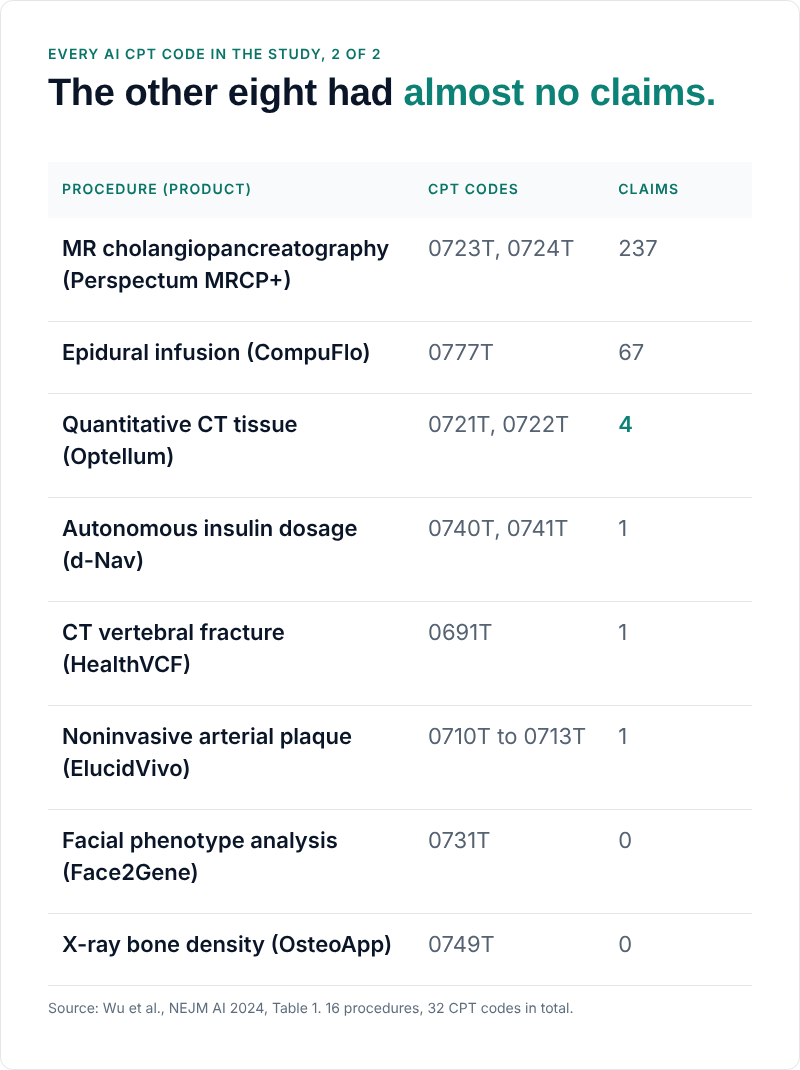
The second half of the list shows how thin the long tail was. Eight procedures had 237 claims or fewer, and two had none.
Pricing showed how payers valued these tools. CMS set the national payment for HeartFlow FFRCT at $930.34 in an office setting in November 2021, and Anthem's median negotiated rate in California and New York was $909.77. For diabetic retinopathy screening (CPT 92229), CMS paid $45.36 in 2021 while the median private rate was $127.81. The paper also noted that 92229 carried a practice expense relative value unit of 1.34 versus 0.53 for its non-AI counterpart, which shifts value from physician work toward the cost of the device.
The authors were explicit about limits. Their database captures a fraction of total claims (about 40% of U.S. claims by their estimate) and covers commercially insured patients under 65. It misses AI billed under non-AI-specific codes, AI paid through Medicare's inpatient NTAP program such as Viz.ai, unreimbursed pilots, and software bundled into hardware. They wrote that the claims counts should be read mainly as relative magnitudes over time.
One lung-related detail is worth keeping. CPT 0721T and 0722T, quantitative CT tissue characterization with Optellum's Virtual Nodule Clinic as the example product, had 4 claims in the dataset, effective July 1, 2022. In 2023, billable AI in lung nodule assessment existed on paper and almost nowhere in practice.
A later study using Medicare data confirms the pattern. Zink and colleagues, writing in The American Journal of Managed Care in May 2024, tracked CT-based fractional flow reserve (FFRCT), the first AI-enabled software Medicare paid for, using 100% of fee-for-service claims from 2018 through 2022. Annual claims grew from 1,083 to 12,363, and billing hospitals grew from 66 to 323. But the top 20% of hospitals submitted 67.5% of claims, and only about 17% of hospitals that performed coronary CT angiography also billed for FFRCT. Billing hospitals were larger (438 versus 241 beds) and more often part of a health system (86.9% versus 74.8%). The authors concluded that growth was concentrated among well-resourced hospitals and clinicians.
Every one of those findings is a snapshot from 2023 or earlier. The rest of this edition asks what changed.
2. Devices: from 221 authorizations a year to more than 1,600 on the list
Start with supply. The 2023 claims paper noted that more than 500 AI devices had been through FDA evaluation. In August 2024, MedTech Dive reported that the FDA had authorized 950 AI or machine learning-enabled devices, with more than three-quarters in radiology. The FDA's July 2025 list update added 211 devices cleared since its September 2024 update, about 81% of them in radiology, according to AuntMinnie. In August 2026, OncoDaily reported that the FDA list held more than 1,500 devices, and by September 2026 the FDA's own page says the agency has authorized over 1,600. The FDA page does not break the total down by year or specialty.
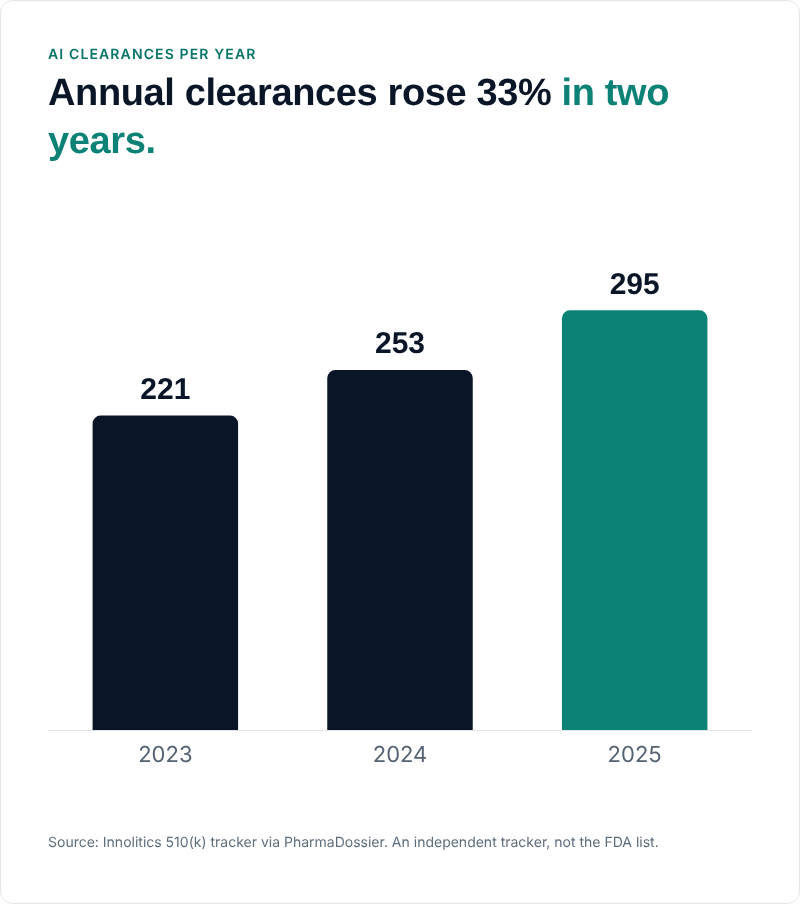
For annual counts, an independent tracker from Innolitics, summarized by PharmaDossier, puts 510(k) clearances at 221 in 2023, 253 in 2024, and 295 in 2025. That is a 33% increase from 2023 to 2025. In 2025, radiology accounted for 211 of the 295 clearances, or 71.5%. PharmaDossier also cites 1,451 cumulative devices through December 31, 2025, with 1,104 in radiology (76%).
📊 Data point: Annual AI clearances rose from 221 in 2023 to 295 in 2025, a 33% increase in two years, per an independent 510(k) tracker.
Two cautions apply. First, the annual series and the cumulative figure come from different trackers and do not sum to each other; the source itself notes this. Second, the FDA does not publish a per-year radiology series on its list page, so radiology share by year here is the tracker's, not the agency's. The direction is not in doubt. The precise counts are.
What matters for buyers is not the count. It is that radiology still holds roughly three-quarters of the list, which means the evidence base for AI outside imaging is thinner than the headline total suggests.
3. Physicians: 38% to 81% in three years
The fastest adoption curve is among clinicians. The AMA's annual physician survey found that 38% of physicians used AI in a professional context in 2023. In the survey released March 12, 2026, that figure was 81%, based on nearly 1,700 physicians surveyed in January and February. The average number of use cases per physician rose from 1.1 to 2.3.
The most common uses are documenting clinical care and summarizing medical research. Attitudes moved with usage. The share who believe AI gives physicians an advantage in caring for patients rose from 65% to 76%. The share who find more AI use more exciting than concerning rose from 30% to 37%, while 40% are equally excited and concerned.
📊 Data point: Physician AI use went from 38% (2023) to 81% (2026), and average use cases per physician from 1.1 to 2.3.
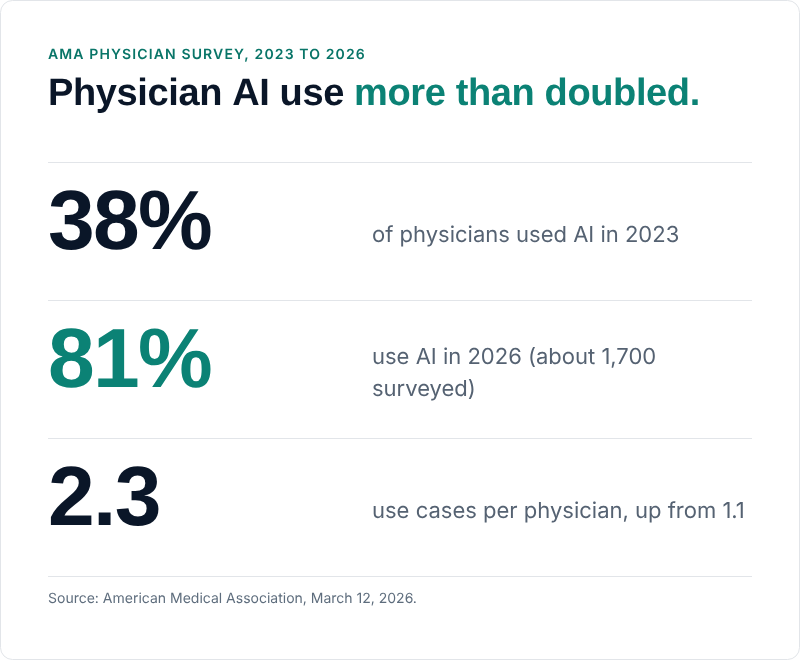
The concerns are specific. About 88% report some level of concern about skill loss, and 28% are personally concerned. Patient privacy is the only area where more physicians expect harm than help (41% versus 13%). And 85% want a say in how AI is adopted in their practice. AMA CEO John Whyte said AI "has quickly become part of everyday medical practice."
Read the 81% carefully. It counts any professional use, and the leading uses are documentation and research summaries, not diagnosis. That is real adoption, but it is not the same as adopting diagnostic AI that changes a clinical decision.
4. Hospitals: use is up, but the divide is persistent
Hospital data comes from ASTP/ONC, using American Hospital Association survey data. Among non-federal acute care hospitals, 66% reported using predictive AI integrated into their EHRs in 2023 and 71% in 2024. The 2024 numbers by hospital type show the divide: 86% of health system-affiliated hospitals, 81% of urban hospitals, 56% of rural hospitals, and 37% of independent hospitals.
The ASTP/ONC tables allow a direct comparison across the two years. Healthcare Brew, citing the same ASTP brief, reports that 96% of large hospitals used predictive AI in 2024 versus 59% of small hospitals. Rural use rose from 48% to 56%. Urban use rose from 77% to 81%. Multi-hospital system members went from 81% to 86%, and independent hospitals from 31% to 37%.
📊 Data point: Urban versus rural predictive AI use was 77% versus 48% in 2023 and 81% versus 56% in 2024. The gap narrowed from 29 points to 25 points.

This matters because the common story is that the divide is widening. On the 2023 to 2024 ASTP/ONC data, it narrowed slightly by urban and rural status (29 points to 25) and by system affiliation (50 points to 49). The divide is still large and ASTP/ONC calls it persistent. It is not, on this data, growing. A projection that it will widen needs a newer data release to support it. ASTP/ONC's Data Brief 80 (September 2025) is the latest hospital release found for this edition, and it covers 2023 and 2024 only.
A separate analysis by Oklahoma State University's Brian Whitacre, reported by KGOU on August 19, 2026 and still under peer review, uses 2023 AHA data from 1,301 urban and 1,018 rural hospitals and reports 51% rural versus 81% urban. The rural figure differs from ASTP/ONC's 48% because the samples and definitions differ. Whitacre's finding on purpose is the more useful one: rural hospitals are less likely to use AI for clinical decisions or treatment recommendations, equally likely to use it for billing and operations, and almost twice as likely to use models from their EHR vendor as to build their own. He argues for a "HITECH 2.0" program to help rural hospitals adopt and evaluate AI.
5. The governance gap: who checks the model?
Adoption is one question. Evaluation is another. ASTP/ONC also asked hospitals whether they test predictive models on their own data. In 2024, 82% of adopting hospitals reported checking accuracy, 74% checked for bias, and 79% conducted post-implementation monitoring.
The breakdown by hospital type is where the divide shows up again. Local accuracy evaluation among urban hospitals rose from 65% in 2023 to 75% in 2024, while independent hospitals went from 44% to 41%. Local bias evaluation rose from 47% to 61% at urban hospitals and from 30% to 31% at independent ones.
📊 Data point: Independent hospitals that check model accuracy on local data fell from 44% (2023) to 41% (2024), while urban hospitals rose from 65% to 75%.
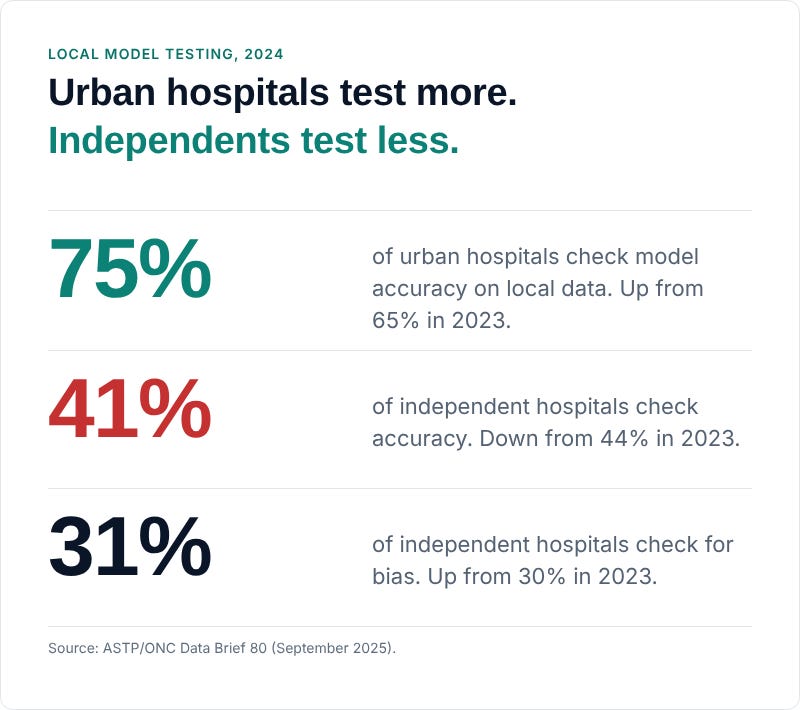
For a health system leader, this is the sharpest finding in the dataset. The hospitals with the least capacity to adopt AI are also the least likely to test it. A model validated at a large academic center does not automatically perform the same on an independent hospital's patients. Under-resourced facilities inherit vendor claims they cannot check.
A JAMA Network Open study published December 12, 2025 by Jordan Everson, Paige Nong, and Chelsea Richwine adds the generative AI picture from the 2024 AHA IT Supplement. About 31.5% of hospitals were already using generative AI integrated with their EHR, and another 24.7% planned to within a year. System members were at 38.5% versus 16.3% for independent hospitals, urban hospitals at 35.5% versus 25.4% for rural, and major teaching hospitals at 53.9%. The authors also found that hospitals running all three local evaluation practices (accuracy, bias, and post-deployment checks) were slower to adopt than those running only one, and they warned of a digital divide in which some hospitals adopt without full safeguards.
The fastest-growing use cases also tell a story. In the same ASTP/ONC brief, using predictive AI to simplify or automate billing rose from 36% to 61% of adopting hospitals between 2023 and 2024, and scheduling from 51% to 67%. The money is moving to operations first.
6. The money: funding and spending, 2024 to 2025
Capital followed the same curve. Rock Health reports U.S. digital health venture funding of $10.9 billion in 2023 and $10.5 billion in 2024, then $14.2 billion in 2025, up 35% and the highest total since 2022. The first half of 2026 brought $7.4 billion across 244 deals, up from $6.4 billion in the first half of 2025 on a nearly flat deal count (245 then). Median deal size rose to $14 million, the highest since 2022. Deal count fell about 5%, from 509 to 482, so the dollars concentrated: average deal size rose from $20.7 million to $29.3 million. AI-enabled companies took 54% of 2025 funding, up from 37% in 2024. Rock Health no longer reports an AI-enabled share for 2026 because AI has become ubiquitous among digital health companies.
📊 Data point: Megadeals of $100 million or more took 22% of capital in 2024, 42% in 2025, and 45% in the first half of 2026. AI-enabled companies went from 37% of funding in 2024 to 54% in 2025.

Menlo Ventures' 2025 State of AI in Healthcare report, published October 21, 2025 and based on a Morning Consult survey of more than 700 executives in August and September 2025, puts 2025 healthcare AI spending at about $1.4 billion, nearly triple the prior year. No 2026 edition had been published when this was written. Of that, $600 million went to ambient clinical documentation and $450 million to coding and billing automation. Menlo reports that 27% of health systems, 18% of outpatient providers, and 14% of payers have deployed domain-specific AI.
Notice what that spending buys. Documentation and billing are the largest categories. Those are the same use cases that lead the physician and hospital data. Diagnostic AI, the category the FDA list is dominated by, is a smaller share of the dollars than it is of the device count.
7. Reimbursement: the Category I moment
The reimbursement story changed on January 1, 2026. CPT 75577, a new Category I code for AI quantification and characterization of coronary atherosclerotic plaque from coronary CT angiography, took effect. AuntMinnie reports that the 2026 Medicare physician fee schedule rate is more than $1,000 for physician offices and imaging centers, and the hospital outpatient rate is $950.50.
The code list changed in the same update. AMA's 2026 CPT set added 288 codes, deleted 84, and revised 46, and MedCentral's review of the AI-related changes names four: 75577, 0992T and 0993T (perivascular fat analysis for cardiac risk, without and with a concurrent heart CT), and 0972T (multispectral imaging for burn wounds). It also reports that 75577 replaced the four temporary codes 0623T to 0626T, the Cleerly codes in the 2023 study, which were deleted on January 1, 2026.

The 2026 and 2027 pipeline is bigger than four codes. AMA's Category III long descriptor document, updated October 2, 2026, lists 19 codes whose descriptors name augmentative or assistive algorithmic analysis or computer-aided analysis. Only two are effective now (July 1, 2026): 1036T and 1041T. The other 17 carry a January 1, 2027 effective date in the document's release table, although some of its narrative text also mentions October 1, 2026, so confirm the date in the official code set before billing. Cancer risk and prognosis is the largest group.
The cardiac, PET, and angiography codes cover tasks that already have FDA-authorized products behind them.
The remaining five span brain, breast ultrasound, intraoperative tumor imaging, and neurostimulation.
The same AMA source names seven earlier Category III codes for AI-enabled services that took effect in 2025: 0902T for electrocardiogram measurements, 0932T for echocardiogram measurement, 0877T to 0880T for medical chest imaging, and 0898T for image-guided prostate biopsy. AMA gives these as examples, not a complete list.
A caution on counts. Adding the 19 codes in AMA's current document to the 7 AMA names for 2025 gives at least 26 AI-related Category III codes beyond the 2023 study's list, and the 2023 study's 32 codes are not all still active (0623T to 0626T were deleted). That is a count of what these AMA sources name, not an official total, and no source found for this edition publishes one. Anyone quoting a single number should name the source and date. Looking ahead, a September 2026 analysis of the CPT Editorial Panel agenda by Medikode, citing Madhani Healthcare Consulting, counted 4 of 49 proposed Category I codes and 3 of 40 proposed Category III codes as involving AI or algorithmic analysis. Nothing from that meeting is in a live code set.
This is the first Category I code of its kind in this series' timeline. Compare it with the 2023 baseline, where billable AI lived mostly in Category III codes and in a handful of procedures. A permanent code with a defined payment rate converts a pilot budget line into a product line.
📊 Data point: CPT 75577 took effect January 1, 2026 at a hospital outpatient rate of $950.50, per AuntMinnie.
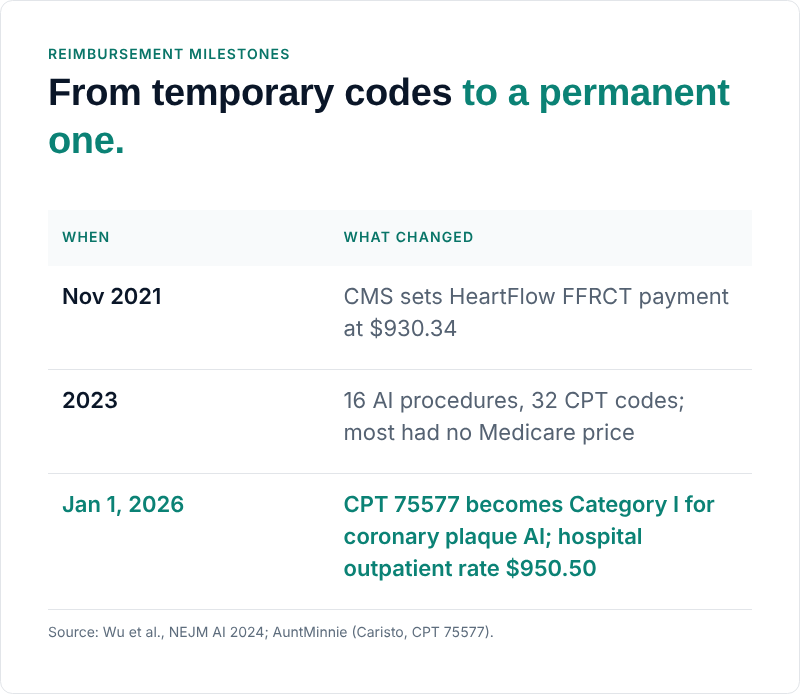
For other specialties, the lesson is about sequencing. Clearance gets a product to market. Evidence gets it a code. A code gets it paid. The 2023 claims study showed that only a few procedures had completed that sequence. The 2026 code set shows at least one has.
What this means for health system leaders, FQHCs, and AI diagnostics
For health system leaders, the three-year record says to separate three questions that vendors blend. Is the tool authorized? Is it reimbursed? Has it been tested on our patients? Most clinical AI in the 2023 to 2026 data passes the first test, a few pass the second, and the third is the one almost nobody on the independent side of the divide can answer.
For FQHCs, the data is a warning and an opening. The ASTP/ONC numbers show independent facilities using predictive AI at 37% and checking accuracy locally at 41%. Community health centers need vendors who bring validation data, monitoring, and a reimbursement path, not just a license. A reimbursed model changes the economics: it is how a tool reaches a clinic that cannot fund a pilot.
For radiology and AI diagnostics, the device list is the easy part. Radiology still holds roughly three-quarters of authorized devices, and the Category I code for coronary plaque shows how a diagnostic can reach permanent payment. In lung cancer screening, where earlier detection is the point, the same path applies: clear it, prove it, get it coded, and make it work in the facilities that have the fewest resources. Oatmeal Health's LungAI is investigational and not FDA cleared.
The record from 2023 to 2026 supports a simple conclusion. Adoption is no longer the hard part. Proof, access, and local validation are.
Key References
Wu K, Wu E, Theodorou B, Liang W, Mack C, Glass L, Sun J, Zou J. "Characterizing the Clinical Adoption of Medical AI Devices through U.S. Insurance Claims." NEJM AI 2024;1(1), published November 9, 2023. DOI: 10.1056/AIoa2300030.
Zink A, Boone C, Joynt Maddox KE, Neprash HT, et al. "Artificial Intelligence in Medicare: Utilization, Spending, and Access to AI-Enabled Clinical Software." The American Journal of Managed Care, Health IT special issue, May 31, 2024. Everson J, Nong P, Richwine C. "Uptake of Generative AI Integrated With Electronic Health Records in US Hospitals." JAMA Network Open, December 12, 2025.
U.S. FDA, "Artificial Intelligence-Enabled Medical Devices," page current as of September 22, 2026. MedTech Dive (950 devices as of August 2024). AuntMinnie, FDA July 2025 update. OncoDaily, August 18, 2026. PharmaDossier (annual and cumulative counts from the Innolitics 510(k) tracker).
American Medical Association, "AI usage among doctors doubles as confidence in technology grows," March 12, 2026; Fierce Healthcare coverage of the same survey.
ASTP/ONC Data Brief 80, "Hospital Trends in the Use, Evaluation, and Governance of Predictive AI, 2023 to 2024" (September 2025); AHA Center for Health Innovation, November 4, 2025; Healthcare Dive, September 18, 2025; Healthcare Brew, November 24, 2025. KGOU/StateImpact Oklahoma, August 19, 2026 (Brian Whitacre, Oklahoma State University).
Rock Health, 2025 year-end and H1 2026 funding overviews; Healthcare Dive and Fierce Healthcare coverage of H1 2026 (July 2026). Menlo Ventures, "2025: The State of AI in Healthcare," October 21, 2025. AuntMinnie, "CMS finalizes Medicare reimbursement for Caristo's coronary plaque analysis." MedCentral, "CPT 2026 Updates Expand Lab, Category III, and AI Codes"; AMA, "CPT Category III Codes Long Descriptors" (updated October 2, 2026); AMA, "CPT codes offer the language to report AI-enabled health services" (October 10, 2025); TechTarget, "AMA releases CPT 2026 code set, adds codes for health AI," September 11, 2025; Medikode, "AMA September 2026 CPT Panel: AI Coding Rules Take Shape."
Jonathan Govette is the Co-Founder and CEO of Oatmeal Health, which is building AI lung cancer diagnostics to catch cancers earlier in underserved communities. He writes The Oatmeal Bite for health system leaders, FQHCs, and radiology teams.