


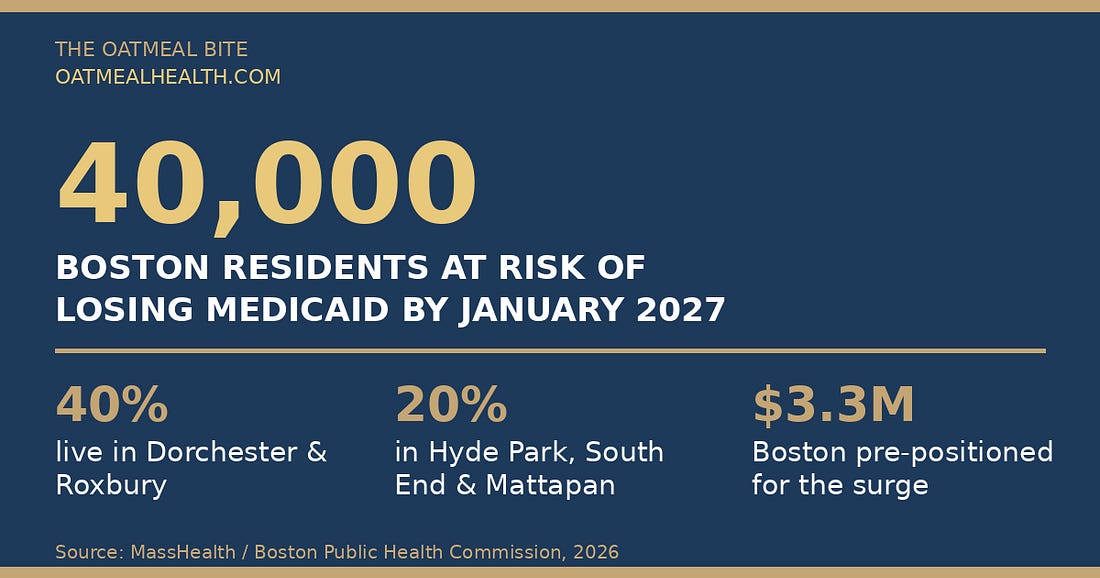
Forty thousand Boston residents are about to fall off a cliff — and the city just moved to cushion the drop.
By January 1, 2027, new federal Medicaid work requirements will hit Massachusetts with unprecedented force. People who don’t document 80 hours of work, job training, or qualifying activities each month face losing their coverage. And the communities most exposed — Dorchester, Roxbury, Hyde Park, Mattapan, and the South End — are exactly the ones Boston’s community health centers (CHCs) were built to serve.
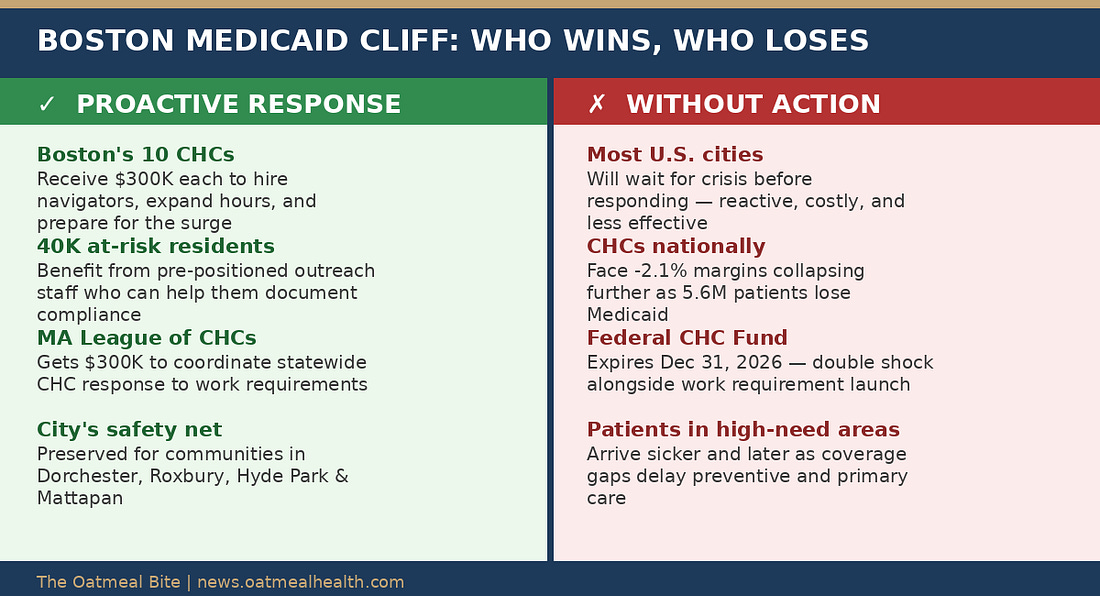
This week, the City of Boston announced $3.3 million in ARPA funding to pre-position ten community health centers and the Massachusetts League of Community Health Centers for what’s coming. Each of the ten CHCs gets $300,000. The League gets $300,000 to coordinate statewide.
Here’s what I’m watching — and why it matters far beyond Boston.
🧵 First: What the work requirements actually say
The Medicaid work requirements embedded in the federal reconciliation bill aren’t future-tense anymore. They have an effective date:
January 1, 2027: Work requirements begin for Medicaid enrollees aged 19-64 who are not exempt
80 hours per month of qualifying activity (employment, job training, education, volunteer work, or caregiving)
Eligibility re-verified every six months instead of annually
Exemptions for pregnancy, disability, full-time caregiving, and residents of rural counties with high unemployment
Massachusetts has already modeled the impact. The state projects 99,000 to 300,000 people statewide could lose coverage — not because they don’t qualify, but because they can’t navigate the new documentation requirements. National data from the Commonwealth Fund estimates 5.6 million current CHC patients nationwide lose Medicaid if work requirements take effect as written.
🗺️ Who’s actually at risk in Boston
The $3.3M isn’t being spread evenly. The geography of risk drives the strategy:
40% of Boston's at-risk Medicaid population lives in Dorchester and Roxbury
20% are concentrated in Hyde Park, the South End, and Mattapan
These neighborhoods are served almost exclusively by community health centers — not hospital systems, not private practices
This is the part of the story that doesn’t get told often enough: CHCs don’t get to turn patients away. They’re Federally Qualified Health Centers (FQHCs) with a mandate to serve all patients regardless of ability to pay. When someone loses Medicaid, the CHC still sees them. The revenue just disappears.
⚠️ The Double Cliff — why this timing is uniquely dangerous
Here’s the financial reality that’s not getting enough attention: CHCs are facing two fiscal shocks simultaneously, both landing in late 2026 and early 2027.
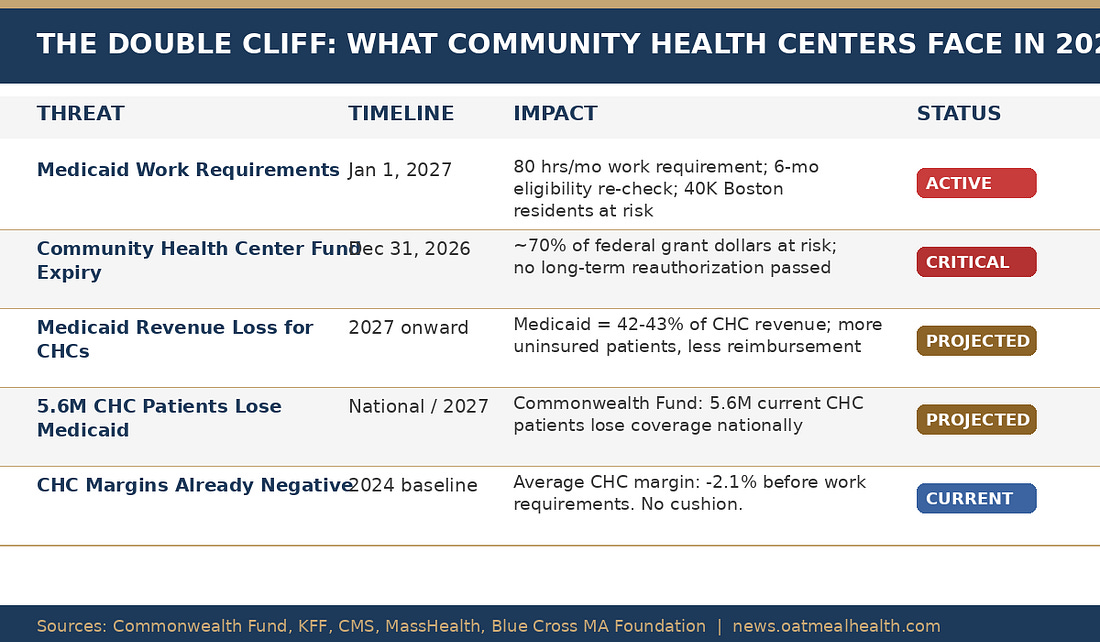
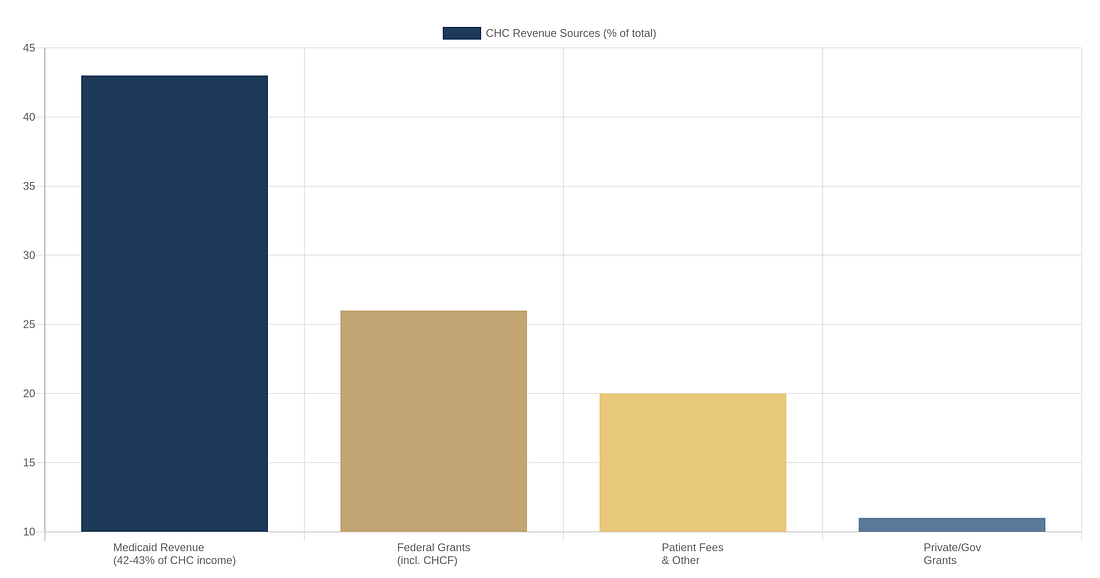
Shock One: Medicaid work requirements kick in January 1, 2027. For CHCs, Medicaid isn’t a secondary revenue stream — it’s the primary one. Nationally, Medicaid accounts for 42-43% of the $46.7 billion in total community health center revenue
Shock Two: The Community Health Center Fund (CHCF) — the dedicated federal funding stream that supplements Medicaid reimbursement for CHCs — expires December 31, 2026. Without reauthorization, CHCs lose a critical revenue cushion at exactly the moment they’ll need it most.
And the baseline position is already precarious. By 2024, average CHC operating margins had fallen to negative 2.1%. These organizations are running on fumes before the double shock arrives.
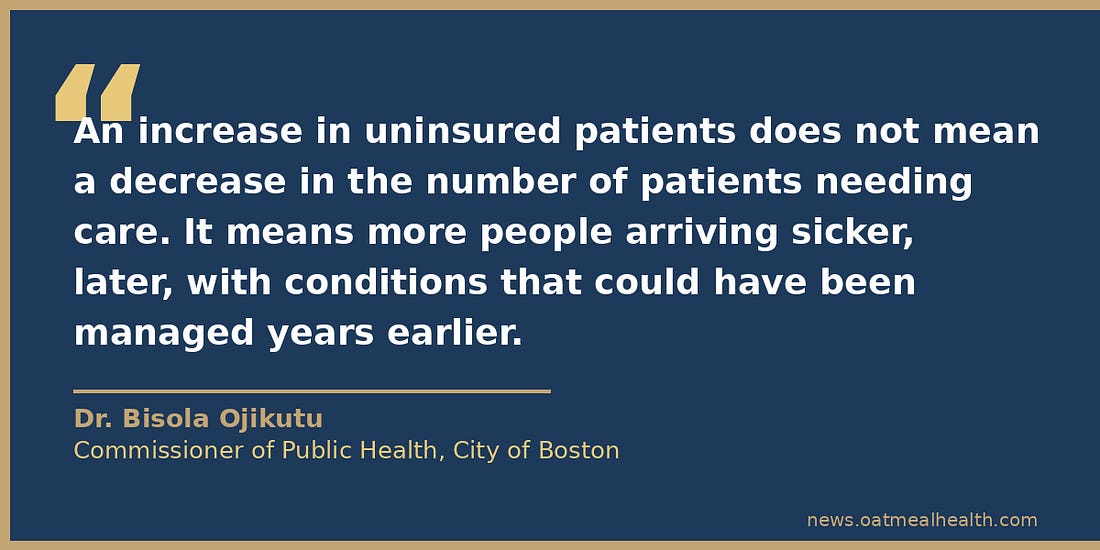
“An increase in uninsured patients does not mean a decrease in the number of patients needing care. It means more people arriving sicker, later, with conditions that could have been managed years earlier.”
— Dr. Bisola Ojikutu, Commissioner of Public Health, City of Boston
✅ What Boston got right
Most cities will wait for the crisis before responding. Boston is spending money now to prevent it.
The $300,000 per CHC is specifically targeted at:
Hiring outreach navigators who can help patients document their work activities before January 2027
Expanding clinic hours to reach working patients who can’t come in during business hours
Building digital infrastructure for the eligibility documentation process
Language-accessible outreach to immigrant communities who may not know the requirements exist
The Massachusetts League of Community Health Centers gets its $300,000 to coordinate across all ten sites — so lessons learned at Codman Square in Dorchester can be shared quickly with DotHouse in Dorchester, or East Boston Neighborhood Health Center, or Whittier Street in Roxbury.
This is how public health actually works: you don’t treat an epidemic after it starts. You pre-position resources where the outbreak is predicted to hit. Dr. Ojikutu understands this. The question is whether the federal government will make the intervention necessary in the first place.
📊 The national math
Let’s zoom out to the national picture, because this isn’t just a Boston story.
1,400+ community health centers operate across the United States
32 million patients served annually
5.6 million of those patients are at risk of losing Medicaid under the work requirements (Commonwealth Fund)
$344 billion to $911 billion in potential federal Medicaid cuts projected over the next decade (KFF)
42-43% of CHC revenue tied to Medicaid
Average CHC margin: -2.1% as of 2024
The math doesn’t work. You cannot cut 40%+ of an organization’s revenue while simultaneously mandating it serve the same number of patients (at higher acuity, because delayed care means sicker patients) and expect the system to survive.
Some CHCs will close. Some will merge. Some will cut services. The communities with the fewest alternatives — rural counties, urban neighborhoods without hospital proximity, areas where the CHC is literally the only provider — will feel it first and worst.
📌 What still needs to happen
Boston’s $3.3M is a signal, not a solution. What still needs to happen:
Congress needs to reauthorize the Community Health Center Fund before December 31, 2026. This is not a partisan issue — CHCs serve red counties and blue cities alike.
States need to design the simplest possible compliance documentation systems. The more paperwork, the more people fall off not because they don’t qualify, but because they can’t navigate the bureaucracy.
Other cities need to follow Boston’s lead and pre-fund CHC outreach capacity NOW — not after January 2027.
Health systems need to engage. If CHCs collapse in underserved communities, those patients don’t disappear. They show up in emergency rooms, sicker and more expensive.
🍞 The bottom line
Boston just put $3.3 million where it needs to go. The city looked at 40,000 residents at risk of losing Medicaid by January 2027 and said: we’re not going to wait for the cliff to crumble. We’re going to put up guardrails.
The question the rest of the country has to answer is whether the federal government is willing to design a system that doesn’t require every city to spend millions just to maintain coverage for people who are already enrolled and already eligible.
Work requirements are politically popular. The administrative burden they create — the cliff they push people off of — is a policy choice. Boston chose differently.
Watch this space. The January 2027 deadline is coming fast, and the community health centers in your city are watching what Boston does very carefully.
The Oatmeal Bite covers health policy, community health, and the business of healthcare at the intersection of data and human impact. If this landed, forward it to someone in healthcare policy or hospital administration. They need to see this.