Aidoc First Read FDA Breakthrough Designation
The FDA fast-tracked a chest X-ray AI that drafts radiology reports - but it is not cleared yet, and the distinction will reshape how every health system builds its radiology AI roadmap.
Radiology is the bottleneck nobody wants to talk about. Emergency departments run faster triage algorithms. Oncologists have molecular diagnostics. But in imaging, a physician orders a study, the image sits in a worklist, and somebody eventually has to read it. That somebody is increasingly hard to find, increasingly busy, and increasingly asked to read more with less time per case.
A new Neiman Health Policy Institute study put numbers to what radiologists already know. Outpatient imaging interpretation turnaround times more than doubled between 2014 and 2023 - a 113 percent increase across 2.6 million studies. CT scan turnaround times rose 318 percent over that period. MR imaging climbed 256 percent. Ultrasound went up 140 percent. Even plain radiographs - the fastest modality to read - increased 63 percent. The steepest portion of that curve happened in the last two years of the study. The hockey stick is real and accelerating.
Into that gap, Aidoc on June 25, 2026 announced that the FDA granted Breakthrough Device Designation (BDD) to First Read, an AI system designed to analyze chest radiographs and generate preliminary high-quality radiology report text. It is Aidoc's second BDD in under a year, following CARE Triage in September 2025. The headline sounds like a product launch. It is not. And the gap between what this designation means and what most people think it means is exactly what health system leaders need to understand before it shapes their next procurement cycle.
1. What FDA Breakthrough Device Designation Actually Means
The FDA's Breakthrough Device Designation was created by the 21st Century Cures Act in 2016. It is an expedited review pathway for medical devices that address life-threatening or irreversibly debilitating conditions and offer more effective treatment or diagnosis than existing alternatives.
What BDD gives a company is access. More frequent FDA meetings, faster feedback cycles on submissions, and priority review when the formal application finally arrives. It does not shorten the development process. It does not lower the clinical evidence bar. It does not put a product on the market.
The device granted BDD Q260882 - which is how the FDA tracks it - is still classified as investigational use only. First Read has not been cleared or approved by the FDA. It cannot be deployed commercially. It cannot be billed for. A radiologist cannot sign a report generated by First Read and bill it as their clinical interpretation unless and until the device completes the regulatory pathway. The BDD designation is a lane change on the highway. The destination is the same.
How long does that highway take? The FDA does not publish precise statistics, but analysis of BDD programs finds that approximately 12 to 13 percent of devices granted BDD ultimately receive market authorization. The average time from BDD to clearance or approval for AI devices in radiology has generally ranged from 18 to 36 months, though some take longer depending on the complexity of clinical evidence required.
This distinction matters enormously because health system AI procurement often operates on a different timeline than the regulatory calendar. A health system that starts building a workflow around First Read today is building around a product that does not yet exist in cleared form. When the cleared version arrives, it may look different from the investigational version. The clinical evidence package may constrain the indicated use. Reimbursement pathways may not be established at launch.
None of that means BDD is unimportant. It means it is a signal about direction and priority, not a deployment decision.
2. The Supply-Demand Mismatch Driving This Race
The Neiman HPI data is worth sitting with. A 113 percent increase in turnaround times is not a staffing blip. It is structural. And it has real clinical consequences.
An MIT Sloan study found that CT imaging turnaround delays can add up to 150 minutes to emergency department patient stays and directly delay clinical decision-making. In a department where throughput determines capacity and capacity determines revenue, 150 minutes per case is not a rounding error. It is an operations problem with a financial signature.
📊 CT imaging turnaround times increased 318% between 2014 and 2023, according to the Neiman Health Policy Institute study of 2.6 million outpatient studies.
The structural driver is a mismatch that compound interest cannot fix quickly. Imaging volumes are growing 3 to 4 percent annually as the population ages, chronic disease prevalence increases, and care pathways increasingly route through imaging. The radiologist workforce grows at roughly 1 percent per year. Training a radiologist takes 5 years of residency plus fellowship for most subspecialties. You cannot simply accelerate production to close a gap of that magnitude.
The chart below shows how FDA authorizations for AI medical devices have accelerated, reflecting the industry's bet that AI can help close the supply-demand gap in radiology capacity.
By the end of 2025, the FDA had authorized 1,451 AI-enabled medical devices. Of those, 1,104 - 76 percent - were in radiology. In 2025 alone, 331 new AI devices received authorization. The field is not waiting for a single breakthrough. It is flooding the zone with modality-specific, finding-specific tools and betting that deployment at scale generates the performance data needed to move up the complexity curve.
Report generation AI like First Read represents the next frontier: not just flagging findings for radiologist review, but producing the structured text output that has traditionally required radiologist authorship and dictation.
3. What First Read Actually Does
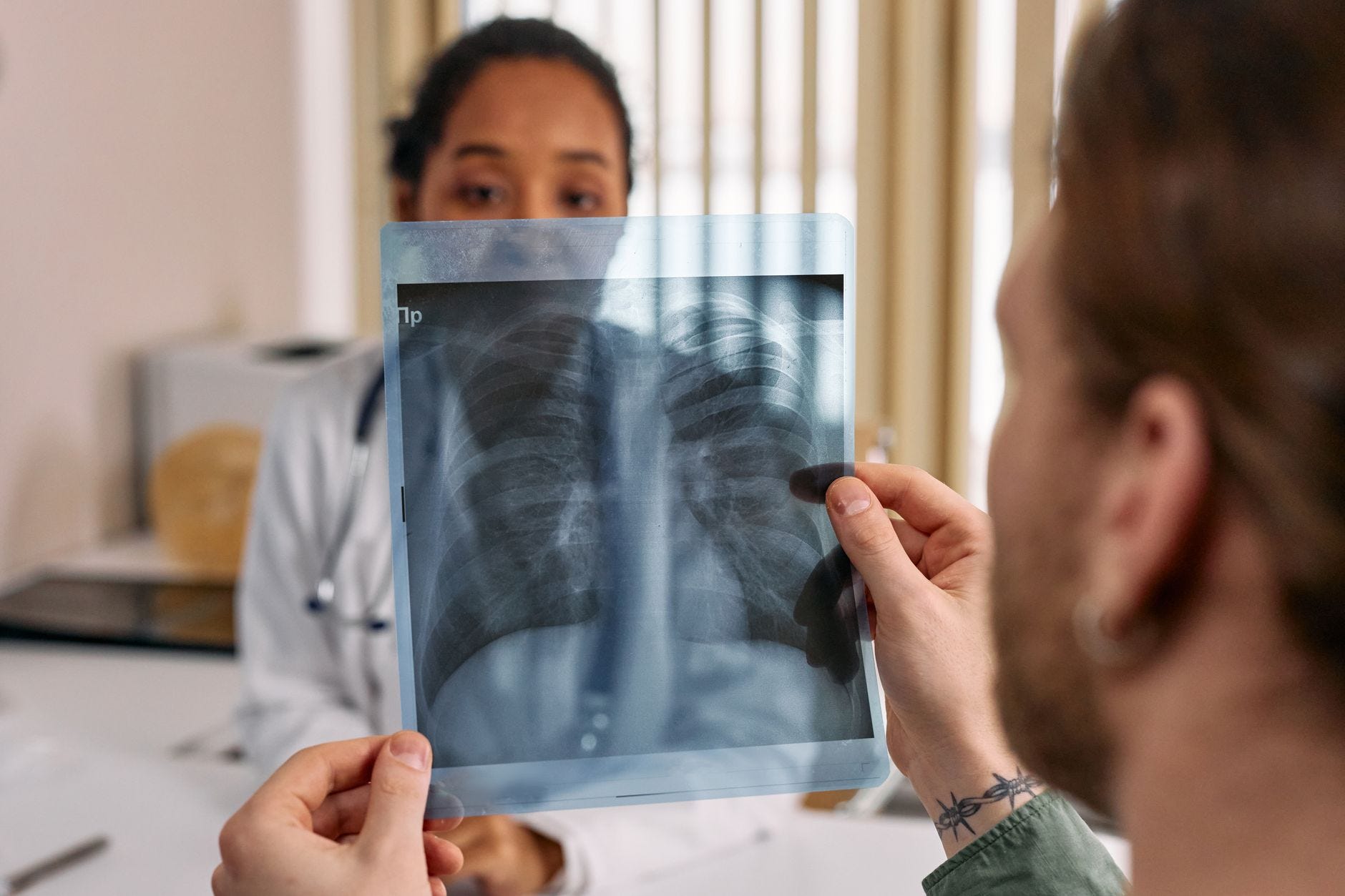
Aidoc describes First Read as an AI system that analyzes chest radiographs and generates high-quality preliminary report text. The BDD was granted for four life-threatening findings. The full commercial version is designed to handle more than 100 pre-specified findings across chest radiography.
First Read is built on the same underlying architecture as Triage - Aidoc's FDA-cleared abdominal CT triage application. The CARE foundation model powers both products. This is architecturally significant: the AI backbone has already been through FDA clearance for one application, and the clinical validation methodology has precedent. That does not guarantee clearance for First Read, but it reduces the architectural uncertainty in the regulatory path.
What First Read does not do: issue final radiology reports. Under the investigational framework and, in all likelihood, under any cleared framework, a radiologist must sign every report produced by First Read. The AI drafts. The radiologist interprets, modifies, and authenticates. This is the standard model for generative AI in high-stakes clinical contexts, and for good reason. Errors, automation bias, and hallucination in radiology reports carry direct patient safety risk. Every sentence in a radiology report carries clinical and legal weight.
📊 Aidoc's platform has analyzed more than 120 million patient cases and is deployed in nearly 2,000 hospitals worldwide, including Sutter Health, Wellspan Health, and Mercy.
The primary value proposition of First Read is time reduction on the reporting workflow. If an AI can produce a structurally complete preliminary draft from image analysis, the radiologist's cognitive task shifts from dictating a report from scratch to reviewing, editing, and signing a document that is largely pre-composed. For routine, normal-result chest radiographs - which make up a significant portion of radiology workload - a high-quality draft could substantially reduce per-study time.
The chart below illustrates where the turnaround time problem is most severe, ranked by modality. CT and MR are the most critical, but even X-ray has seen a 63 percent increase - directly relevant to where First Read is designed to intervene.
4. Aidoc Is Not Alone in This Race
On the same day Aidoc's BDD news broke publicly, another company - UpDoc - received actual FDA clearance for an LLM-based patient-facing clinical AI platform, a reminder that the regulatory calendar is not waiting for any single company.
More directly competitive: Cognita Health received its own Breakthrough Device Designation for a generative AI system for chest X-ray report drafting in June 2026, within days of Aidoc's announcement. Two BDD grants for chest radiograph report generation in the same month is not a coincidence. It reflects where the FDA, and the industry, see the most acute unmet clinical need.
The competitive implication for health systems is important. When two companies receive BDD for functionally similar products in the same month, one of them - or neither of them - will be first to clearance. The one that clears first will have a meaningful head start on deployment evidence, physician adoption, and enterprise contract structure. Health systems that are locked into one vendor's investigational product when the other clears will face difficult switching decisions.
📊 1,451 AI medical devices were authorized by the FDA through December 2025. Radiology accounts for 1,104 of them - 76 percent of the total. In 2025 alone, 331 new AI devices cleared.
The AI report drafting race is also not just chest radiography. Aidoc's own portfolio has expanded through its CARE foundation model into abdominal CT, cardiac imaging, and neurological applications. The platform strategy matters: a health system that deploys Aidoc's triage tools today is building the integration foundation that makes deploying First Read - once cleared - significantly easier. That is not an accident. It is the enterprise software playbook applied to clinical AI.
5. Deep Dive: What This Means for Procurement and AI Strategy
Health system AI strategy right now is being shaped by two forces pulling in opposite directions. The first is urgency: turnaround times are getting worse, radiologists are burning out, and there is real operational and financial pressure to do something. The second is regulatory maturity: the cleared AI portfolio is growing but still limited, and the pipeline is full of products that will look different when they clear than they do in investigational demos.
First Read sits squarely in the second category. BDD means Aidoc has a prioritized path to clearance. It does not mean the product is ready to deploy in patient care.
A practical procurement framework for health systems evaluating AI radiology report generation tools should examine four dimensions.
What is actually cleared today?
Aidoc has 31 or more FDA-cleared tools. None of them is First Read. The cleared portfolio covers triage, prioritization, and finding flagging - not report generation. The cleared tools are deployable now. First Read is not. Health systems evaluating Aidoc's total portfolio should distinguish clearly between what can be contracted and deployed today versus what they are being shown as roadmap material.
What is the clinical evidence package?
BDD grants are based on the device addressing an unmet need, not on clinical evidence of performance in the field. The clinical evidence required for clearance will need to demonstrate that First Read's preliminary reports are accurate, safe, and beneficial. That package does not yet exist in cleared form. Before committing to report generation AI at scale, health systems should ask vendors to provide their clinical evidence once available and establish contractual milestones around clearance events.
What does radiologist workflow integration look like?
First Read generates draft text. But where does that text go? How does it enter the radiologist's reporting workflow? Does it integrate with existing dictation systems, PACS platforms, and RIS software? The clinical workflow integration challenge for report generation AI is substantially more complex than worklist prioritization. A product that generates a good draft but creates friction in the authoring workflow may not reduce turnaround time in practice.
What is the reimbursement pathway?
There is no established CPT code for AI-generated preliminary reports reviewed and signed by a radiologist. The reimbursement picture for report generation AI is genuinely unclear at this stage. Radiology departments evaluating these tools should not assume that existing Professional Component billing for radiologist interpretation will capture the full value created by AI assistance, nor should they assume that a new specific reimbursement code will be available at clearance.
The scorecard below reflects the current landscape as First Read's BDD creates anticipation and procurement pressure across the market.
6. What This Means For You
The Aidoc First Read BDD is real news. It is not a product launch. Here is how different roles should respond right now.
FQHC executives and community health center leaders: FQHCs often rely on teleradiology networks for imaging interpretation. AI report drafting could eventually reshape how those contracts are structured - both in cost and turnaround time. Monitor this space closely but do not build contracts around investigational products. Ask your teleradiology partners what their AI strategy looks like for 2027 and beyond.
Health system administrators and CMOs: Review your radiology AI roadmap against the regulatory status of every tool you are evaluating. Separate cleared from investigational. Cleared tools (worklist prioritization, finding triage) can be deployed now. Report generation tools like First Read cannot. Build your integration infrastructure today around cleared tools, so you are ready when report generation clears.
Radiologists and radiology practice leaders: The framing of AI report drafting as replacing radiologist dictation misses the point. The real shift is cognitive load. A well-trained AI that produces a structurally complete draft moves the radiologist from authoring to editing and authenticating. For departments drowning in volume, that is a meaningful change. Engage with investigational programs if offered. Your workflow feedback at this stage directly shapes what the cleared product looks like.
Healthcare investors and founders: Two BDDs for chest X-ray report drafting in the same month indicates FDA consensus that this is an area of genuine unmet clinical need. The 12 to 13 percent historical BDD-to-market conversion rate means many of these products will not make it in their current form. Back companies with cleared product foundations, strong clinical evidence pipelines, and existing deployment infrastructure - not just promising models.
Health system technology officers: The integration challenge for report generation AI is substantial. Unlike triage tools that flag items in a worklist, report generation AI needs to connect to dictation systems, EHR documentation workflows, and radiologist signing processes. Start mapping your current workflow dependencies now so you can move quickly when cleared products become available.
Closing
The chest X-ray is the most ordered imaging study in medicine. An AI that can reliably draft a preliminary report for more than 100 findings - if it clears and performs in the real world - changes the arithmetic of radiology capacity in a meaningful way. Not by replacing radiologists. By changing what a radiologist's working hour produces.
Aidoc's First Read BDD is a credible, meaningful step toward that future. The FDA does not grant Breakthrough Device Designation to products it does not believe are worth prioritized attention. Aidoc has 31 cleared products, 120 million analyzed cases, and an enterprise footprint across nearly 2,000 hospitals. The foundation model argument is not marketing - it is the reason this product has a faster regulatory path than a de novo entrant starting from scratch.
But the future is not today. Health system leaders who treat a BDD announcement like a product launch will spend real money on phantom infrastructure. Health system leaders who dismiss it because the product is not yet cleared will be flat-footed when it clears. The right posture is engaged awareness: understand what exists, what is coming, and where your workflow gaps are, so you can move decisively when the regulatory calendar permits.
What would change your AI readiness the most right now? Hit reply.
About the Author
Jonathan Govette is the Co-Founder and CEO of Oatmeal Health, an AI lung cancer diagnostic company catching cancers earlier in the communities that need it most. Oatmeal uses AI to identify unscreened high-risk patients, navigate them to care, and score every lung CT for malignancy risk - billed under CPT 0721T. Stage I survival is 77%. Stage IV is 9%. We work in FQHCs because that gap is largest there.
Jonathan writes daily about radiology, pulmonology, AI diagnostics, health policy, hospital operations, and healthcare startups.
Subscribe to stay ahead of healthcare's most important shifts. Weekly deep-dives on AI, radiology, health policy, FQHCs, and the business of healthcare - written for operators, clinicians, and investors who want the signal, not the noise. Subscribe at oatmealhealthjonathangovette.substack.com
Key References
Aidoc press release, June 25 2026: "Aidoc Receives FDA Breakthrough Device Designation for AI That Drafts Radiology Reports" - https://www.aidoc.com/about/news/aidoc-receives-fda-breakthrough-device-designation-for-ai-that-drafts-radiology-reports/
Neiman Health Policy Institute, 2024: "Imaging Interpretation Turnaround Time More Than Doubled Between 2014 and 2023" - https://www.neimanhpi.org/press-releases/imaging-interpretation-turnaround-time-more-than-doubled-between-2014-and-2023/
Healthcare Dive / MedTech Dive, June 26 2026: "Aidoc wins breakthrough nod for AI that reads chest X-rays" - https://www.healthcaredive.com/news/aidoc-wins-breakthrough-nod-for-ai-that-reads-chest-x-rays/823948/
FDA AI/ML-Enabled Medical Devices List, December 2025: 1,451 authorized AI devices, 1,104 in radiology (76%)
MIT Sloan Action Learning: CT imaging delays can add up to 150 minutes to emergency department patient stays


