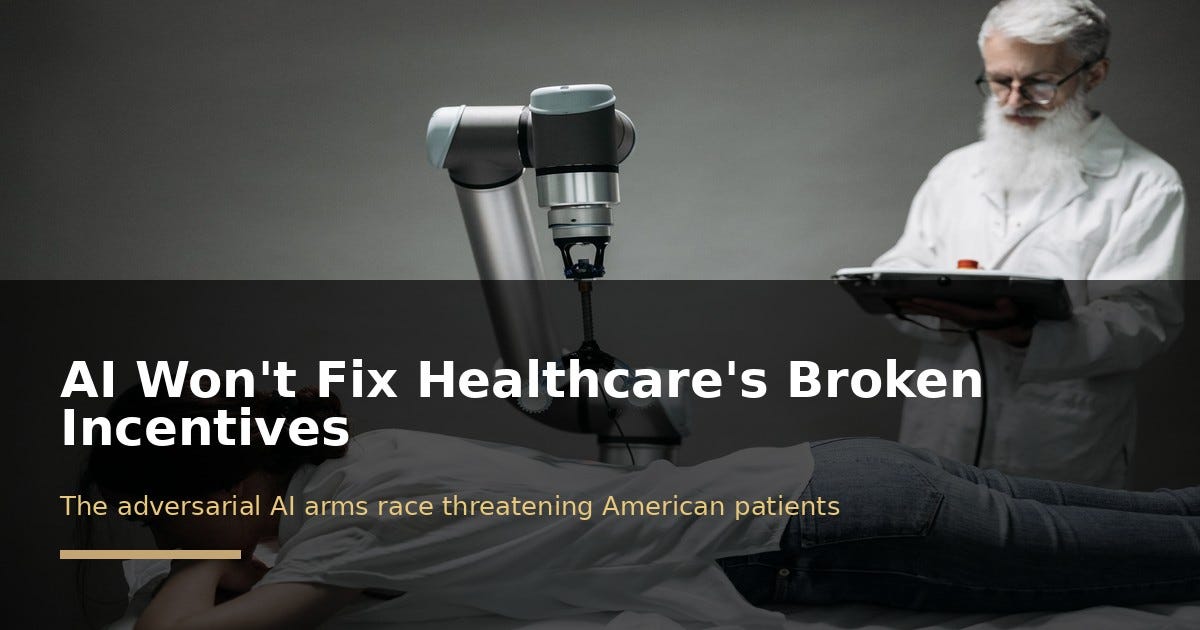
AI Won't Fix Healthcare's Broken Incentives
Marc Andreessen says AI is already a better doctor than 99.99% of humans. Mark Cuban says the same AI will be deployed against you. Both are right, and that is the problem.
On July 12, 2026, Marc Andreessen posted on X. The statement was brief, confident, and viral within hours: "AI is already a better doctor than 99.99% of human doctors. This is good news."
He was not wrong about capability. The evidence is mounting that large language models perform at or above median physician benchmarks on a range of diagnostic reasoning tasks. The technology is real. The capability gains are real.
Then Mark Cuban replied. And his reply cut straight to the thing nobody in Silicon Valley wants to talk about.
Cuban warned that AI could make healthcare worse - not because the tools are weak, but because of who else gets access to them. Insurers, he argued, will weaponize the same AI that helps doctors diagnose faster to deny claims faster. "For every future agent we give AI doctors to deal with this friction, the conglomerates will have multiple adversarial agents doing all they can to delay and deny," he wrote. He called it the agentic version of Spy vs. Spy.
Both men are right. And the fact that they are both right is the entire problem.
Andreessen is making a capability argument. Cuban is making an incentives argument. These are not the same debate. Capability is easy to demonstrate in a benchmark. Incentives are structurally embedded in trillion-dollar businesses that profit from the opacity of the current system. Better tools handed to a broken system do not fix the system. They accelerate it.
1. The Andreessen Thesis and Its Limits
Marc Andreessen's claim has a foundation. AI systems are genuinely improving diagnostic performance. In controlled evaluations, large language models have matched or exceeded average physician accuracy on board exam questions and clinical reasoning tasks. Andreessen Horowitz has bet heavily on this thesis, deploying capital into Hippocratic AI, Ambience Healthcare, and Abridge, and managing a $500 million Biotech Ecosystem Venture Fund backed by Eli Lilly.
The problem is not the claim itself. The problem is what the claim leaves out.
A benchmark is not a patient. A controlled evaluation is not a clinical encounter with a 67-year-old woman who has three comorbidities, takes eleven medications, lives alone, and has a history of not following up. AI diagnostic accuracy in a lab setting tells you almost nothing about what happens when the AI's recommendation hits a prior authorization wall, a plan formulary exclusion, a specialist wait list, or a billing department.
In one peer-reviewed study, an AI system missed half of true medical emergencies - a metric that benchmark scores do not capture.
The capability argument wins on accuracy. It loses on access, continuity, and the structural filters between a diagnosis and the actual delivery of care. Those filters are not a technology problem. They are a financial model problem. And the financial model is optimized for something other than getting the right care to the right patient.
2. The Cuban Thesis: The Adversarial Agent Problem
Mark Cuban has been living in the healthcare system long enough to know how it responds to disruption. He launched Cost Plus Drugs in 2022, selling generic medications at manufacturer cost plus a flat 15 percent markup with no pharmacy benefit manager and no hidden pricing. By early 2026, the platform had expanded to over 50 drugs, with major manufacturers including Pfizer, AstraZeneca, Eli Lilly, and Novo Nordisk participating.
His insight is simple: the system does not fix itself when you give it better tools. It uses better tools to preserve its existing incentive structure.
The evidence backs him up. Cigna's AI algorithm processed approximately 300,000 prior authorization denials in just two months, with medical reviewers allegedly spending an average of 1.2 seconds per case. UnitedHealthcare denied 20 percent of ACA marketplace claims in Plan Year 2024 - and for Medicare Advantage prior authorizations, denied approximately 12.8 percent of requests, one of the highest rates nationally.
Now the arms race is going agentic. The same AI infrastructure being built to help providers navigate prior authorization and appeal denials is being deployed by payers to issue them faster. The revenue cycle has become an adversarial AI battlefield.
In 2026, healthcare organizations are deploying AI at both ends of every claim: providers use Akasa, Waystar, and Adonis to file and appeal; payers use Cohere Health and SmarterDx to evaluate and deny. The automation is symmetric. The power is not.
3. The Numbers Behind the Arms Race
The scale of the problem is not theoretical. Employer health benefit costs exceeded $18,500 per employee in 2026, a 15-year high according to Mercer. That represents a 6.7 percent year-over-year increase, with Aon projecting closer to 9.5 percent when full-year data is counted.
The prior authorization system is the most visible pressure point. In 2024, Medicare Advantage insurers alone processed nearly 53 million prior authorization requests and denied 4.1 million of them - a 7.7 percent denial rate. When patients and providers appealed those denials, 80.7 percent were fully or partially overturned.
That number should stop you. Eight in ten denials that get appealed are overturned. That is not a medical determination. That is a financial filter designed to eliminate patients who do not have the resources to fight back.
Claim denial rates hit 11.8 percent of initial submissions across commercial insurance in 2024. Working a denied claim costs an average of $57.23 per claim, up from $43.84 the year prior. And 65 percent of denied claims are never reworked at all.
The physician burden is equally stark. The average physician spends 13 hours per week on prior authorization tasks alone. Two in five practices now employ staff dedicated exclusively to prior authorization.
A January 2026 study in Health Affairs found that AI systems deployed in insurance decision-making lack robust governance processes to monitor accuracy and potential bias. Four states passed bills in the 2025 legislative session to prohibit payers from using AI to deny medical necessity or prior authorization determinations outright.
4. Thirty Years of Technology Promises
The Cuban-Andreessen debate is not new in its form. Healthcare has been here before. Electronic health records were going to transform care delivery. HITECH Act passed in 2009, roughly $38 billion in federal incentives deployed, and the result was a documentation system that many physicians describe as the primary driver of their burnout.
Telehealth was going to democratize access. It did expand access to some populations during COVID, but it also introduced new billing complexity, new equity gaps, and a reimbursement regime that has been partially rolled back since 2023.
Every technology cycle produced better tools. None of them changed the underlying incentive structure. The incentive structure profits from complexity, from opacity, from the friction between a patient's need and the delivery of care.
AI is different from its predecessors in one critical dimension: scale and speed. A physician reviewing a chart is bounded by human cognition. An AI agent reviewing 300,000 claims per month at 1.2 seconds per case is bounded by compute costs. That asymmetry matters enormously.
5. What Cuban Is Actually Proposing
Mark Cuban's response to the incentives problem is not to reject technology. It is to reject the intermediaries. His blueprint: eliminate PBMs, build patient-side AI, and force pricing transparency.
The Break Up Big Medicine Act, which Cuban backed, was introduced in February 2026. It would force large insurers to separate PBM divisions, provider groups, and drug distribution networks from their core insurance business.
His investment in Claimable, an AI startup that writes appeal letters for patients whose insurance claims are denied, illustrates the patient-side approach. Roughly three out of four patients who appeal through it win a reversal - consistent with the broader data showing that most denials cannot withstand a challenge.
Deep Dive: The Incentives Map
To understand why AI will not automatically fix healthcare, you need to understand who is paid to do what.
The Payer Incentive
A commercial insurer is paid a premium. It pays out claims. The difference is profit. The financial incentive is to minimize claims paid. AI makes denial mechanisms faster, cheaper, and scalable to volumes that human reviewers could never match. UnitedHealth is spending approximately $1.5 billion on AI in 2026. The primary application is not diagnostic assistance. It is claims processing and risk adjustment.
The Provider Incentive
A provider in a fee-for-service model is paid per service. Prior authorization creates friction between the service and the payment. Revenue cycle management firms exist because that friction has become so severe that hospitals cannot manage it internally. Working a denied claim costs $57.23. With denial rates at 11.8 percent and 65 percent of denied claims never reworked, a $1 billion hospital system is leaving roughly $77 million on the table annually.
The Patient Incentive
A patient has no financial incentive in this structure. They want care. They are operating in a system where 82 million Americans made healthcare affordability trade-offs last year, and employer health costs now exceed $18,500 per employee annually. When AI enters as a denial tool, patients bear all the cost: delayed care, abandoned claims, higher out-of-pocket exposure, and worse health outcomes.
The Accountability Gap
Four states passed legislation in 2025 requiring human review of AI denial decisions. Federal rulemaking in 2026 now requires specific denial reasons. These are meaningful steps. They are not sufficient to reverse a structural incentive that pays for denials.
What This Means For You
FQHC executives and community health center leaders: Your denial rate is almost certainly above the commercial average. Invest in AI tools on the provider side before your payers upgrade their denial infrastructure. The window to get ahead of the asymmetry is closing.
Health system administrators and CMOs: The $1.5 billion UnitedHealth is spending on AI this year is going to claims processing. Model your denial rate trends over the next three years and build that into your RCM strategy now.
Radiologists and pulmonologists: Prior authorization for advanced imaging is already algorithmically driven at most major payers. Build relationships with RCM teams and understand the authorization landscape for your primary CPT codes - including CPT 0721T for AI-augmented lung cancer screening.
Healthcare investors and founders: The highest-margin opportunity in healthcare AI is the adversarial layer - tools that help providers fight payer denials faster than payers issue them. Claimable's 75 percent reversal rate is a product-market fit signal.
Policy advocates: The regulatory window is open. Four states have passed AI denial prohibition bills. The 2026 midterms create a federal legislative opportunity.
Closing
Andreessen is right that AI can diagnose better than most physicians in controlled settings. Cuban is right that the same technology will be deployed against patients at scale by the entities that profit from denying care.
The technology is not the problem and it is not the solution. It is an accelerant. It makes whatever system it enters faster and more efficient. If that system is aligned with patient outcomes, AI is transformative. If that system profits from complexity and denial, AI is a faster denial machine.
The question is not whether AI is smarter than a doctor. The question is: who controls it, who benefits from it, and who gets left out. That answer matters a lot more than any benchmark score.
If you are running an FQHC, a radiology practice, a health system, or a startup trying to build something real in healthcare, reply directly to this email. I want to hear what you are seeing on the ground.
About the Author
Jonathan Govette is the Co-Founder and CEO of Oatmeal Health, an AI lung cancer diagnostic company catching cancers earlier in the communities that need it most. Oatmeal uses AI to identify unscreened high-risk patients, navigate them to care, and score every lung CT for malignancy risk - billed under CPT 0721T. Stage I survival is 77%. Stage IV is 9%. We work in FQHCs because that gap is largest there.
Jonathan writes daily about radiology, pulmonology, AI diagnostics, health policy, hospital operations, and healthcare startups. Subscribe at oatmealhealthjonathangovette.substack.com
Key References
Mark Cuban on AI and healthcare denials, July 2026 - Shortlysts/Benzinga coverage of Cuban's X response to Andreessen
KFF analysis: HealthCare.gov insurers denied roughly 1 in 5 in-network claims in 2024
Mercer 2026 National Survey of Employer-Sponsored Health Plans: average cost exceeds $18,500/employee
AMA 2025 survey: 61% of physicians worry AI is increasing prior authorization denials; average physician spends 13 hours/week on PA tasks
CMS Medicare Advantage data 2024: 53M prior auth requests, 4.1M denials, 80.7% overturn rate on appeal


