


Early-stage lung cancer surgery is not the finish line. It is the beginning of a second race, and the ADAURA trial just told us who wins it.
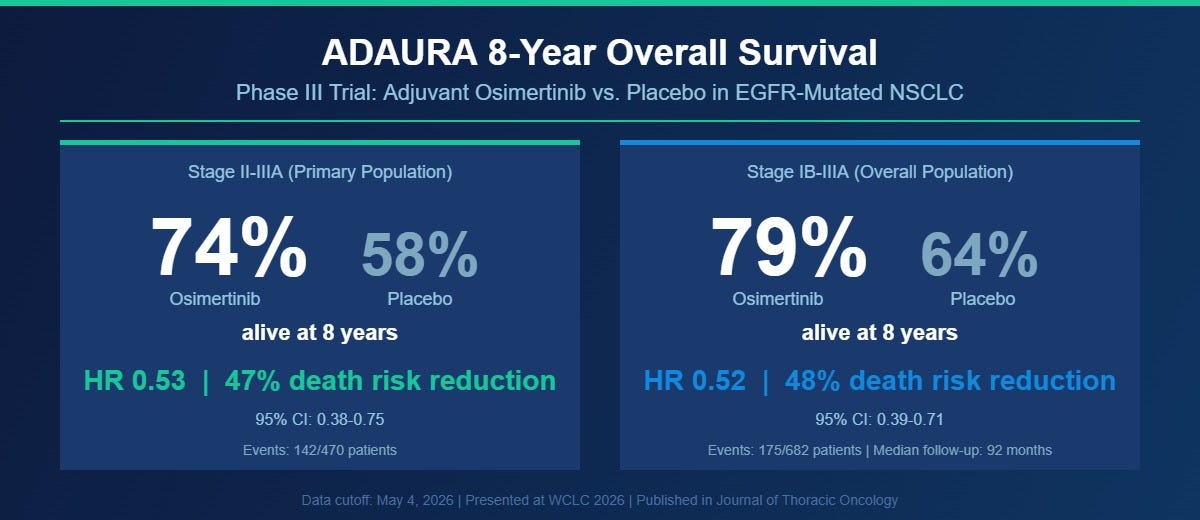
In September 2026, AstraZeneca presented the 8-year exploratory overall survival (OS) update from the Phase III ADAURA trial at the World Conference on Lung Cancer. The data were published simultaneously in the Journal of Thoracic Oncology. The numbers, already striking at three and five years, are now definitive: adjuvant osimertinib (Tagrisso) reduces the risk of death by 47 percent in patients with resected Stage II-IIIA EGFR-mutated non-small cell lung cancer. This is the longest survival follow-up ever reported from a global Phase III trial in this setting.
For thoracic oncologists, radiation oncologists, and health system leaders, the question is no longer whether osimertinib belongs in the adjuvant setting. That question is closed. The question is whether your multidisciplinary workflow is built to actually deliver the benefit these numbers promise. Most are not.
This piece gives tumor board teams a concrete reference framework for understanding what the 8-year data means, who benefits, what the real-world adherence evidence tells us, and how to operationalize these results in four specific steps before the next resected EGFR-mutated NSCLC patient leaves the building.
What the 8-year ADAURA data actually shows
The ADAURA trial enrolled 682 patients with completely resected Stage IB-IIIA EGFR-mutated NSCLC across 200 sites in more than 20 countries. Patients were randomized to receive adjuvant osimertinib or placebo for up to three years, with or without prior adjuvant chemotherapy. The data cutoff for this exploratory OS analysis was May 4, 2026, with a median follow-up of 92 months in the osimertinib arm and 68.5 months in the placebo arm.
The results by population:
Primary population (Stage II-IIIA):
8-year OS rate: 74% with osimertinib vs. 58% with placebo
Hazard ratio: 0.53 (95% CI, 0.38-0.75)
Death risk reduction: 47%
Events: 142 of 470 patients
Overall population (Stage IB-IIIA):
8-year OS rate: 79% with osimertinib vs. 64% with placebo
Hazard ratio: 0.52 (95% CI, 0.39-0.71)
Death risk reduction: 48%
Events: 175 of 682 patients
Translate these into absolute terms. In the primary population, the 16-percentage-point survival gap at eight years means that for every six patients treated with adjuvant osimertinib rather than placebo, one additional patient is alive who would otherwise not be. In the broader Stage IB-IIIA population, the gap is 15 percentage points. These are not marginal gains at the edge of confidence intervals. These are durable, statistically robust, clinically meaningful separations in survival curves that are sustained nearly a decade out from surgery.
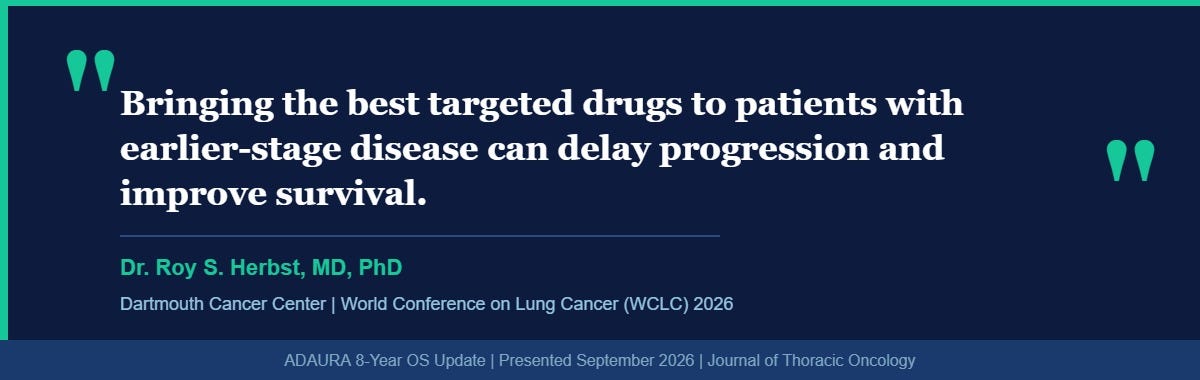
Dr. Roy S. Herbst of Dartmouth Cancer Center, who presented the data at WCLC 2026, described the result as a paradigm shift: "Bringing the best targeted drugs to patients with earlier-stage disease can delay progression and improve survival." He noted that the benefit is especially impressive given the high rates of crossover to osimertinib following disease recurrence in the placebo arm. That crossover should have narrowed the survival gap. It did not.
Dr. Susan Galbraith, AstraZeneca's executive vice president of oncology research, characterized the finding as reinforcing that osimertinib is the adjuvant standard of care: "These results underscore the importance of treating early."
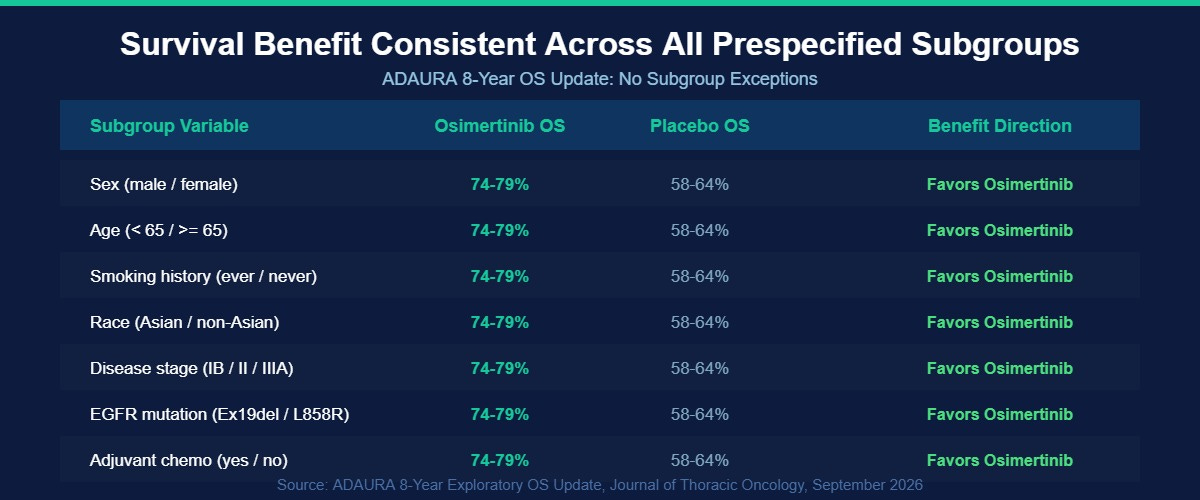
The benefit held across every prespecified subgroup analyzed: sex, age, smoking history, race, disease stage, EGFR mutation type (exon 19 deletion vs. L858R), and adjuvant chemotherapy use. That breadth of consistency matters for tumor boards because it forecloses the common fallback of deferring adjuvant therapy based on patient-level factors that the data do not support as meaningful modifiers.
Why the crossover story matters to your tumor board
One detail buried in the data deserves more clinical attention than it typically receives. The ADAURA placebo arm had high rates of crossover to osimertinib after disease recurrence. Crossover dilutes survival differences by giving the control arm access to the experimental treatment at progression, making the experimental arm's benefit harder to demonstrate. The fact that a 47-48 percent reduction in death risk survived that dilution is a signal of unusual treatment durability.
Put differently: even patients who received osimertinib only at the point of metastatic recurrence did substantially worse than patients who received it in the adjuvant setting. The survival advantage is not simply a function of osimertinib's activity. It is a function of when in the disease course the drug is deployed.
This has direct implications for how tumor boards frame the adjuvant discussion with patients and families. The argument for adjuvant osimertinib is not merely that the drug works. It is that the drug works differently, and more powerfully, when it targets micrometastatic disease before clinical relapse. Framing it as "cancer prevention" rather than "additional treatment" aligns with the actual biology and may improve patient acceptance of a three-year regimen.
The real-world adherence data changes the risk equation
The trial data establish what is possible with adjuvant osimertinib. Real-world data tell us what is actually happening in practice, and the gap is substantial.
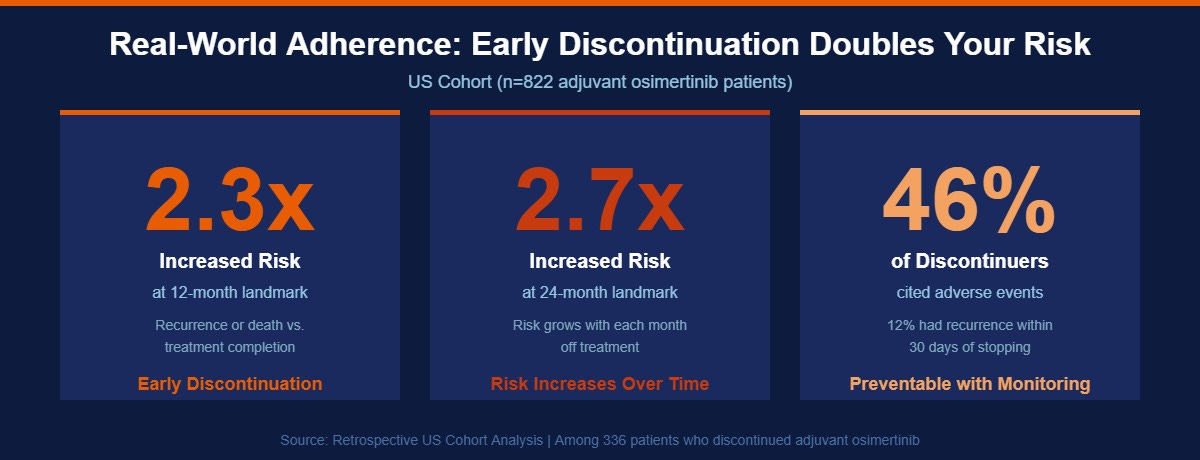
A retrospective US cohort analysis of 822 patients receiving adjuvant osimertinib found that early treatment discontinuation before completing the three-year course was associated with dramatically worse outcomes:
At the 12-month landmark: patients who discontinued early had a 2.3-fold increased risk of recurrence or death compared to patients who remained on treatment.
At the 24-month landmark: the risk increased further, to 2.7-fold.
Among the 336 patients who discontinued: 12 percent experienced disease recurrence within 30 days of stopping, and 46 percent cited adverse events as the reason for stopping.
The structure of that finding deserves unpacking. Nearly half of patients who stopped did so because of toxicity, not because the cancer came back. Toxicity-driven discontinuation is a systems failure, not a patient failure. It means that tumor boards and medical oncology teams are not catching and managing adverse events early enough to keep patients on a regimen that meaningfully extends their lives.
The most common adverse events driving discontinuation in the trial and real-world populations include diarrhea, rash, paronychia, and interstitial lung disease. None of these are unmanageable with proactive monitoring and timely dose modification. But proactive monitoring requires a workflow that reaches patients between clinic visits, tracks symptom burden longitudinally, and has a defined protocol for dose interruption or reduction before a patient decides on their own to stop.
Tumor boards that approve adjuvant osimertinib without a corresponding plan for adherence infrastructure are not fully delivering the benefit the ADAURA trial demonstrates. They are setting up the patient for a 2.3- to 2.7-fold increase in recurrence risk every month they are not completing the course.
The four-question framework for every EGFR-mutated resected NSCLC case
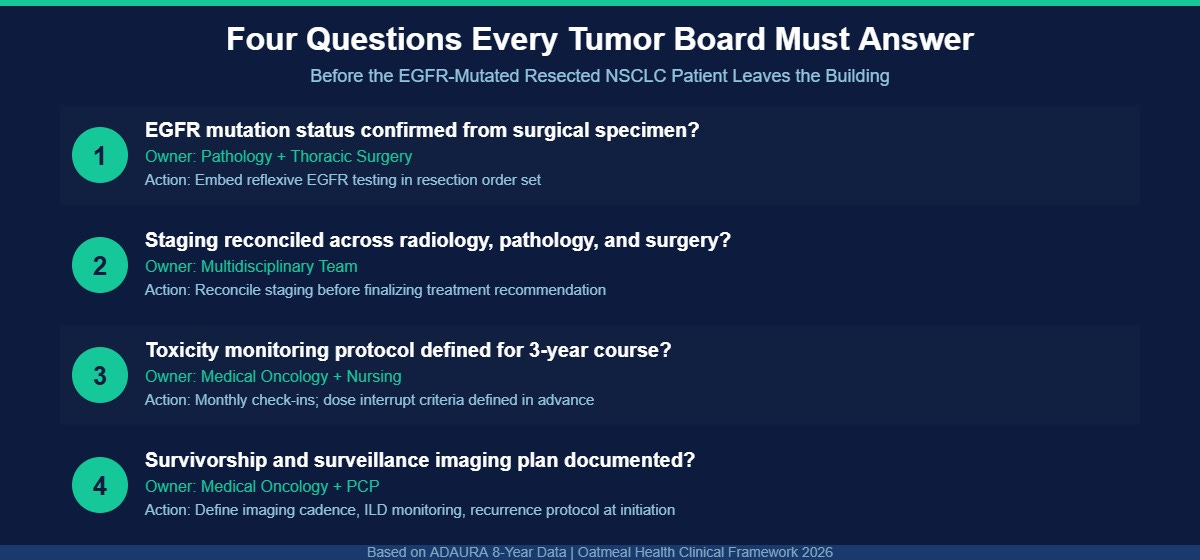
The ADAURA 8-year data resolve the clinical question of whether to offer adjuvant osimertinib. They create four operational questions that every multidisciplinary team must be able to answer before the patient leaves the tumor board discussion. If any question cannot be answered, the workflow has a gap that needs to be closed before the next case reaches the board.
Question 1: Is the EGFR mutation status confirmed from the surgical specimen?
Adjuvant osimertinib applies only to EGFR-mutated disease. This seems obvious, but the operational reality is that reflexive EGFR testing on resected specimens is not universal. In community hospitals and non-academic thoracic surgery programs, the reflex order for biomarker testing after resection is often not placed, or placed inconsistently, or not routed to pathology in a manner that ensures the result is available before the patient returns for their first post-surgical oncology visit.
If your thoracic surgery program does not have a protocol requiring EGFR mutation testing on every resected Stage IB-IIIA NSCLC specimen, the patient seen in surgery this week may be invisible to medical oncology when adjuvant therapy is appropriate. The care gap opens before the tumor board convenes.
The fix is an order set, not a reminder. Embed reflexive biomarker testing into the surgical resection pathway so that pathology automatically orders the panel when the specimen is received. The result should be in the chart before the patient's 30-day post-surgical visit.
Question 2: Is the staging confirmed and aligned across radiology, pathology, and surgery?
The survival data differ by stage. Stage IB patients have a meaningful but narrower benefit than Stage II-IIIA patients, which affects how the adjuvant conversation is framed, particularly for patients with comorbidities, concerns about a three-year regimen, or quality-of-life priorities that affect treatment tolerance.
Staging discordance between the radiology read, pathology staging, and the surgeon's operative staging is more common than tumor boards typically acknowledge. A patient staged as IIA on CT may be restaged as IB by pathology based on the resected specimen, or vice versa. If the multidisciplinary team is working from different staging documents, the adjuvant recommendation may be applied to the wrong patient or framed with the wrong data.
Staging reconciliation should be a standing agenda item for every resected NSCLC case at tumor board. The radiologist, pathologist, and surgeon should each confirm the staging before the treatment recommendation is finalized. This is not a high-cost intervention; it is a structured conversation that takes two minutes and prevents misapplication of the data.
Question 3: Is there a toxicity monitoring protocol in place for the three-year course?
The real-world discontinuation data above are not an argument against adjuvant osimertinib. They are an argument for infrastructure. A 46 percent adverse event rate among patients who discontinue is not a signal that the drug is intolerable. It is a signal that adverse events are reaching the threshold of patient-initiated discontinuation before clinical teams have intervened.
Standard oncology follow-up intervals (clinic visit every three months) may not be sufficient to catch diarrhea or rash in the window before it becomes dose-limiting. Remote symptom monitoring tools, patient-reported outcome surveys, and nurse navigator check-ins at one-month intervals can extend the team's reach between visits.
Write the protocol before the first patient starts adjuvant therapy, not after the first patient discontinues. The protocol should specify: the minimum monitoring interval, the symptom thresholds that trigger a proactive call, the defined criteria for dose interruption versus dose reduction, and who in the team holds the responsibility for each decision.
Question 4: Is a survivorship and surveillance imaging plan defined at the time of adjuvant initiation?
Eight-year data mean you are managing a patient relationship across nearly a decade. The ADAURA trial was three years of treatment and nearly eight years of follow-up. Recurrence can occur after the adjuvant course ends, and in EGFR-mutated NSCLC, late recurrence is a documented pattern.
Survivorship imaging protocols for adjuvant osimertinib patients should be written at the time the patient starts therapy, not when the course ends. This includes: the timing and modality of surveillance imaging during and after the adjuvant period, pulmonary function tracking for patients at risk of ILD, the plan for re-biopsy and repeat molecular testing if recurrence is detected, and the handoff protocol from medical oncology to primary care for long-term survivorship.
The practical test for your tumor board: after reviewing a resected Stage II-IIIA EGFR-mutated NSCLC case, can every member of the team answer all four questions before the meeting ends? If not, identify which question lacks a defined answer and who owns the action item to close it.
What this means for radiation oncology
Radiation oncologists are less directly in the adjuvant osimertinib treatment chain, but the ADAURA 8-year data have meaningful implications for how the radiation oncology team functions in the multidisciplinary workflow.
First, radiation oncology plays a direct role in staging. PET-CT and CT interpretation that guides clinical staging before and after resection informs whether a patient meets the Stage IB-IIIA criteria for adjuvant eligibility. Precision in staging reads, clear documentation of nodal involvement, and proactive communication of ambiguous findings to the tumor board are not administrative tasks. They are clinical decisions that determine whether a patient receives a drug that reduces their death risk by 47 percent.
Second, for patients with locally advanced NSCLC who are not surgical candidates, the ADAURA data reinforce the growing body of evidence for EGFR-targeted approaches in combination with definitive chemoradiation. While the adjuvant osimertinib indication is specific to resected disease, the survival durability demonstrated in ADAURA raises the question of how earlier biomarker-guided systemic therapy might interact with radiation in the unresectable setting. This is a research question, not a current standard, but radiation oncologists who are not engaged with the biomarker-driven evolution of thoracic oncology are increasingly working alongside medical oncologists without a shared clinical language.
Third, radiation oncology teams that treat patients with chest wall or mediastinal recurrence after completed adjuvant osimertinib courses face a different disease biology than the pre-ADAURA recurrence population. The patient who recurs after three years of adjuvant osimertinib may have acquired resistance mutations that change the re-treatment calculus. Radiation oncologists should be part of the molecular tumor board conversation at recurrence, not only at initial staging.

What this means for health system leaders
Health system leaders tend to engage with ADAURA as a coverage and formulary question. It is that, but it is also an operational question.
The practical barriers to delivering the ADAURA benefit in a health system setting are not primarily clinical. They are logistical. Does the thoracic surgery program have a reflexive biomarker ordering protocol tied to the surgical resection pathway? Does the medical oncology team have a defined symptom monitoring workflow that reaches patients at monthly intervals rather than quarterly? Does the tumor board have a structured format that ensures all four decision-framework questions are answered for every resected NSCLC case?
None of these require capital investment. They require someone to own the process design and a clinical leader with the authority to standardize it across the program.
The return on that investment is substantial. A 47 percent reduction in death risk for a patient population that is relatively early-stage, already resected, and otherwise well enough to tolerate a three-year oral regimen is not a marginal benefit. For a health system with a meaningful thoracic surgery volume, the aggregate effect on five- and eight-year survival outcomes is a measurable quality metric, a HEDIS-adjacent survivorship outcome, and increasingly, a network value proposition.
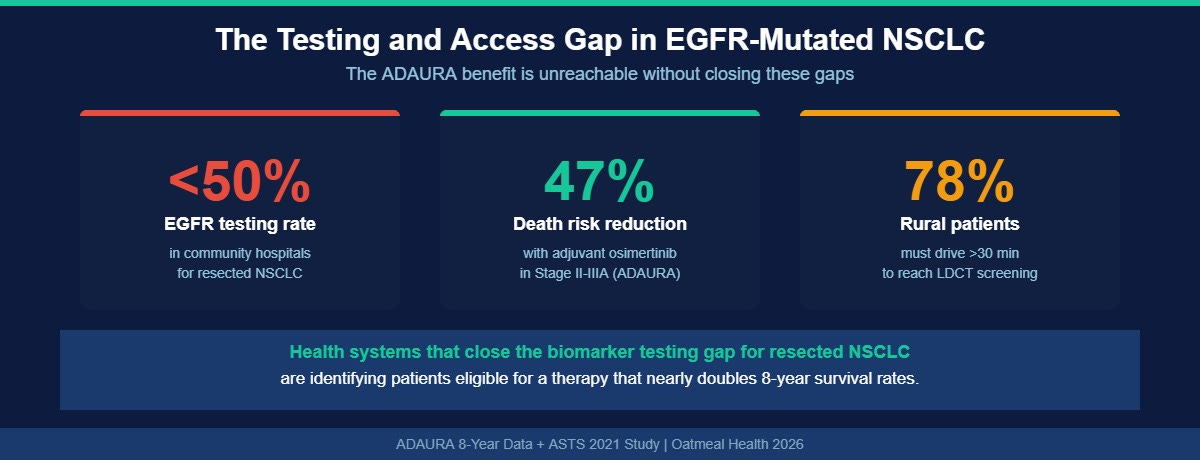
The access dimension matters too. EGFR mutation testing rates in community settings remain below the rates in academic medical centers, and the gap in adjuvant osimertinib initiation tracks closely with the testing gap. Health systems that invest in closing the biomarker testing gap for resected NSCLC are not only improving quality. They are identifying patients who are eligible for a therapy that keeps them alive nearly twice as often at eight years as patients who do not receive it.
The AI diagnostics connection
At Oatmeal Health, we build AI lung cancer diagnostics designed for the settings where catching cancer early is hardest: underserved communities, rural hospitals, and health centers where low-dose CT screening referral pathways are inconsistent and follow-up infrastructure is thin. The ADAURA 8-year data are directly relevant to that work.
The survival benefit in ADAURA applies to resected early-stage disease. It does not apply to Stage IV. The 47 percent reduction in death risk is available only to patients who are identified early enough to be surgical candidates. For patients whose lung cancer is found at Stage IIIB or Stage IV because they were never screened or because a screening finding was not followed up, the ADAURA benefit is not in reach.
This is the upstream case for lung cancer screening in underserved populations. Every patient who is identified at Stage II through a well-functioning screening program and who meets the criteria for surgical resection is a potential ADAURA patient. Every patient who falls through the screening gap because they lack access to LDCT, a primary care home to order it, or a follow-up system to close the loop is a patient who will not get to Stage IB-IIIA before becoming unresectable.
The AI diagnostic layer in screening programs matters precisely because it compresses the time between an ambiguous finding and a clinical decision. A nodule that sits in a queue for two weeks before a radiologist reads it, and then another two weeks before the primary care provider acts on the read, is a nodule that may have crossed a staging threshold. The AI read that flags and prioritizes it in 24 hours is not a technical upgrade. It is a care access intervention.
For radiology leaders whose lung screening programs refer into thoracic oncology networks: the ADAURA 8-year data are an argument for measuring your program's staging distribution at referral, not just your scan volume. A screening program that finds mostly Stage IIIB and IV cancers is not delivering the ADAURA opportunity. A program that finds Stage I and II cancers is.
Key takeaways for the tumor board checklist
The ADAURA 8-year data are clear enough that they require no hedging on the clinical recommendation. Adjuvant osimertinib is the standard of care for resected Stage IB-IIIA EGFR-mutated NSCLC. The debate about whether to offer it is over.
The work now is operational. Before your next resected EGFR-mutated NSCLC case reaches the tumor board, confirm the following:
Reflexive EGFR testing on the surgical specimen is embedded in the pathology order set, not dependent on a physician's memory.
Staging is reconciled across radiology, pathology, and surgery before the treatment recommendation is finalized.
A toxicity monitoring protocol exists with defined intervals shorter than standard quarterly follow-up, clear thresholds for intervention, and an assigned owner for proactive patient contact.
A survivorship and surveillance imaging plan is documented at the time of adjuvant initiation, including post-course imaging cadence, pulmonary function tracking, and a re-biopsy protocol for late recurrence.
The eight-year survival curves in ADAURA are separated by 15 to 16 percentage points and sustained. That separation does not happen by accident. It happens when every step from resection to adjuvant initiation to toxicity management to long-term surveillance is operationalized with intention.
Your tumor board is the operational center where that intention either becomes a system or stays an aspiration.
Key References
Roy S. Herbst et al., "ADAURA Exploratory 8-Year Overall Survival Landmark Update," Journal of Thoracic Oncology, September 2026; presented at WCLC 2026.
AstraZeneca press release: "Eight-Year ADAURA Update Shows Sustained Overall Survival Benefit With Adjuvant Osimertinib in Resected EGFR-Mutated NSCLC," September 2026.
Targeted Oncology, "Adjuvant Osimertinib Sustains 8-Year OS Benefit in Resected EGFR+ NSCLC," September 2026.
ASCO Post, "Long-Term Benefit Seen With Adjuvant Osimertinib in EGFR-Mutated NSCLC," September 2026.
OncLive, "ADAURA 8-Year Overall Survival Landmark Update," September 2026.
Jonathan Govette is the Co-Founder and CEO of Oatmeal Health, an AI lung cancer diagnostics company focused on catching cancers earlier in underserved communities. He writes The Oatmeal Bite on the policy, payment, and technology forces shaping thoracic oncology and community health.