

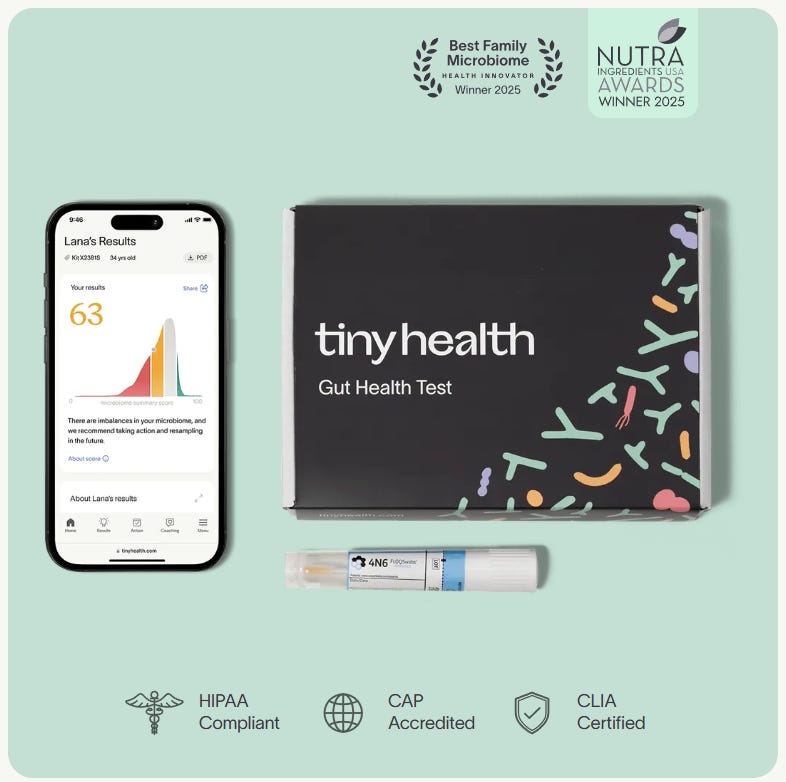
On October 1, 2026, Tiny Health closed a $33 million Series B. The round was oversubscribed. B Capital led it. Stanford Medicine, Mayo Clinic, and Massachusetts General Hospital are on the enterprise partner list. More than 6,000 practitioners use the platform.
And the CEO describes the product as a wellness test.
That gap between the institutional partnerships and the regulatory label is not a contradiction. It is a strategy. It is also a lens for understanding one of the more important questions in diagnostics right now: when does clinical adoption require clinical evidence? The answer is not as obvious as most procurement policies assume.
This piece walks through the Tiny Health round, the evidence behind the test, the regulatory lane the company chose deliberately, and the oncology science that shows where the microbiome field is actually heading. It ends with a practical checklist for the administrators, medical directors, and benefits leaders who will be pitched something like this next quarter.
1. The round in plain numbers
Tiny Health raised $33 million in a Series B led by B Capital. Existing investors Spero Ventures, The Venture City, and Overwater Ventures participated. New capital came from Black Opal Ventures, Denver Ventures, Pave Health Ventures, Alumni Ventures, Gaingels, and Pari Passu Ventures. B Capital's Nick Whitehead, a senior principal who called the gut microbiome "one of the most significant and under-explored frontiers in human health," joins the board.
The round brings total funding to $46 million. Working backward: a $4.5 million seed in 2021 and an $8.5 million Series A in late 2023 account for $13 million. The Series B is roughly 72% of everything the company has ever raised. Three-quarters of its capital arrived in one round.
The stated use of proceeds covers three areas. First, scaling TinyAI, an analytical engine trained on approximately 200,000 longitudinal gut and vaginal microbiome profiles. Second, launching a $5 million Microbiome Research Program that invites academic and clinical researchers to use Tiny tests and data. Third, expanding research into four clinical areas: inflammatory bowel disease, perimenopause and menopause, oncologic drug response, and GLP-1 receptor agonist interactions.
Notice the shape of that list. One item is a product. Two are research. A company that calls itself a wellness test is spending a meaningful share of new capital on the work a diagnostics company does when it wants to cross the payer line.
The company did not disclose a valuation or an absolute revenue figure. CEO Cheryl Sew Hoy told MedCity News that revenue has more than doubled each year. The company has roughly 40 employees and plans to add 30, a 75% headcount expansion funded by this round. The direct-to-consumer tests cost $249 each. The Tiny+ subscription costs $399 per year for two tests; more than half of customers subscribe. Adult test volume now exceeds pediatric test volume. Half of revenue comes from DTC.
These are directional figures from a private company. Treat them as such.
2. The 54-infant trial that anchors the narrative
The centerpiece of Tiny Health's clinical story is a randomized controlled trial published in Pediatric Allergy and Immunology in 2025. The citation is Nieto et al., doi: 10.1111/pai.70182. The paper's title is "Improving immune-related health outcomes post-cesarean birth with a gut microbiome-based program: A randomized controlled trial."
The result is a striking one. Infants in the intervention arm had 83% lower odds of developing eczema compared to controls.
What the trial actually shows deserves a careful read.
The study enrolled C-section infants and divided them into an intervention arm and a control group. The intervention combined at-home microbiome testing, strain-specific probiotic recommendations, and parental education. In the intervention arm, 64% of infants received Bifidobacterium-containing probiotics. In the control arm, 3% did. The follow-up window is described as short, and the paper itself notes the small sample size as a limitation. The publicly available study page does not state the odds ratio numerically, does not give a confidence interval, and does not report a p-value.
A modeled scenario circulating alongside the trial projects 260 fewer eczema cases per 1,000 pediatric patients. That number comes from Dr. Elisa Song, a collaborator and Tiny Health's chief medical officer, speaking with NutraIngredients. The article identifies it explicitly as a model, not a trial result. Both figures show up in vendor materials. Buyers should know which is which before a purchasing decision.
None of this makes the 83% result false. A small randomized trial with a strong effect is a legitimate reason to run a larger one. Tiny Health says a second RCT is active. The appropriate framing for the existing evidence is: early, company-run, and promising. The follow-up trial will tell a more complete story.
What the existing evidence does not support: use in clinical practice as a validated diagnostic, payer coverage, or comparison to FDA-cleared devices. The 2025 Lancet Gastroenterology and Hepatology international consensus statement on the microbiome, which surveyed the global literature, concluded that current gut microbiome data may be useful for research purposes but that "there is still insufficient evidence to apply them in clinical practice." The same panel advised against reports recommending therapies, including dietary interventions, because those recommendations fall outside evidence-based practice.
That is the peer-reviewed consensus view, as of 2025. The Tiny Health trial is a meaningful contribution to a field where that consensus may shift. But as of today, the field's own experts say it has not shifted yet.
3. "We are a wellness test": a regulatory lane, chosen deliberately
Sew Hoy's phrase is not a slip. Every word is intentional. A product positioned as wellness does not claim to diagnose, treat, or prevent disease. That positioning shapes everything downstream: who regulates it, who pays for it, and what evidence a buyer can reasonably demand before putting it near a patient.
The regulatory backdrop changed materially in 2025. On March 31, 2025, the U.S. District Court for the Eastern District of Texas vacated the FDA's final rule on laboratory-developed tests (LDTs). The consolidated cases were American Clinical Laboratory Association v. FDA and Association for Molecular Pathology v. FDA. The court held that LDTs are services, not devices under the Food, Drug and Cosmetic Act, and that FDA's device authority does not extend to professional testing services offered from a single laboratory. CLIA, administered by CMS, remains the oversight framework.
FDA chose not to appeal and has issued a notice of intent to rescind the rule. The ruling is narrow: it applies to tests developed, validated, and offered within a single laboratory. Tests distributed across multiple laboratories, or tests built on FDA-regulated components, face unresolved questions. But for a test that generates results from a single CLIA-certified lab and issues wellness-framed reports, the ruling means no FDA submission is required.
That is not a critique of Tiny Health specifically. It describes the lane. Roughly 31 DTC microbiome testing companies worldwide operated as of a December 2023 University of Maryland report. About half of them also sell supplements and recommend them in test reports. Twelve of the 27 US-based companies in that analysis claimed CLIA-compliant labs. None of those products carry FDA clearance, because FDA clearance is not required in this lane.
A 2026 study published in Communications Biology tested seven DTC gut microbiome services using the same standardized fecal sample, prepared according to NIST reference methods. The study found major discrepancies in species identification and relative abundance between providers. Critically, the variability between providers was approximately the same magnitude as the biological variability between different human donors. The authors' conclusion: "Analytical performance is a prerequisite for making sound clinical recommendations."
A wellness label answers to a marketing standard and a laboratory's own quality system. A cleared device answers to FDA on intended use and clinical validity. A covered service answers to payers on outcomes. A product can clear one bar without clearing the others. When an enterprise partner list reads Stanford, Mayo, and Mass General alongside a $249 DTC consumer kit, the institutional affiliations do not automatically validate the product for clinical use. They validate it for research and for adoption by practitioner communities that have made their own judgment calls.
4. Why the B2B arm matters more than the consumer kit
The DTC story is easier to tell, but the more consequential story is the practitioner channel.
Powered by Tiny, the B2B platform, grew fourfold in the past year. More than 6,000 practitioners use it. Forty-seven enterprise partners are named, including Stanford Medicine, Fullscript, Mayo Clinic's Executive Health and Longevity Programs, Atria Institute, and Massachusetts General Hospital. Nick Whitehead of B Capital told MedCity News that when the firm surveyed practitioners who had evaluated multiple microbiome tests, Tiny Health consistently rated highest.
That is a real distribution advantage. It also illustrates how clinical adoption usually works in practice, and the pattern matters for anyone responsible for a purchasing decision.
A diagnostic tool rarely enters a workflow because a randomized trial told a committee to buy it. It enters because clinicians in a specific niche, here executive health, longevity medicine, and integrative practice, adopt it first. Peers follow. Evidence arrives later, sometimes much later. Imaging AI followed an almost identical path. Many radiology AI tools reached daily use in US health systems before any head-to-head prospective evaluation was published. The FDA cleared more than 1,600 AI and machine learning devices through 2025. The majority of those cleared devices have no published post-market performance data.
6,000 practitioners is a distribution base, not a clinical outcome. Adoption answers a different question than evidence does. The adoption number tells you the product is usable and that a defined community of clinicians has found value in it. It does not tell you whether the product changes patient outcomes, lowers downstream cost, or reduces harm at a population level. Those are separate claims, and they require separate evidence.
When a vendor presents adoption and evidence side by side in a pitch deck, ask which question each data point answers. The first is a sales metric. The second is a clinical metric. They are not interchangeable, and a health system that conflates them is making its procurement decisions on the wrong basis.
5. The oncology signal: the science is moving faster than the products
None of this is a case that the microbiome does not matter clinically. The case that it does matter, in specific, measurable contexts, is getting stronger.
The strongest recent signal is in oncology. In January 2026, Nature Medicine published the full results of the FMT-LUMINate trial. The phase 2, multicenter, open-label study was run at five academic centers across Canada. Lead investigator Dr. Arielle Elkrief of Universite de Montreal and colleagues combined fecal microbiota transplantation with immune checkpoint inhibition in two parallel cohorts.
The trial enrolled 40 treatment-naive patients: 20 with non-small cell lung cancer and PD-L1 expression of 50% or higher, and 20 with cutaneous melanoma. The protocol began with bowel preparation followed by 36 to 40 oral FMT capsules from healthy donors. Within one week, NSCLC patients started pembrolizumab monotherapy; melanoma patients started nivolumab plus ipilimumab.
The results in the NSCLC cohort were striking. Objective response rate: 80%. Disease control rate: 95%. One-year overall survival: 100%. There were no grade 3 or higher adverse events in the NSCLC group.
The melanoma results were more complex. Objective response rate: 75%. One-year overall survival: 79%. But 65% of melanoma patients experienced severe toxicities. A 15% incidence of myocarditis, linked to recipients of Prevotella-rich donors, was reported.
The authors are explicit about the limitations. It was a small, single-arm study. Multiple donors were used, introducing variability. Enrollment was affected by pandemic-related adjustments. There is no control arm, so the response rates cannot be compared directly with standard immunotherapy alone. They call for larger mechanistic studies.
An 80% response rate in 20 NSCLC patients is a hypothesis-generating result. It is not a standard of care, and it is not ready for clinical adoption. But it is a real signal, generated by credible investigators at academic centers, published in a top-tier journal, with a defined mechanism (donor microbiome composition modulating immunotherapy response) and a defined population (PD-L1 high NSCLC). That is exactly the kind of early evidence that earns a phase 3 trial.
Tiny Health's stated research agenda includes oncologic drug response. The company has 200,000 microbiome samples. If that data produces controlled evidence linking microbiome profiles to immunotherapy outcomes, the company will have earned a different regulatory lane. Until then, the oncology literature and a wellness kit share a field without sharing an evidence base.
6. What every buyer should ask before a microbiome tool enters a clinical workflow
Procurement leaders, medical directors, and benefits administrators get pitched tools like this frequently. The questions below are not specific to Tiny Health. They apply equally to imaging AI, to liquid biopsy tests, to any new diagnostic tool looking for a home in a clinical workflow.
First: What is the intended use, in the vendor's own regulatory language?
"Wellness" and "diagnostic" are not synonyms. The intended use determines which regulatory lane the product is in, what evidence the company is required to produce, and what a health system can be held accountable for when it recommends the product to a patient. The contract should match the claim. If the vendor says "wellness" but the sales pitch implies clinical utility, that gap is a liability.
Second: What is the evidence, by design?
Ask for the full citation for every study named. Ask specifically for the odds ratio, the confidence interval, the sample size, the follow-up duration, the enrollment criteria, and the funder. A company-funded trial is not automatically bad evidence. It is a reason to look for independent replication. If no independent replication exists, ask why and when one is planned.
Third: Who pays, and why?
Tiny Health's tests are not covered by insurance. A $249 cash-pay kit reaches a different population than a covered clinical service. If the evidence for a product comes from a specific population (infants born via C-section to health-conscious parents who seek out a $249 kit), applying that evidence to a general clinical population requires explicit justification.
Fourth: What happens to the data?
Tiny Health holds approximately 200,000 microbiome samples and is building a predictive model on them. The $5 million research program will give academic researchers access to tests and data. For any product that involves patient samples or patient-level data, the contract should specify consent procedures, secondary-use limitations, data retention terms, de-identification standards, and what happens to the data if the company is acquired or changes its business model.
Fifth: What is the pathway to reimbursement, and when?
CEO Sew Hoy has said publicly that reimbursement depends on continued scientific validation and clinical evidence. That is a credible answer. It is also a clear statement that the product is not in a reimbursed clinical workflow today. A tool that depends on out-of-pocket spend structures who benefits from it. Health systems that adopt cash-pay diagnostics for executive health programs are making a different choice than systems that want to close access gaps.
7. The lung cancer screening connection
At Oatmeal Health, we focus on a specific population: patients who face the highest risk of late-stage lung cancer diagnosis, and the systems that serve them. The FMT-LUMINate result matters directly to that work.
An 80% response rate in PD-L1-high NSCLC patients receiving FMT plus pembrolizumab is a meaningful signal in a disease where early detection is still the most powerful lever we have. Most lung cancers are still found late, when treatment options are limited and survival is poor. Improving treatment response in those late-stage patients matters enormously. If the microbiome is a real variable in immunotherapy response, then the populations we work with, who are already at elevated risk from detection delays, have the most to gain from getting this right.
The path from FMT-LUMINate to a clinical standard of care is long and requires controlled trials, donor standardization, and replication across populations. We are watching that path carefully, and we will report on it as the evidence develops.
What the Tiny Health round illustrates is the shape of the moment. Venture capital is moving into the microbiome field with real capital and real institutional partners. The science is producing genuine signals. The evidence gap between those signals and clinical-grade tools is real and measurable, but it is narrowing in some areas, particularly oncology. The question is whether the capital and the evidence are converging on the same problems.
The 54-infant eczema trial and the 20-patient NSCLC FMT trial are not the same kind of evidence. They are not asking the same question or reaching the same population. But they both point toward a field that is serious about turning observation into intervention. That is worth tracking.
About
Jonathan Govette is Co-Founder and CEO of Oatmeal Health, a company dedicated to making lung cancer screening accessible to every patient who needs it. He writes about healthcare diagnostics, payer policy, and the evidence gap between clinical promise and clinical practice. This newsletter comes out daily.
Key References
- Nieto P, et al. Improving immune-related health outcomes post-cesarean birth with a gut microbiome-based program: A randomized controlled trial. Pediatric Allergy and Immunology. 2025;36:e70182.
- Elkrief A, et al. Fecal microbiota transplantation plus immunotherapy in non-small cell lung cancer and melanoma: the phase 2 FMT-LUMINate trial. Nature Medicine. January 2026.
- NutraIngredients. "Tiny Health Raises $33M Series B to advance microbiome intelligence." October 1, 2026.
- MedCity News. "Tiny Health secures $33M to expand microbiome testing." September 2026.
- Lancet Gastroenterology and Hepatology. International consensus statement on gut microbiome applications in clinical practice. 2025.