


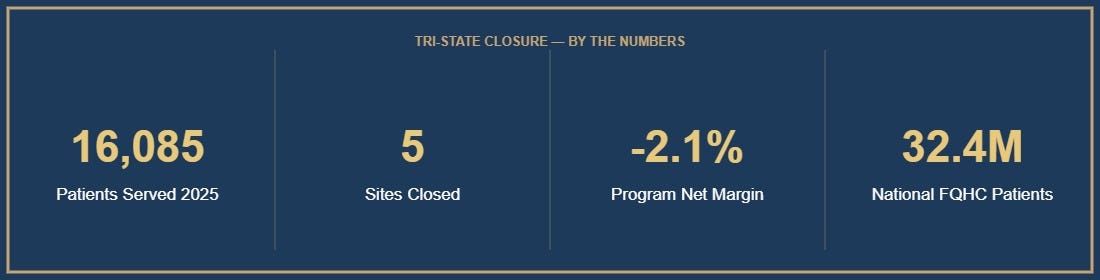
On Thursday, September 24, 2026, patients arrived at Tri-State Community Health Centers in Berkeley Springs, West Virginia, and found the doors locked. A handwritten sign said the organization was facing an “organizational emergency.” Four more sites across Maryland and Pennsylvania had gone dark the same way, for a total of five, with little or no advance notice.
Tri-State is not a small footnote. It was founded in 1987 as a nonprofit federally qualified health center and served 16,085 patients in 2025. Of those, 70.8 percent lived at or below 200 percent of the federal poverty level. These are people for whom a locked clinic door does not mean a rescheduled appointment. It means a gap in insulin, blood pressure medication, or a cancer follow-up that may not be filled anywhere else within driving distance.
This piece looks at what is publicly known about the closure, how HRSA oversight is supposed to work, and why the financial and administrative structure of the health center program makes a sudden shutdown easier to imagine than most leaders admit.
1. What We Know About September 24
The facts on the ground are limited, and it is worth separating them from speculation. According to local reporting from the Morgan Messenger and the Hancock News, clinics in Berkeley Springs, Hancock, Cumberland, and McConnellsburg closed on September 24, along with one additional site. The following Monday, Berkeley Springs and Hancock reopened.
Interim CEO David Olson had started the week before. He told reporters the organization was dealing with requirements from HRSA, but he declined to say what those requirements were. He also said HRSA had begun handling issues differently roughly six months earlier, and that Tri-State had been submitting the information the agency asked for.
Patients were contacted, appointments were rescheduled or referred elsewhere, and some patients had already experienced weeks of trouble getting medications because of insurance provider disconnections before the closure.
That is the full public record as of this writing. Nobody outside Tri-State and HRSA knows whether the trigger was a financial reporting gap, a governance issue, a scope-of-project mismatch, or something else. What matters for the rest of the industry is the mechanism: a federal requirement, a small leadership team in transition, and a clinic network that closed its doors rather than operate outside a condition.
There is a second detail worth holding onto. The reporting says patients had trouble getting medications for weeks before the closure because of insurance provider disconnections. Closures like this are rarely a single event. They are usually the visible end of a slow accumulation of operational problems that nobody outside the building could see.

2. How HRSA Oversight Is Supposed to Work
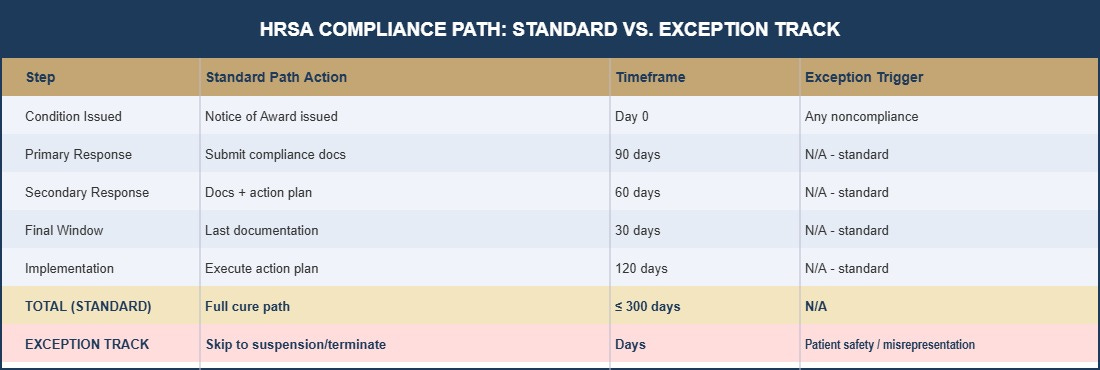
HRSA's Health Center Program Compliance Manual describes a progressive process. A health center that cannot demonstrate compliance with a program requirement typically receives a condition on its Notice of Award. It then gets 90 days to submit documentation showing compliance. If that fails, it receives 60 more days to submit documentation or an action plan. A final 30-day window follows. If HRSA approves an action plan, the center gets 120 days to implement it.
That is up to 300 days of runway in the standard path. A sudden closure does not look like that path.
The manual also carves out exceptions. HRSA can skip the progressive steps for patient safety threats, misrepresentation of corrective actions, loss of operational capacity, or exclusion from federal funding lists. Available actions include withholding cash payments, disallowing costs, suspending or terminating an award, and debarment.
We do not know which track Tri-State was on. But the existence of the fast track matters. A center that has been in the standard 90-60-30 process for months can land in a much harsher posture if a leadership transition, a missed deadline, or a change in how documents are reviewed convinces the agency that operational capacity is at risk.
3. The Paperwork Load Behind the Program
Compliance failures at health centers are rarely dramatic. They are usually the accumulated weight of routine obligations, handled by small teams, under changing federal instructions.
Consider what HRSA is asking of the field right now. On July 30, 2026, the agency published a revision of Form 5A (services provided) and Form 5B (sites), along with all six change-in-scope checklists and three new forms. Comments closed September 28, and the revised package takes effect October 19. HRSA estimates 27,769 respondents, 29,607 total responses, and 31,302 annual burden hours. The forms define a health center's scope of project. Get them wrong and sites or services can fall outside federal protections and payment rules.
Separately, HRSA announced noncompetitive extensions for 272 health centers totaling about $527 million, with individual awards ranging from about $166,000 to about $9.6 million. The extensions run through mid-2027 while service area awards are finalized.
A well-staffed compliance department can absorb this. A rural center with a newly arrived interim CEO and a finance team of a few people cannot absorb it the same way. The regulation is not the problem. The gap between the volume of obligations and the capacity to track them is.
4. The Margin Problem: No Cushion When Something Breaks
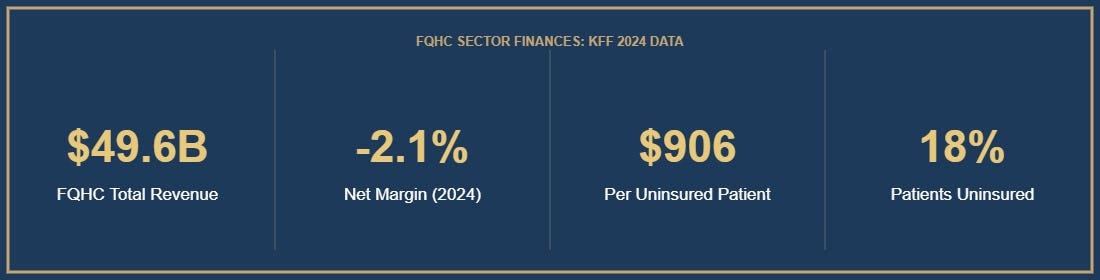
KFF's 2024 profile of the program counts 1,359 health center organizations operating more than 16,300 delivery sites and serving 32.4 million patients. About 90 percent of patients live in low-income households, 30 percent live in rural areas, and 18 percent are uninsured. Total revenue was $49.6 billion, and the net margin was negative 2.1 percent. Federal Section 330 grants covered only $906 per uninsured patient.
In a negative-margin business, every disruption is expensive. A withheld payment, a repayment demand, or a condition that requires reimbursement-based drawdowns instead of advance funding can turn a manageable problem into a cash crisis within weeks. Payroll does not wait for a corrective action plan.
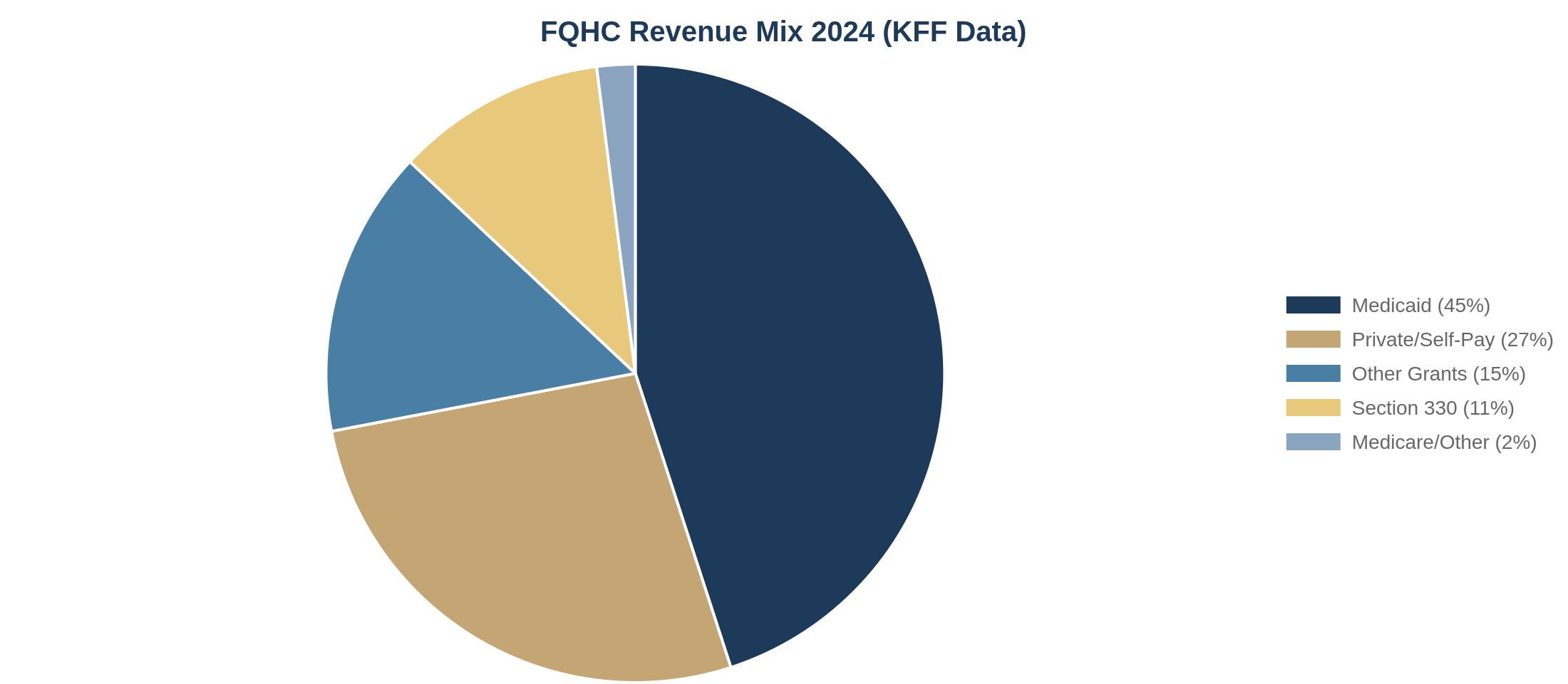
The revenue mix also explains why the money is fragile. Medicaid accounts for 45 percent of revenue, private insurance and self-pay for 27 percent, other grants and contracts for 15 percent, and Section 330 for 11 percent. The federal grant that comes with the oversight is the smallest slice, but it is the slice that carries the program's legal status, including the federal designation that unlocks many of the payment and liability protections the rest of the revenue depends on.
5. What a Closure Costs Patients
It is easy to treat a five-day closure as an administrative event. For patients it is a clinical one. Tri-State served 2,123 children, 10,795 adults between 19 and 64, and 3,167 older adults in 2025. Most of the adults are the people health systems struggle to reach: low-income, often Medicaid-enrolled or uninsured, with chronic disease that is managed only when a primary care relationship is stable.
Cancer screening is where the damage compounds. Screening depends on a chain: a clinician identifies the eligible patient, orders the scan, tracks the result, and closes the loop on an abnormal finding. A closure breaks the chain at its first link. A 2021 study in the Annals of the American Thoracic Society found that 78 percent of rural residents must drive more than 30 minutes to reach a lung cancer screening center, compared with 17 percent of urban residents.
6. The Medicaid Squeeze Raises the Stakes
The Tri-State closure arrived while the whole sector is bracing for a larger financial shift. NACHC projects that about 2 million health center patients could lose Medicaid coverage by 2034, adding about 1.7 million uninsured patients to health center rosters. The association also warns that one in four centers may close or reduce services within two years without additional funding. The Congressional Budget Office projects that 10.3 million people nationally could lose Medicaid coverage by 2034, with 7.6 million becoming uninsured.
The stress is already visible in other places. In July 2026, eight school-based health clinics run by FQHCs in Southwest Virginia closed, and the Virginia Community Healthcare Association asked Rep. Morgan Griffith for help as federal funding pressures mounted.
It also helps to be honest about the tradeoff HRSA faces. The agency has a duty to protect federal dollars and patients, and strict enforcement is part of that duty. The hard question is not whether oversight should exist. It is whether the system gives struggling centers enough technical assistance, notice, and time to fix problems before the only remaining option is to close the building.
7. What Boards, Executives, and Partners Should Do Now
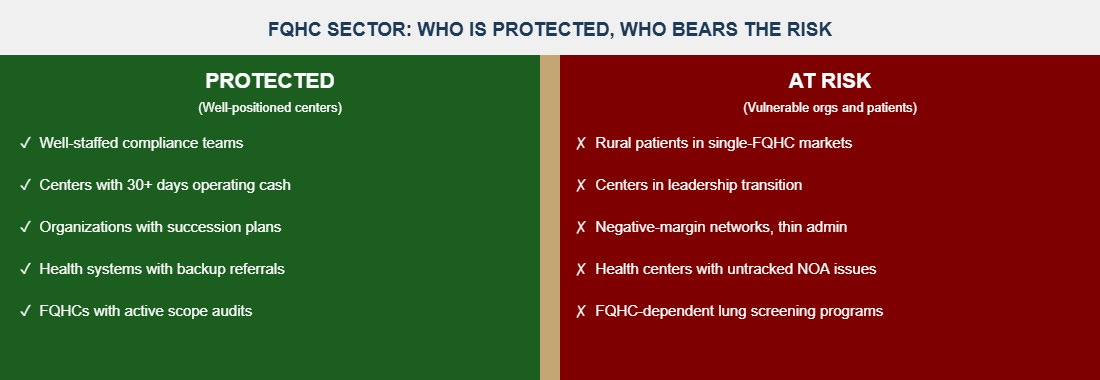
The practical response is not alarm. It is inventory. Five steps are worth taking this quarter: map every open NOA condition with owner and due date; confirm who can act during a leadership transition; stress test cash for 60 days on reimbursement basis; review scope of project before October 19; write a closure and continuity plan.
For health systems and payers: if a partner FQHC supplies meaningful primary care access or referral volume, ask for its compliance calendar the same way you would ask for a vendor's disaster recovery plan.
Deep Dive: The Compliance Infrastructure Gap
The Tri-State event points to something structural that has no simple policy fix. The health center program was designed for organizations with dedicated compliance staff: people who track Notice of Award conditions, maintain the scope-of-project forms, and respond to agency letters within required windows.
HRSA's Form 5A/5B revision takes effect October 19, 2026. Getting this wrong is not a technicality: a service delivered outside an approved scope is not covered by the FTCA malpractice protection. A site delivered outside scope may not qualify for the enhanced Medicaid reimbursement rate that makes the whole financial model work.
The solution is not simpler rules. It is better technical assistance, earlier escalation paths, and a sector-wide recognition that compliance capacity is a patient safety issue, not just a bureaucratic one.
Three Investment Priorities for the Next 12 Months
First, a live compliance dashboard. Every open condition, every pending deadline, every outstanding submission has an owner and a due date in a system that sends reminders.
Second, a documented leadership transition protocol. When a CEO leaves, the incoming leader gets a written briefing: here are our open conditions, here are the deadlines, here is who to call at HRSA. The briefing happens on day one, not week three.
Third, a 60-day cash model. Modeled under the assumption that drawdowns shift to reimbursement basis, what happens to payroll, supplies, and rent? Centers that have run this model know their floor.
What This Means For You
FQHC executives and boards: Run a compliance audit this quarter. Map every open Notice of Award condition with owner, due date, and documentation status. Review your scope of project before October 19 when the new Form 5A and 5B requirements take effect.
Health system administrators and CMOs: If FQHCs are part of your primary care access strategy, treat their compliance stability as a vendor risk. Ask for their compliance calendar. Build a contingency referral pathway for unexpected closures.
Radiologists and lung cancer screening programs: Track no-show and lost-to-follow-up rates by referring site. A sudden change at a community health center partner can show up in your screening volume before anyone calls you.
Healthcare investors and founders: The compliance burden at FQHCs creates real demand for administrative technology that reduces obligation tracking load and automates scope-of-project documentation.
Policy advocates: Push for stronger HRSA technical assistance programs, especially for centers in leadership transition.
The Tri-State doors reopened within days at two sites. The vulnerability that closed them is still in the system. Every FQHC board should spend an hour this month asking whether their compliance calendar would survive a leadership transition.
Key References
Morgan Messenger and Hancock News, September 24, 2026: Tri-State Community Health Centers closures in WV, MD, PA
HRSA Health Center Program Compliance Manual, Chapter 2: Health Center Program Oversight
Federal Register, September 24, 2026: Health Center Program Performance Period Extensions (272 awardees, ~$527 million)
KFF: Community Health Center Patients, Financing, and Services (2024 data)
NACHC: Risk of Medicaid Cuts: 2 million health center patients projected to lose coverage by 2034