


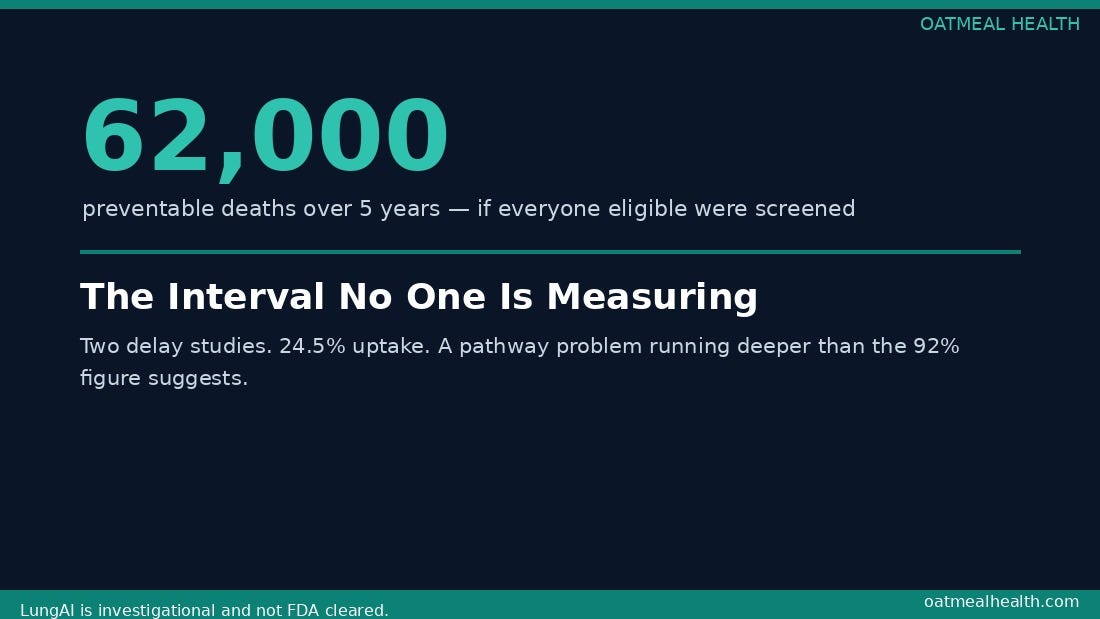
Lung cancer survival has a headline figure that gets repeated in board presentations, grant applications, and hospital marketing materials: 92% ten-year survival for stage I disease found through screening. The number comes from the International Early Lung Cancer Action Program, published in the New England Journal of Medicine in 2006. It is real, it is remarkable, and it belongs to a specific group of patients who were diagnosed and operated on within one month.
Most programs repeat the 92% and stop there. The productive question is what it takes to replicate it, because the answer involves a set of intervals most health systems are not measuring and a patient population most programs are not reaching.
1. What I-ELCAP Actually Found
The International Early Lung Cancer Action Program, led by Claudia Henschke, MD, of Weill Cornell Medicine, enrolled 31,567 asymptomatic men and women in CT screening. As reported by Oncology NEWS International on CancerNetwork in November 2006, screening detected 484 lung cancers. Of those, 412, or 85%, were clinical stage I.
That distribution is the first result worth naming clearly. Lung cancer has historically been diagnosed after symptoms appear, at stage III or IV, when surgery is often no longer an option. I-ELCAP reversed that. Four out of five cancers in the cohort were caught while still small enough to remove. Weill Cornell's own press release called the finding evidence that CT screening can detect lung cancer at its very earliest stage in 85% of patients.
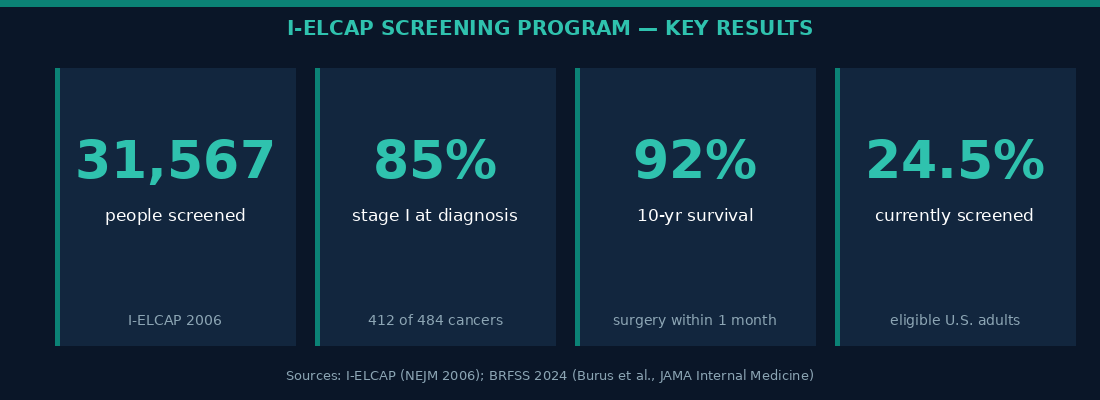
The survival numbers followed. Across all 484 people with screen-detected cancer, regardless of stage or treatment, estimated ten-year lung cancer-specific survival was 80%. For the 412 with clinical stage I disease, it rose to 88%. For the 302 stage I patients who had surgical resection within one month of diagnosis, it was 92%.
One detail that gets less attention: all eight stage I patients who chose no treatment died within five years of diagnosis. The cancer was found early enough to cure. Without surgery, it remained fatal.
What I-ELCAP cannot tell you is how many lives the screening program itself saved. Everyone in the study was screened. There was no control group randomized to no screening, so the paper describes what is possible when cancer is caught early and treated quickly. That is a meaningful result for operators building a pathway. It is not a randomized trial of screening versus no screening. We come back to that distinction in section 4.
2. The 302 Patients Behind the 92% Figure
The number that tends to travel is 92%. The number that matters for program design is 302: the count of stage I patients who had surgery within one month of their diagnosis.
Of the 412 patients with clinical stage I disease in I-ELCAP, approximately 73% (our arithmetic, 302 divided by 412) were operated on within that window. The broader stage I group, including patients who waited longer or chose different treatment, reached 88% ten-year survival. The gap between 88% and 92% is four percentage points. That may sound small. In a program that finds 200 stage I cancers per year, it is the difference between roughly 176 and 184 long-term survivors per cohort, compounded across every year the program runs.
The comparison that cuts harder is the untreated group. Eight patients with clinical stage I disease decided not to be treated. Every one of them died within five years. Survival from early-stage lung cancer is achievable. Untreated, even early disease is not survivable.
The careful reading is this: I-ELCAP shows that rapid surgery and excellent survival correlate. It does not prove causation, because patients who receive fast surgery may also be healthier, have smaller or simpler tumors, or have reached surgery through faster, more thorough workups that select for operable cases. Observational data cannot close that gap. What the study does give a program leader is a benchmark: this is what the best pathway looks like.
3. What the Delay Studies Found
If I-ELCAP describes the ceiling, two large retrospective studies describe what happens when programs fall short of it.
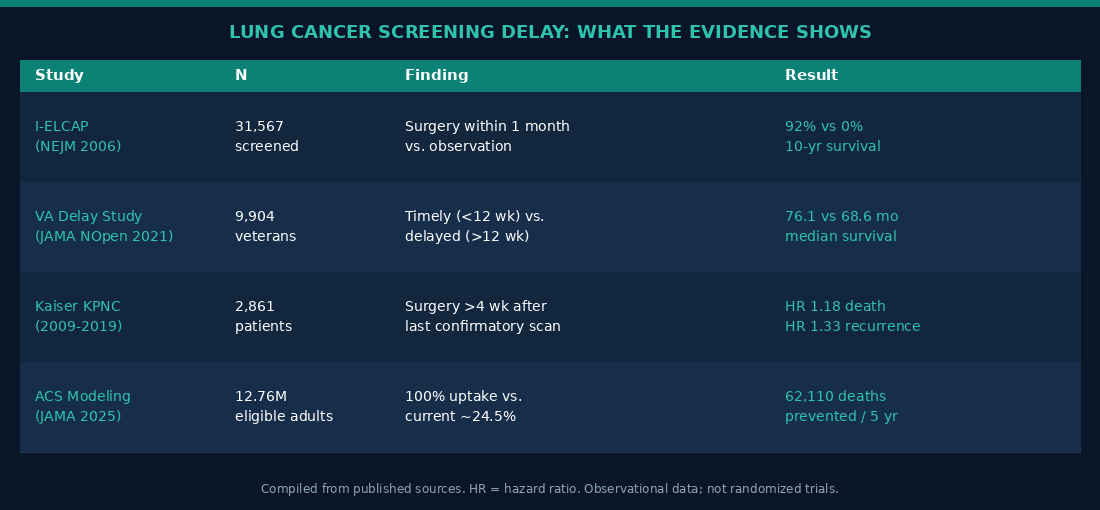
The first was led by Brendan Heiden, MD, and senior author Varun Puri, MD, at Washington University School of Medicine, and published in JAMA Network Open in May 2021. The study examined 9,904 veterans with clinical stage I non-small cell lung cancer who had surgery between October 2006 and September 2016. About 70% were operated on within 12 weeks of their diagnostic CT. About 30% waited longer.
According to WashU's news coverage, average survival was 76.1 months in the timely group and 68.6 months in the delayed group, a difference of 7.5 months. Recurrence rose incrementally with each additional week of delay. During the follow-up period, 4,158 patients, or 42%, had a recurrence.

Dr. Puri's stated conclusion: patients with early-stage lung cancer have the best chance for survival and should seek treatment within 12 weeks of diagnosis.
The second study came from Kaiser Permanente Northern California. It followed 2,861 patients who had surgery for stage I or II lung cancer between 2009 and 2019, measuring time to surgery from the last confirmatory CT, PET scan, or biopsy. The authors found that surgery more than four weeks after that point was associated with meaningfully worse outcomes: an adjusted hazard ratio of 1.18 for death and 1.33 for recurrence. At the 12-week mark the hazard was larger but did not reach statistical significance in that analysis.
Read together, the two studies are directionally consistent and methodologically different. Both point toward the same conclusion: delay costs something, and the cost shows up within the intervals that most health systems already operate inside. A pathway that routinely takes two or three months is not neutral.
Neither study is a randomized trial. Nobody can ethically randomize cancer patients to a waiting group. What these studies offer is real-world evidence from large cohorts. For a program leader designing a pathway, that is usable evidence.
4. The Strongest Evidence, and Its Honest Limits
The randomized evidence for lung cancer screening does not come from I-ELCAP. It comes from the National Lung Screening Trial.
NLST enrolled 53,454 current and former heavy smokers aged 55 to 74 and randomized them to three annual screens with either low-dose CT or chest X-ray. The National Cancer Institute reports that CT screening lowered the risk of dying from lung cancer by 15 to 20%. In absolute terms, that is roughly three fewer deaths per 1,000 people screened over approximately seven years: 17.6 per 1,000 in the CT group versus 20.7 in the X-ray group.
That is a real benefit. An article that builds the whole case on a single survival figure owes readers the other side.
A secondary analysis of NLST data by Edward Patz, MD, and colleagues, published in JAMA Internal Medicine in 2014, estimated that 18.5% of lung cancers detected by low-dose CT were likely overdiagnosed: cancers that would never have caused harm in the patient's lifetime if left undiscovered. The 95% confidence interval was wide, 5.4% to 30.6%. For non-small cell lung cancer specifically, the estimate was 22.5%. The authors estimated 1.38 overdiagnosed cases for every 320 people screened to prevent one lung cancer death.
These estimates are uncertain. They are from one trial, and the intervals are wide. They are still worth keeping in front of you, because they are the honest version of what screening programs do. Some cancers found on screening would never have mattered. A program that does not distinguish them from cancers that will grow and kill is doing unnecessary harm along with its intended good. Better risk stratification reduces that harm. Faster workup on the high-risk cases reduces the delay that costs lives.
Understanding both bodies of evidence is necessary. NLST answers the policy question: does offering screening to a high-risk population reduce deaths? I-ELCAP answers the operational question: what does the pathway look like when it works? Program leaders need both answers. The first justifies the investment. The second defines the execution standard.
5. Only 24.5% of Eligible Adults Are Screened
Everything above assumes a patient reaches the scanner. Most do not.
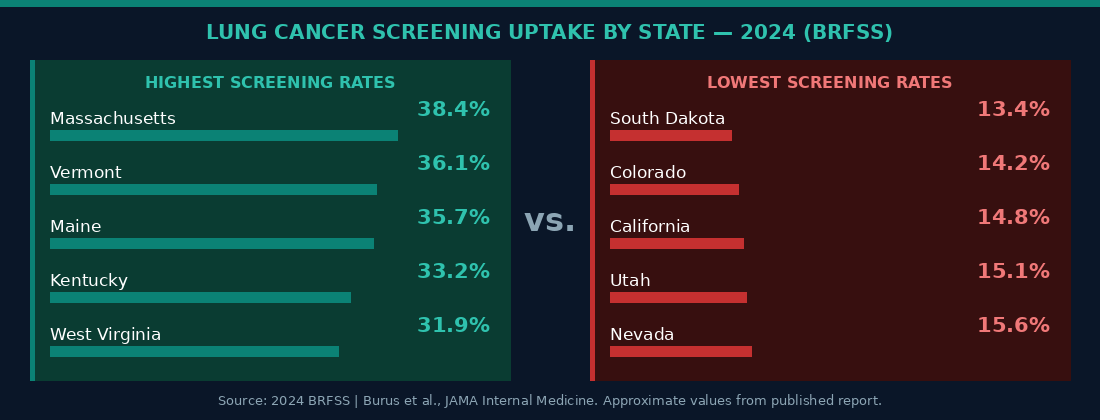
Two 2024 surveys give different estimates of screening uptake, reflecting different methodologies. A study led by Todd Burus, PhD, at the University of Kentucky Markey Cancer Center, published in JAMA Internal Medicine, used the 2024 Behavioral Risk Factor Surveillance System. Of 26,104 respondents who met eligibility criteria, representing approximately 12.3% of U.S. adults aged 50 to 80, 24.5% were up to date on lung cancer screening. That is an increase of about six percentage points from 2022. Rates ranged from 13.4% in South Dakota to 38.4% in Massachusetts.
A separate study led by Priti Bandi, PhD, and senior author Ahmedin Jemal, PhD, at the American Cancer Society, using the 2024 National Health Interview Survey, found 18.7% of eligible adults up to date. The two figures differ because they use different survey instruments and different eligibility denominators. Both represent 2024 data.
The ACS study estimated that 12.76 million people were eligible under USPSTF criteria. At current uptake, approximately 14,970 lung cancer deaths are being prevented over a five-year period, with 190,030 life-years gained. If every eligible adult were screened, those figures would rise to 62,110 deaths prevented and 872,270 life-years gained over five years. Current uptake captures about one quarter of the potential benefit.
The state variation in the Burus study deserves a second look. A nearly threefold gap between 13.4% and 38.4% is not random variation. The regions with the highest lung cancer burden, the Deep South and Appalachia, are often the same regions with the lowest screening rates. That is a structural problem. It exists independently of whether the 92% is achievable.
What the gap between 18.7% and 24.5% and the 100% target tells a program leader is that most of the lives at stake are never entering the pathway at all. A program that optimizes the interval from scan to surgery without addressing the front-end access problem is sharpening one stage of a pipeline most people never enter.
6. The Shared Decision-Making Visit and Where Patients Drop Out
Medicare requires a counseling and shared decision-making (SDM) visit before a beneficiary's first low-dose CT scan. The visit must confirm eligibility, use one or more decision aids, address benefits and potential harms, discuss comorbidities and willingness to undergo treatment, and cover smoking cessation and adherence to annual follow-up. It is where the screening pathway officially starts.
The required visit creates a documented touchpoint before the scan. It is also where programs lose patients who are otherwise eligible. A 2023 analysis in the Journal of the American College of Radiology examined claims data from a national Medicare Advantage plan and found that only about one-third of patients who completed a shared decision-making visit went on to have a low-dose CT scan within 180 days. Two-thirds did not. The paper identified insurance status, geography, and primary care visit frequency as predictors of follow-through, but the bottom line for a program leader is this: having a patient arrive at the SDM visit does not mean they will reach the scanner.
The gap between SDM completion and scan completion is the interval no program report mentions and most programs cannot measure. It requires linking data across a primary care visit, a radiology schedule, and an imaging completion record. Most EMR configurations do not surface that linkage automatically.
This matters for program leaders because it is where eligible patients disappear before anyone measures anything. The publicly reported metrics, scan completion rates, positive screen rates, follow-up adherence rates, all begin after the first scan. They say nothing about how many eligible patients arrived at the SDM visit and never came back.
7. How the Intervals Stack Up
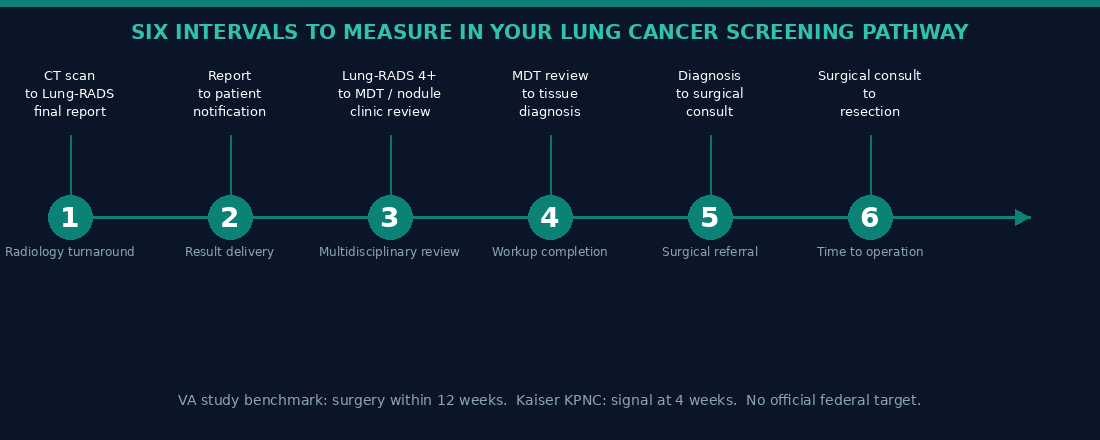
A screening program that is working at the level I-ELCAP described has to do several things in sequence, each within a defined window. The I-ELCAP benchmark is surgery within one month of diagnosis. The WashU and Kaiser studies suggest that twelve weeks and four weeks, respectively, are meaningful thresholds. To reach any of those, the entire upstream pathway has to function.
The sequence, roughly: eligibility identification, SDM visit completion, scan completion, radiologist read and Lung-RADS categorization, follow-up imaging or biopsy for positive screens, nodule board or multidisciplinary tumor board review, surgical referral, preoperative clearance, and surgery. Each step has its own interval. None of them are standardized across programs. Most are not publicly reported.
The American College of Radiology's Lung Cancer Screening Registry, which more than 1,900 facilities participate in, collects data on screening completion, incidental findings, and Lung-RADS results. It does not collect time-to-surgery or time-from-diagnosis-to-treatment. The Commission on Cancer requires accredited programs to track certain quality metrics, but interval-to-treatment is not universally mandated across all settings.
What that means practically: a program can achieve excellent scan rates, excellent Lung-RADS documentation, and excellent radiologist performance, and still lose the survival benefit at the surgery scheduling step, because nobody is tracking how long it takes to get from positive biopsy to operating room.
The ACS study's estimate of 62,110 preventable deaths over five years assumes 100% uptake. That is not a realistic near-term target. But the 75-percentage-point gap between current uptake and 100% is not the only gap. Inside the patients who do get screened, there is a gap between the programs that achieve I-ELCAP-level intervals and those that do not. Both gaps cost lives. The second gap receives less attention because it is harder to measure.
8. What Closing the Gap Requires
The upstream gap, the difference between 24.5% and 100% uptake, requires solving access. That means navigators who reach rural and underserved populations, primary care systems that systematically identify and refer eligible patients rather than waiting for them to ask, insurance coverage that removes cost barriers, and program infrastructure in the regions where lung cancer burden is highest. None of those are quick fixes. Some require policy change.
The interval gap, the difference between a program that achieves surgery within one month and one that takes three, is a different kind of problem. It is an operations problem. It requires tracking intervals end to end, from SDM visit to scan, from scan to radiologist report, from Lung-RADS 3 or 4 to follow-up, from positive pathology to surgery. It requires a multidisciplinary team that meets regularly and has authority to move cases faster. It requires a surgical scheduling system that treats early-stage lung cancer as time-sensitive. And it requires someone in the organization who is accountable for the interval, not just for scan volume.
Programs that want to approach I-ELCAP-level outcomes have three concrete starting points. First, measure the interval from abnormal screen to treatment initiation and report it quarterly. This single metric forces visibility on the problem. Second, establish a Lung-RADS 4 fast-track protocol that sets an expected time from category assignment to tissue diagnosis and puts a person in charge of moving cases along it. Third, build a surgical scheduling pipeline for screen-detected stage I cancer that bypasses the general queue when interval targets are at risk.
None of these require major capital investment. They require data infrastructure, process discipline, and leadership attention. Programs that already track these intervals and can demonstrate performance against the I-ELCAP benchmark are the ones worth studying. They exist. Most do not publish their interval data in a form that allows comparison.
9. The One Number Worth Remembering
The 92% ten-year survival figure from I-ELCAP is real and it is achievable. It belongs to a specific pathway: screening detects stage I disease, the patient has surgery within one month of diagnosis, and the tumor is completely resected. Replicating that outcome requires every step of the pathway to function within tight intervals, starting with getting eligible patients to the scanner in the first place.
The number that puts the 92% in perspective is 62,110: the number of lung cancer deaths the ACS estimates could be prevented over five years if every eligible American were screened. Current uptake, somewhere between 18.7% and 24.5% depending on the survey, captures roughly a quarter of that benefit. The other three-quarters wait on access, outreach, and system infrastructure that most programs have not built.
Improving the interval performance of existing programs is necessary. It is not sufficient. Both problems need attention simultaneously, and most programs are focused on one while ignoring the other.
10. Sources
Henschke CI, Yankelevitz DF, Libby DM, Pasmantier MW, Smith JP, Miettinen OS. Survival of patients with stage I lung cancer detected on CT screening. N Engl J Med. 2006;355(17):1763-1771.
Heiden BT, Eaton DB Jr, Engelhardt KE, Chang SH, Yan Y, Schoen MW, Puri V. Analysis of delayed surgical treatment and oncologic outcomes in clinical stage I non-small cell lung cancer. JAMA Netw Open. 2021;4(5):e2111613.
Kunitomo Y, Bade B, Bhatt A, Annema J, Argento C, Barta J, Semaan R. Analysis of timeliness and outcomes of lung cancer surgery using time-to-surgery from the confirmatory test. Presented at CHEST Annual Meeting, October 2021.
National Cancer Institute. National Lung Screening Trial Overview. cancer.gov.
Patz EF Jr, Pinsky P, Gatsonis C, Sicks JD, Kramer BS, Tammemagi MC, Chiles C, Black WC, Aberle DR; NLST Overdiagnosis Manuscript Writing Team. Overdiagnosis in low-dose computed tomography screening for lung cancer. JAMA Intern Med. 2014;174(2):269-274.
Burus T, Smeltzer MP, Faris NR, et al. Current uptake of lung cancer screening in the United States: analysis of the 2024 Behavioral Risk Factor Surveillance System. JAMA Intern Med. 2025.
Bandi P, Minihan AK, Siegel RL, et al. Updated review of major cancer screening tests in the US. JAMA Oncol. 2024.
Huo J, Xu Y, Sheu T, Volk RJ, Shih YT. Complication rates and downstream medical costs associated with invasive diagnostic procedures for lung abnormalities in the community setting. JAMA Intern Med. 2019;179(3):324-332.